
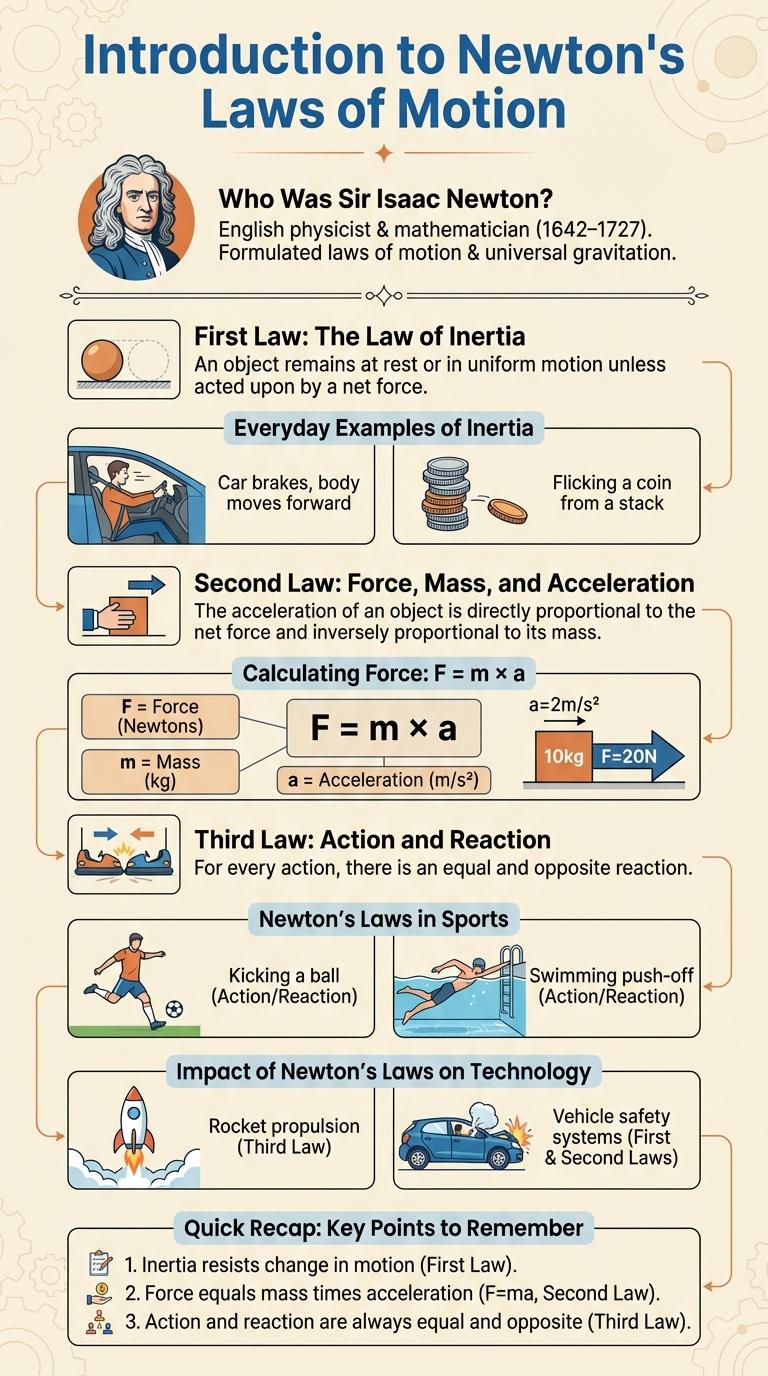
Newton's laws of motion describe the fundamental principles governing the relationship between an object's motion and the forces acting upon it. These laws explain how objects respond to external forces, including concepts of inertia, acceleration, and action-reaction pairs. Understanding Newton's laws is essential for analyzing everyday motions and engineering applications.
Introduction to Newton's Laws of Motion
Newton's Laws of Motion form the foundation of classical mechanics and describe the relationship between a body and the forces acting upon it. These laws explain how objects move in response to applied forces.
- First Law (Law of Inertia) - An object at rest stays at rest, and an object in motion remains in motion at a constant velocity unless acted upon by a net external force.
- Second Law (Law of Acceleration) - The acceleration of an object is directly proportional to the net force acting on it and inversely proportional to its mass.
- Third Law (Action-Reaction Law) - For every action force, there is an equal and opposite reaction force exerted by the object.
Understanding Newton's Laws helps explain everyday phenomena, from falling objects to vehicle motion and satellite orbits.
Who Was Sir Isaac Newton?
Sir Isaac Newton was a renowned English mathematician, physicist, and astronomer who fundamentally shaped modern science. His work laid the foundation for classical mechanics through the formulation of the three laws of motion.
- Mathematical Genius - Newton developed calculus independently, providing essential tools for analyzing motion and change.
- Principia Mathematica Author - In 1687, he published "Philosophiae Naturalis Principia Mathematica," introducing his laws of motion and universal gravitation.
- Scientific Legacy - Newton's laws remain central to physics, explaining the relationship between forces and the motion of objects across a wide range of phenomena.
First Law: The Law of Inertia
Newton's First Law of Motion, known as the Law of Inertia, states that an object will remain at rest or move at a constant velocity unless acted upon by an external force. This law explains why objects resist changes to their motion.
Inertia is the property of matter that keeps objects maintaining their state of motion. For example, a stationary book will not move unless pushed, and a moving car will keep moving unless brakes are applied.
Everyday Examples of Inertia
Newton's First Law of Motion, also known as the law of inertia, states that an object will remain at rest or in uniform motion unless acted upon by an external force. Everyday examples of inertia include a passenger moving forward in a car when it suddenly stops and a book resting on a table staying in place until pushed. Inertia explains why objects resist changes in their state of motion, highlighting the importance of forces in daily activities.
Second Law: Force, Mass, and Acceleration
Newton's Second Law of Motion explains how force affects the motion of an object. It establishes a clear relationship between force, mass, and acceleration.
- Force Equals Mass Times Acceleration - The force applied to an object is the product of its mass and acceleration (F = ma).
- Acceleration is Proportional to Force - Increasing the force on an object results in a proportional increase in acceleration.
- Mass Inversely Affects Acceleration - For the same force, an object with greater mass will experience less acceleration.
Calculating Force: F = m × a
Newton's Second Law of Motion explains the relationship between force, mass, and acceleration. It is expressed by the formula F = m x a.
Force (F) is calculated by multiplying mass (m) in kilograms by acceleration (a) in meters per second squared. This law helps predict how an object will move when subjected to an external force.
Third Law: Action and Reaction
Newton's Third Law of Motion states that for every action, there is an equal and opposite reaction. This principle explains the interaction forces between two objects.
When an object exerts a force on another, the second object simultaneously exerts a force of equal magnitude in the opposite direction. These forces always come in pairs and act on different objects, ensuring balance in physical interactions. This law is fundamental in understanding propulsion, collision mechanics, and everyday motion phenomena.
Newton's Laws in Sports
How do Newton's Laws of Motion apply to sports? Newton's Laws explain the movement and interactions of athletes and sports equipment. These principles help improve performance and safety in various sports.
| Newton's Law | Application in Sports |
|---|---|
| First Law (Inertia) | Players maintain motion until acted on by an external force, like a tackle or friction. |
| Second Law (F=ma) | A sprinter's acceleration depends on the force applied against the ground and their mass. |
| Third Law (Action-Reaction) | When a swimmer pushes water backward, the water pushes them forward with equal force. |
How does understanding Newton's Laws enhance athletic training? Coaches use these laws to design drills that optimize force and motion. Athletes improve technique by leveraging the principles of force, mass, and acceleration.
Impact of Newton's Laws on Technology
| Newton's Law | Impact on Technology |
|---|---|
| First Law of Motion (Inertia) | Design of seat belts and airbags in vehicles to enhance passenger safety during sudden stops or collisions. |
| Second Law of Motion (F=ma) | Development of precise control systems in robotics and aerospace engineering to manage force and acceleration. |
| Third Law of Motion (Action-Reaction) | Foundation for rocket propulsion technology, enabling spacecraft to launch by expelling gas in the opposite direction. |
| Combined Laws | Advancement in vehicle dynamics and stability control systems improving fuel efficiency and handling performance. |
| Applied Physics | Optimization of mechanical devices and machinery performance in manufacturing through force and motion analysis. |