
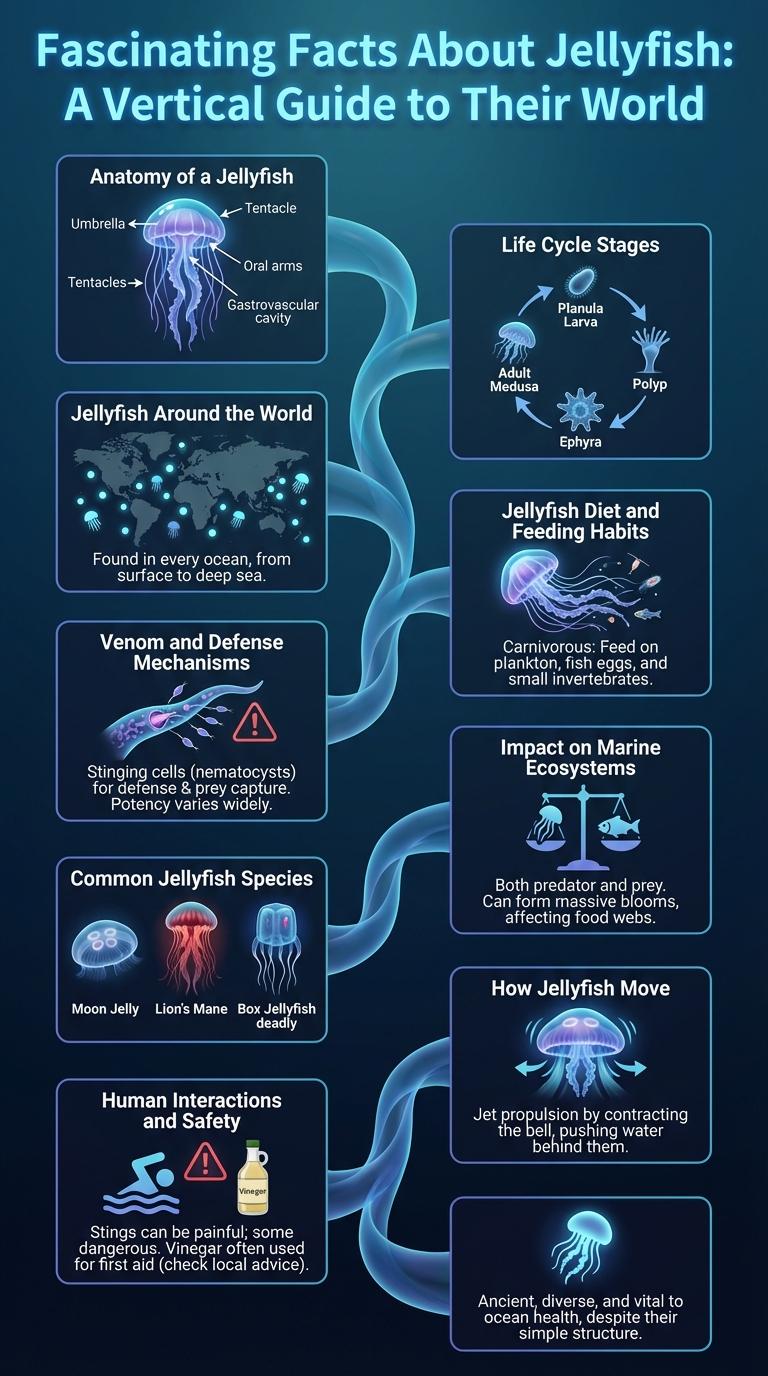
Jellyfish exhibit a mesmerizing blend of beauty and biological complexity that fascinates marine enthusiasts worldwide. Their gelatinous bodies and pulsating movements reveal unique adaptations essential for survival in diverse ocean habitats. Understanding jellyfish through infographics highlights their anatomy, lifecycle, and ecological role, offering a visual exploration of these captivating creatures.
Fascinating Facts About Jellyfish
Jellyfish have existed for over 500 million years, making them older than dinosaurs. These marine creatures consist of 95% water and lack a brain, heart, and bones. Some species glow in the dark due to bioluminescence, creating mesmerizing underwater displays.
Anatomy of a Jellyfish
Jellyfish are marine animals known for their translucent, bell-shaped bodies and gelatinous texture. Their anatomy is simple yet highly specialized for survival in aquatic environments.
The structure of a jellyfish includes key components that allow it to move, feed, and defend itself efficiently.
- Bell - The main body, or bell, contracts to propel the jellyfish through water.
- Tentacles - Long, trailing tentacles capture prey with venomous stinging cells called nematocysts.
- Oral Arms - Surround the mouth and assist in transporting food to the digestive cavity.
Life Cycle Stages
Jellyfish undergo a complex life cycle consisting of several distinct stages. The cycle begins with the fertilized egg developing into a free-swimming planula larva.
The planula attaches to a surface and transforms into a sessile polyp. The polyp matures and undergoes strobilation, releasing ephyra, which develop into adult medusae.
Jellyfish Around the World
| Region | Jellyfish Species |
|---|---|
| Atlantic Ocean | Moon Jellyfish (Aurelia aurita) |
| Pacific Ocean | Box Jellyfish (Chironex fleckeri) |
| Indian Ocean | Lion's Mane Jellyfish (Cyanea capillata) |
| Mediterranean Sea | Compass Jellyfish (Chrysaora hysoscella) |
| Arctic Ocean | Arctic Lion's Mane Jellyfish (Cyanea annasethe) |
Jellyfish Diet and Feeding Habits
Jellyfish primarily feed on small fish, plankton, and various marine invertebrates. Their tentacles, equipped with specialized stinging cells called nematocysts, capture prey by paralyzing or killing it upon contact. Once immobilized, the jellyfish uses its oral arms to transfer food to its mouth for digestion.
Venom and Defense Mechanisms
Jellyfish possess venomous cells called nematocysts that deliver painful stings to predators and prey. This venom can paralyze or deter attackers, providing an effective defense mechanism.
Their transparent, gelatinous bodies allow them to blend into their surroundings, reducing visibility to predators. Some species also exhibit bioluminescence, which can confuse or scare away threats.
Impact on Marine Ecosystems
How do jellyfish impact marine ecosystems? Jellyfish play a crucial role in marine food webs by serving as both predators and prey. Their population blooms can significantly alter nutrient cycles and affect fish populations.
What effect do jellyfish blooms have on human activities? Large jellyfish swarms can clog fishing nets and damage fishing gear, affecting fisheries economy. They also impact tourism by deterring swimmers and clogging intake pipes in coastal power plants.
How do jellyfish influence biodiversity in oceans? Jellyfish compete with fish for plankton, sometimes reducing fish populations and altering ecosystem balance. Their presence can lead to decreased biodiversity by changing species compositions in affected areas.
Why are jellyfish important indicators of ocean health? Jellyfish population changes often reflect shifts in water temperature, pollution, and overfishing. Monitoring jellyfish can provide valuable data for assessing climate change and marine ecosystem disturbances.
What role do jellyfish play in nutrient recycling? Jellyfish contribute to nutrient cycling by releasing organic matter when they die, enriching the seafloor environment. This process supports benthic organisms and helps maintain ecosystem productivity.
Common Jellyfish Species
Jellyfish belong to the phylum Cnidaria and are found in oceans worldwide. They are known for their gelatinous bodies and stinging tentacles.
Common jellyfish species include the Moon Jellyfish, Lion's Mane Jellyfish, and the Box Jellyfish. The Moon Jellyfish is easily recognized by its translucent bell and four horseshoe-shaped gonads. The Lion's Mane Jellyfish is the largest species, with tentacles that can extend over 30 meters.
How Jellyfish Move
Jellyfish move by rhythmically contracting and relaxing their bell-shaped bodies. This pulsating motion propels them through the water with surprising efficiency.
- Bell Contraction - Jellyfish contract their bells to push water behind them, generating forward momentum.
- Passive Drifting - They often drift with ocean currents to conserve energy during movement.
- Muscle Control - Specialized muscles in the bell control the speed and force of each contraction for precise navigation.