
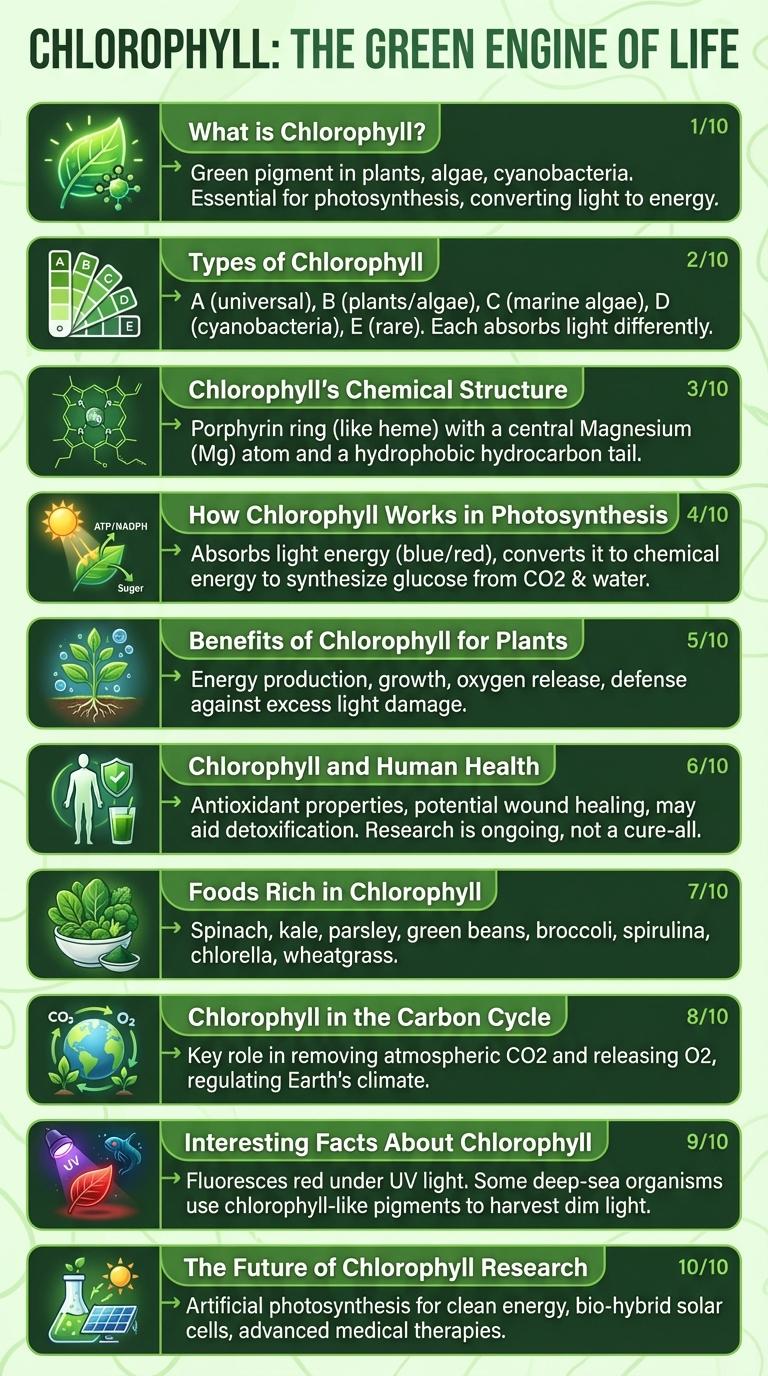
Chlorophyll is the green pigment found in plants that plays a crucial role in photosynthesis by absorbing sunlight to convert carbon dioxide and water into glucose and oxygen. This infographic visually breaks down the chemical structure, types, and functions of chlorophyll, highlighting its importance in sustaining life on Earth. Understanding chlorophyll helps explain how plants contribute to the planet's oxygen supply and energy cycle.
What is Chlorophyll?
Chlorophyll is a green pigment found in the chloroplasts of plants, algae, and some bacteria. It plays a crucial role in photosynthesis by absorbing light energy, primarily from the blue and red parts of the electromagnetic spectrum. This pigment enables plants to convert sunlight into chemical energy, essential for growth and oxygen production.
Types of Chlorophyll
Chlorophyll is a vital pigment found in plants, algae, and cyanobacteria, essential for photosynthesis. There are several types of chlorophyll, each with unique absorption properties and roles in capturing light energy.
- Chlorophyll a - Primary pigment in photosynthesis, absorbing blue-violet and red light for energy conversion.
- Chlorophyll b - Accessory pigment that broadens the light spectrum by capturing blue and red-orange light.
- Chlorophyll c - Found in certain algae, it helps in harvesting light and transferring energy to chlorophyll a.
- Chlorophyll d - Present in some red algae, it absorbs far-red light, allowing photosynthesis in deeper waters.
- Chlorophyll f - Recently discovered, this pigment absorbs near-infrared light, expanding the range of photosynthesis.
Chlorophyll's Chemical Structure
Chlorophyll is a green pigment essential for photosynthesis in plants, algae, and cyanobacteria. Its chemical structure enables the absorption of light energy, primarily in the blue and red wavelengths.
- Porphyrin Ring - Chlorophyll's structure features a porphyrin ring with a magnesium ion at its center, crucial for capturing light energy.
- Hydrocarbon Tail - A long phytol chain attached to the porphyrin ring helps anchor chlorophyll molecules within the thylakoid membranes of chloroplasts.
- Light Absorption - The conjugated double bonds in the ring system allow chlorophyll to absorb specific light wavelengths, facilitating energy transfer during photosynthesis.
How Chlorophyll Works in Photosynthesis
| How Chlorophyll Works in Photosynthesis | |
|---|---|
| Role of Chlorophyll | Chlorophyll is a green pigment located in the chloroplasts of plant cells that captures light energy from the sun. |
| Light Absorption | Chlorophyll primarily absorbs blue (450-495 nm) and red (620-750 nm) wavelengths of light, reflecting green, which gives plants their characteristic color. |
| Energy Conversion | The absorbed light energy excites electrons to a higher energy state, initiating the process of converting light energy into chemical energy. |
| Electron Transport | High-energy electrons travel through the electron transport chain, driving the production of ATP and NADPH, essential molecules for sugar synthesis. |
| Photosynthesis Outcome | Chlorophyll helps convert carbon dioxide and water into glucose and oxygen, powering plant growth and releasing oxygen into the atmosphere. |
Benefits of Chlorophyll for Plants
Chlorophyll is a crucial pigment in plants responsible for absorbing light energy during photosynthesis. It enables plants to convert sunlight into chemical energy, which fuels growth and development. This process not only produces oxygen but also supports the synthesis of essential nutrients for the plant's survival.
Chlorophyll and Human Health
Chlorophyll is a green pigment found in plants that plays a vital role in photosynthesis, converting sunlight into energy. It is also linked to several health benefits when consumed by humans through leafy greens and supplements.
Chlorophyll has antioxidant properties that help protect cells from damage and support detoxification processes. Studies suggest it may improve skin health, aid in wound healing, and promote better digestion.
Foods Rich in Chlorophyll
Chlorophyll is a green pigment found in plants responsible for photosynthesis and has numerous health benefits. It helps improve blood quality, supports detoxification, and boosts energy levels.
Foods rich in chlorophyll include leafy greens, green vegetables, and certain herbs. Consuming these foods regularly can enhance overall wellness and provide essential nutrients.
Chlorophyll in the Carbon Cycle
What role does chlorophyll play in the carbon cycle? Chlorophyll is essential for photosynthesis, allowing plants to convert carbon dioxide into organic compounds. This process reduces atmospheric CO2, helping regulate Earth's climate.
How does chlorophyll impact carbon storage? By capturing sunlight, chlorophyll drives the synthesis of glucose, which plants use to grow and store carbon. These carbon compounds remain in plant biomass until released by decomposition or consumption.
| Aspect | Details |
|---|---|
| Function | Absorbs light to power photosynthesis |
| Carbon Input | CO2 from the atmosphere |
| Carbon Output | Glucose and oxygen |
| Environmental Impact | Reduces greenhouse gases |
| Ecological Role | Supports food webs by producing organic matter |
Interesting Facts About Chlorophyll
Chlorophyll is a green pigment found in plants, algae, and cyanobacteria. It plays a crucial role in photosynthesis by absorbing light energy.
There are different types of chlorophyll, with chlorophyll-a being the primary pigment for photosynthesis. Chlorophyll helps convert sunlight into chemical energy, sustaining plant life and oxygen production. Its unique green color is due to the absorption of red and blue light while reflecting green wavelengths.