
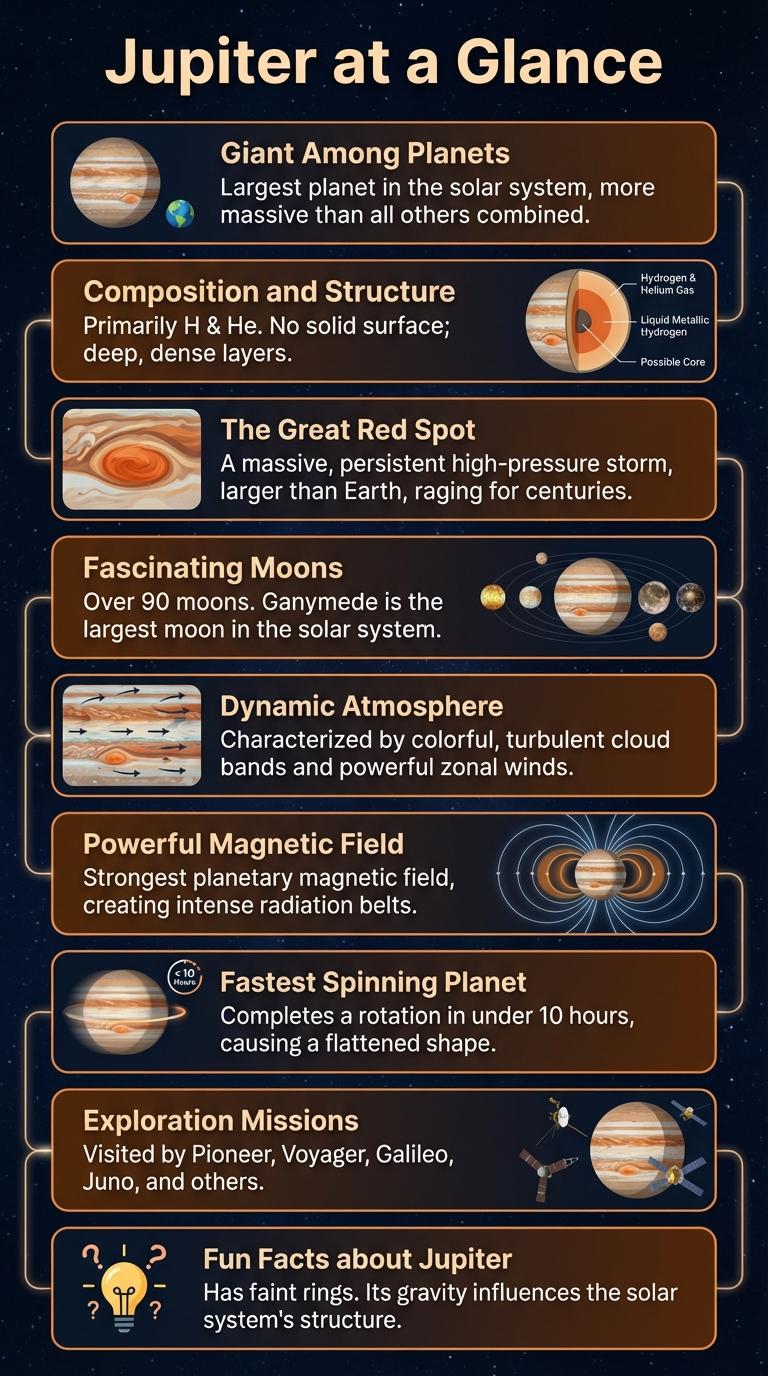
Jupiter, the largest planet in our solar system, is known for its striking bands of clouds and the famous Great Red Spot, a massive storm. This infographic highlights key facts about Jupiter's size, composition, moons, and magnetic field. Discover fascinating details about how this gas giant influences our cosmic neighborhood.
Jupiter at a Glance
| Aspect | Details |
|---|---|
| Planet Name | Jupiter |
| Type | Gas Giant |
| Diameter | 139,820 km |
| Mass | 1.898 x 10^27 kg (318 Earth masses) |
| Moons | 79 confirmed |
Giant Among Planets
Jupiter, the giant among planets, is the largest in our solar system with a diameter of about 142,984 kilometers. It is primarily composed of hydrogen and helium, exhibiting a distinct banded appearance caused by its turbulent atmosphere. Jupiter's immense gravity influences numerous moons and shapes the asteroid belt, highlighting its dominant role in the planetary system.
Composition and Structure
Jupiter is the largest planet in the Solar System, composed primarily of hydrogen and helium. Its structure features a dense core surrounded by layers of metallic hydrogen and an extensive atmosphere.
The planet's immense gravity compresses hydrogen into a metallic state, creating strong magnetic fields.
- Atmosphere Composition - Mostly hydrogen (about 90%) and helium (about 10%), with traces of methane, ammonia, and water vapor.
- Core Structure - A dense core made of rock and metal, estimated to be 10-20 times the mass of Earth.
- Internal Layers - Layers include a metallic hydrogen mantle beneath a molecular hydrogen outer shell.
The Great Red Spot
What is the Great Red Spot on Jupiter?
The Great Red Spot is a massive storm on Jupiter, larger than Earth. It has been raging for at least 400 years with winds reaching speeds of 432 km/h (268 mph).
Why is the Great Red Spot red in color?
The reddish hue is caused by complex organic molecules, red phosphorus, or other compounds formed in Jupiter's atmosphere. Sunlight interacting with these chemicals produces the vibrant color.
How big is the Great Red Spot compared to Earth?
The storm measures about 16,350 kilometers (10,159 miles) in width, making it roughly 1.3 times the diameter of Earth. Despite shrinking over the past century, it remains the largest known storm in the solar system.
How does the Great Red Spot affect Jupiter's atmosphere?
The storm influences the surrounding jet streams and weather patterns, causing turbulence in Jupiter's atmosphere. It plays a key role in the planet's complex atmospheric dynamics.
What have spacecraft revealed about the Great Red Spot?
Probes like Voyager and Juno have provided detailed imagery and data on the storm's structure and wind speeds. Scientists continue to study it to understand its longevity and energy sources.
Fascinating Moons
Jupiter possesses a diverse collection of moons, each with unique characteristics that captivate scientists and space enthusiasts. These moons reveal insights into the planet's history and potential for hosting life.
- Europa - This icy moon has a subsurface ocean that might harbor conditions suitable for life.
- Io - Known for its intense volcanic activity, Io is the most geologically active body in the solar system.
- Ganymede - The largest moon in the solar system, Ganymede features a magnetic field and a mix of ice and rock.
Dynamic Atmosphere
Jupiter's atmosphere is a complex and dynamic system dominated by intense storms and vibrant cloud bands. Its rapid rotation and composition lead to striking weather patterns visible from space.
- Great Red Spot - A massive, persistent storm larger than Earth, swirling for at least 400 years in Jupiter's atmosphere.
- Cloud Bands - Alternating dark belts and light zones created by powerful jet streams moving in opposite directions.
- Rapid Rotation - Jupiter completes a rotation in under 10 hours, driving extreme winds exceeding 400 mph.
These atmospheric features exemplify the turbulent and ever-changing nature of Jupiter's gaseous envelope.
Powerful Magnetic Field
Jupiter possesses the most powerful magnetic field of any planet in our solar system, generated by the rapid rotation of its metallic hydrogen core. This magnetic field extends up to 7 million kilometers toward the Sun and nearly reaches Saturn's orbit on the opposite side.
The intense magnetic field traps charged particles, creating enormous radiation belts around Jupiter. These belts are thousands of times stronger than Earth's, posing challenges for spacecraft missions navigating the planet's vicinity.
Fastest Spinning Planet
Jupiter is the fastest spinning planet in our solar system. It completes one full rotation in just about 10 hours.
This rapid spin causes Jupiter to have a noticeable oblate shape, meaning it is flattened at the poles and bulging at the equator. The high rotation speed generates strong atmospheric winds, contributing to the planet's distinctive bands and storms. Jupiter's fast rotation also influences its powerful magnetic field, the strongest of any planet in the solar system.
Exploration Missions
Jupiter has been explored by several spacecraft, including Pioneer 10 and 11, Voyager 1 and 2, Galileo, and Juno. These missions have provided valuable data on Jupiter's atmosphere, magnetic field, and moons. Upcoming missions like the European Space Agency's JUICE aim to further study its icy moons and potential habitability.