
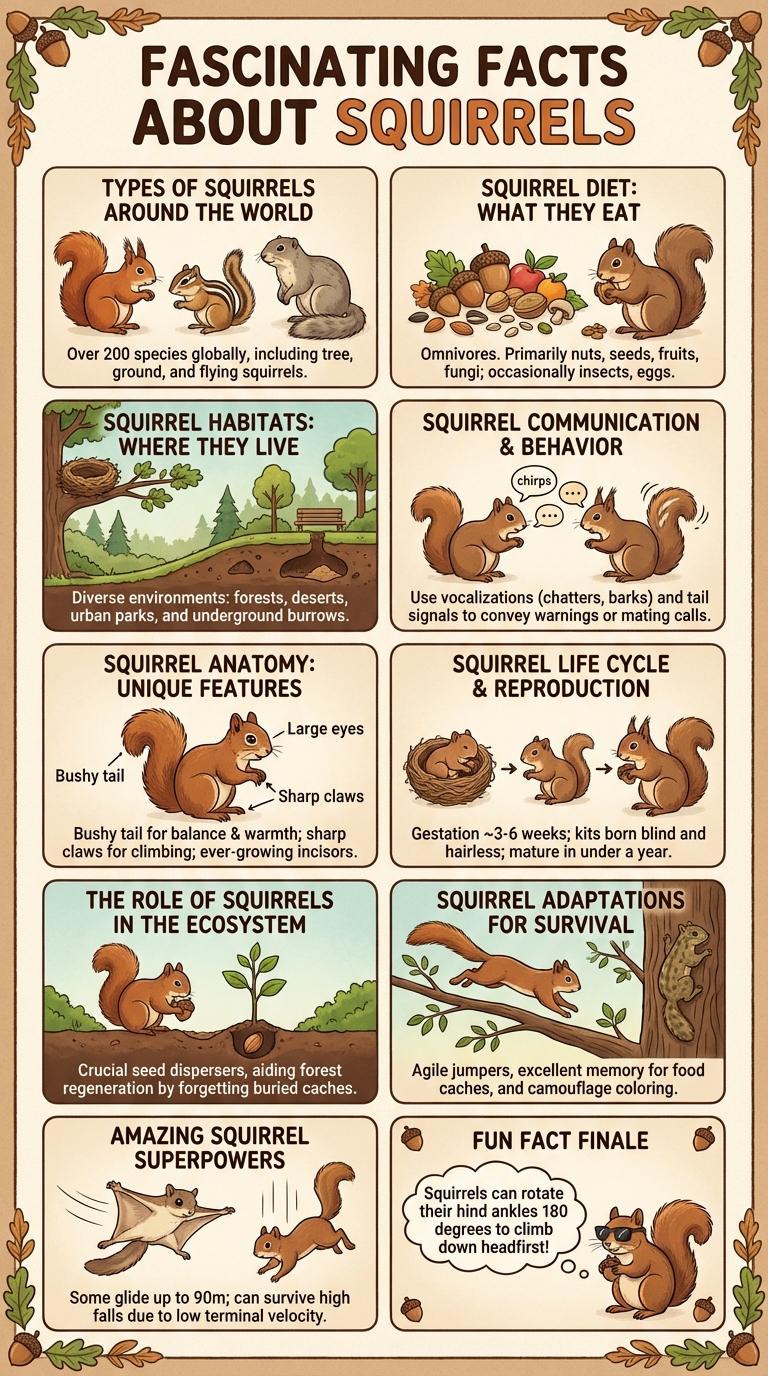
Squirrels are fascinating creatures known for their agility and cleverness in gathering food. Their bushy tails and sharp claws make them perfectly adapted to life in trees and urban environments. Infographics about squirrels reveal intriguing facts about their behaviors, diet, and role in ecosystems.
Fascinating Facts About Squirrels
Squirrels are agile rodents known for their bushy tails and excellent climbing skills. They play a crucial role in forest ecology by dispersing seeds and nuts, promoting tree growth. There are over 200 species of squirrels worldwide, ranging from tiny tree squirrels to the large ground-dwelling species.
Types of Squirrels Around the World
Squirrels are diverse rodents found in various habitats worldwide, ranging from forests to urban areas. They play a crucial role in ecosystems through seed dispersal and as prey for many predators.
- Tree Squirrels - These squirrels live primarily in trees and are known for their agility and bushy tails.
- Ground Squirrels - They inhabit burrows in the ground and are often found in open areas like grasslands.
- Flying Squirrels - Equipped with a membrane that allows gliding between trees, they are nocturnal and elusive.
Squirrel Diet: What They Eat
What do squirrels typically eat in their daily diet? Squirrels primarily consume nuts, seeds, and fruits, which provide essential nutrients for their energy needs. They also eat fungi, small insects, and bird eggs to diversify their diet and adapt to seasonal changes.
| Food Type | Description |
|---|---|
| Nuts | Acorns, walnuts, and hazelnuts rich in healthy fats and proteins |
| Seeds | Sunflower and pumpkin seeds offer vital vitamins and minerals |
| Fruits | Apples, berries, and other seasonal fruits high in carbohydrates |
| Fungi | Mushrooms and truffles providing additional nutrients and fiber |
| Insects and Eggs | Occasional protein sources from insects and bird eggs during scarcity |
Squirrel Habitats: Where They Live
Squirrels inhabit a variety of environments, ranging from dense forests to urban parks. They are highly adaptable rodents that thrive in places with ample food sources and shelter.
Tree squirrels prefer wooded areas with plenty of tall trees for nesting and foraging. Ground squirrels, on the other hand, live in burrows often found in open fields and grasslands.
Squirrel Communication & Behavior
Squirrels use vocalizations, tail movements, and body postures to communicate with each other, conveying warnings, territorial signals, and mating readiness. Their tail flicking acts as an alarm system to alert nearby squirrels of potential predators. Behavioral patterns such as burying nuts and acorn caching demonstrate their impressive memory and survival instincts.
Squirrel Anatomy: Unique Features
Squirrels possess distinctive anatomical features that enhance their agility and survival. Their bushy tails provide balance and communication signals within their environment.
Sharp claws and strong hind legs enable squirrels to climb trees and leap between branches with ease. Large, expressive eyes offer excellent peripheral vision, critical for spotting predators.
Squirrel Life Cycle & Reproduction
Squirrels undergo a fascinating life cycle that begins with birth in the spring. Their development proceeds through distinct stages from infancy to adulthood.
After a gestation period of about 40 to 44 days, a female squirrel typically gives birth to 2 to 8 pups. The young remain in the nest for several weeks, gradually developing fur and opening their eyes. Juvenile squirrels learn essential survival skills before becoming independent.
The Role of Squirrels in the Ecosystem
Squirrels play a crucial role in maintaining healthy ecosystems through various ecological functions. Their behaviors contribute significantly to forest regeneration and biodiversity.
- Seed Dispersal - Squirrels bury seeds and nuts, which often grow into new plants, aiding forest regeneration.
- Soil Aeration - By digging and burying food, squirrels help aerate soil, improving nutrient cycling.
- Food Source - Squirrels serve as prey for many predators, supporting food web dynamics.
Overall, squirrels enhance ecosystem resilience and promote plant diversity through their natural activities.
Squirrel Adaptations for Survival
| Adaptation | Benefit for Survival |
|---|---|
| Sharp Claws | Enable climbing and gripping tree bark securely for escape and food access |
| Strong Hind Legs | Facilitate powerful jumps between trees, aiding quick movement and predator evasion |
| Bushy Tail | Provides balance during leaps, warmth during cold weather, and signals danger to other squirrels |
| Keen Eyesight | Allows detection of predators from afar and precise navigation through dense branches |
| Food Caching Behavior | Supports survival during scarce food periods by storing nuts and seeds in hidden locations |