
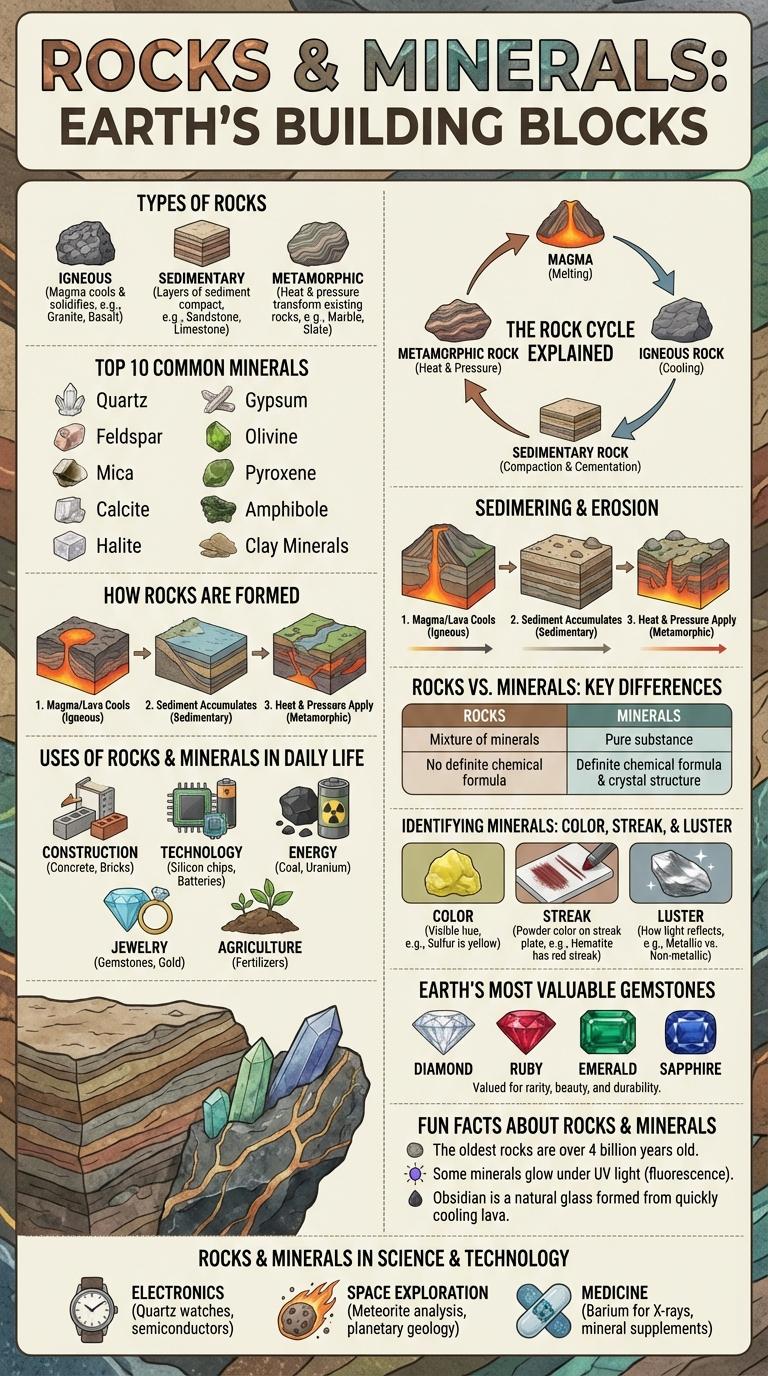
Rocks and minerals form the foundation of Earth's geology, revealing vital information about our planet's history and composition. This infographic breaks down the key types, characteristics, and uses of various rocks and minerals. Understanding their properties helps in fields ranging from construction to environmental science.
Types of Rocks: Igneous, Sedimentary, Metamorphic
Rocks are naturally occurring solid aggregates of one or more minerals. They are categorized into three main types based on their formation process.
Igneous rocks form from the cooling and solidification of molten magma or lava. Examples include granite and basalt, known for their crystalline texture.
Sedimentary rocks develop from the accumulation and compaction of mineral and organic particles. Common types include sandstone and limestone, often containing fossils.
Metamorphic rocks result from the transformation of existing rocks under heat and pressure. Marble and slate are typical examples, characterized by foliated or non-foliated textures.
The Rock Cycle Explained
What is the rock cycle and how does it function? The rock cycle describes the continuous transformation of rocks through three main types: igneous, sedimentary, and metamorphic. This process involves cooling, erosion, heat, and pressure, recycling Earth's materials over millions of years.
Top 10 Common Minerals
Rocks and minerals are fundamental components of the Earth's crust, each with unique properties and uses. Minerals are naturally occurring, inorganic solids with a definite chemical composition, forming the building blocks of rocks.
The top 10 common minerals include quartz, feldspar, mica, calcite, amphibole, pyroxene, olivine, clay minerals, gypsum, and halite. Quartz is the most abundant mineral found in the Earth's continental crust, known for its hardness and resistance to weathering. Feldspar makes up a significant portion of igneous rocks and is essential in ceramics and glass production.
How Rocks are Formed
Rocks are formed through three primary processes: igneous, sedimentary, and metamorphic formation. Igneous rocks form from the cooling and solidification of molten magma or lava. Sedimentary rocks develop from the accumulation and compaction of mineral and organic particles, while metamorphic rocks arise from the alteration of existing rocks under heat and pressure.
Uses of Rocks and Minerals in Daily Life
| Rock or Mineral | Daily Use |
|---|---|
| Quartz | Used in glass making, watches, and electronics due to its durability and piezoelectric properties. |
| Calcite | Key ingredient in cement and concrete, essential for construction and building materials. |
| Granite | Commonly used for countertops, flooring, and monuments because of its hardness and aesthetic appeal. |
| Halite | Known as rock salt, widely used for food seasoning and de-icing roads in winter. |
| Bauxite | Main ore of aluminum, utilized in packaging, transportation, and construction industries. |
Rocks vs. Minerals: Key Differences
Rocks and minerals are fundamental components of the Earth's crust with distinct characteristics. Understanding their differences is essential in geology and earth sciences.
- Composition - Minerals are naturally occurring inorganic substances with a definite chemical composition, while rocks are made up of one or more minerals.
- Formation - Minerals form through geological processes with a crystalline structure, whereas rocks form by the aggregation of minerals via various geological processes.
- Classification - Minerals are classified based on their chemical formula and crystal structure, but rocks are classified by their origin into igneous, sedimentary, or metamorphic types.
Recognizing the key differences between rocks and minerals aids in identifying and studying Earth's materials.
Identifying Minerals: Color, Streak, and Luster
Identifying minerals relies on examining key physical properties such as color, streak, and luster. Color offers a quick visual clue but can vary due to impurities, making other tests essential.
The streak test involves rubbing a mineral on a porcelain plate to observe the color of its powder. Luster describes how a mineral's surface reflects light, classified as metallic or non-metallic for accurate identification.
Earth's Most Valuable Gemstones
Earth's most valuable gemstones are prized for their rarity, beauty, and unique physical properties. These precious stones have been coveted throughout history for jewelry, investment, and industrial use.
- Diamond - The hardest natural substance, diamonds are valued for their brilliance and industrial applications.
- Emerald - Known for their deep green color, emeralds are rare beryls with significant historical importance.
- Ruby - Rubies feature a vibrant red hue caused by chromium and are among the most sought-after gemstones worldwide.
Fun Facts About Rocks and Minerals
Rocks and minerals are the building blocks of the Earth's crust, each with unique properties that make them fascinating to study. Exploring these natural wonders reveals surprising facts about their formation, composition, and uses.
- Minerals are natural chemical compounds - Each mineral has a specific chemical formula and crystal structure that defines its characteristics.
- Igneous rocks form from cooled magma - These rocks solidify either beneath the surface or after volcanic eruptions, creating varieties like granite and basalt.
- Some minerals fluoresce under UV light - Minerals such as fluorite and calcite glow in vibrant colors when exposed to ultraviolet illumination.