
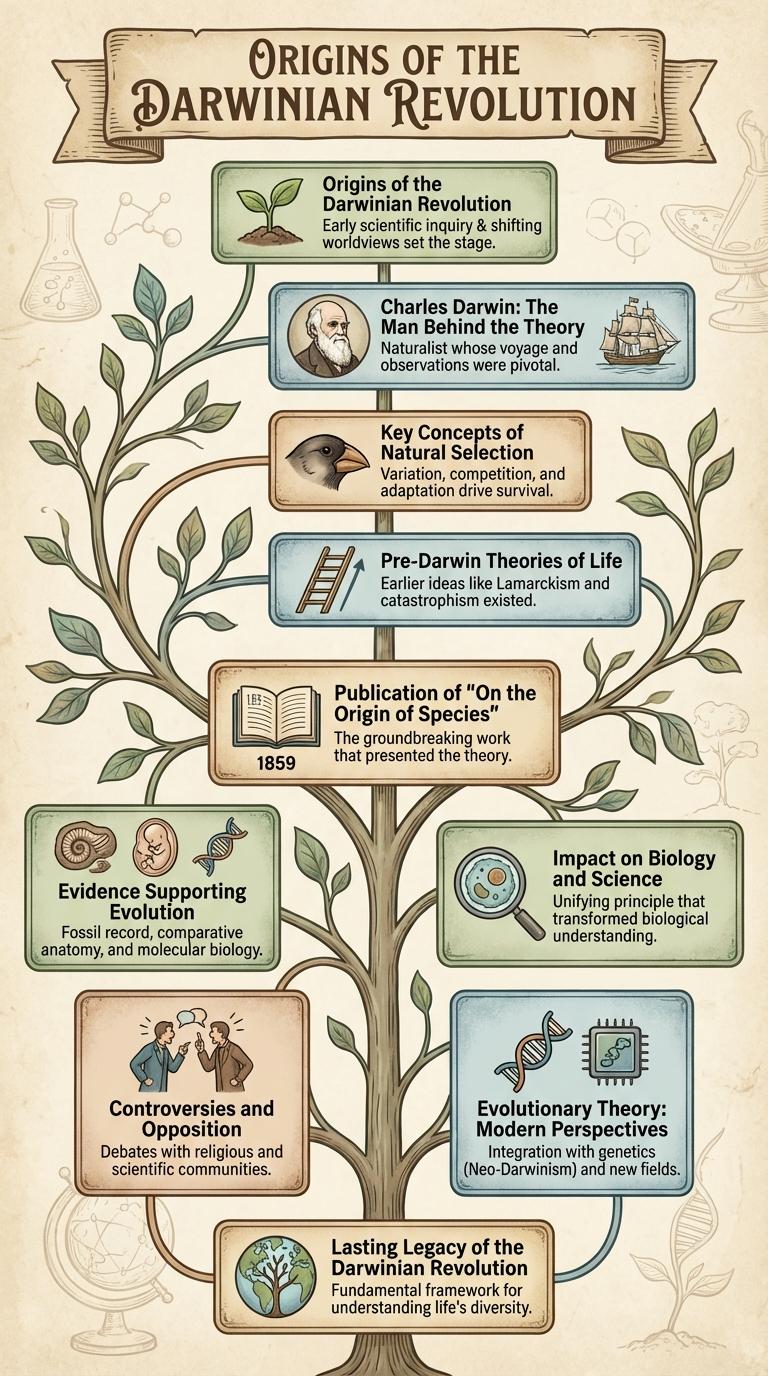
The Darwinian Revolution transformed scientific understanding by introducing the theory of natural selection, reshaping perspectives on evolution and species development. This infographic highlights key concepts, significant figures, and groundbreaking discoveries that fueled this paradigm shift. Explore how Darwin's ideas challenged traditional beliefs and laid the foundation for modern biology.
Origins of the Darwinian Revolution
The Darwinian Revolution marks a pivotal shift in scientific thought about biological diversity. It began with groundbreaking ideas challenging established views on species and natural history.
Charles Darwin's theories originated from extensive observations during the HMS Beagle voyage and influenced by earlier scientific concepts.
- Pre-Darwinian Views - Species were believed to be immutable and created independently.
- Influence of Geological Discoveries - Fossil records and geological strata suggested gradual changes over time.
- Natural Selection Concept - Darwin proposed that species evolve through survival and reproduction of the fittest.
Charles Darwin: The Man Behind the Theory
Charles Darwin, born in 1809, revolutionized biology with his groundbreaking theory of evolution by natural selection. His observations during the voyage of the HMS Beagle were critical in shaping his ideas on species adaptation and survival. Darwin's work challenged established views, laying the foundation for modern evolutionary science.
Key Concepts of Natural Selection
The Darwinian Revolution fundamentally changed the way we understand biological life by introducing the theory of natural selection. This concept explains how species evolve over time through the survival and reproduction of individuals best adapted to their environment.
Natural selection operates on genetic variation within populations, where beneficial traits increase an organism's chances of survival. Over generations, these advantageous traits become more common, leading to evolutionary changes. This process highlights the dynamic interaction between organisms and their environments as a driving force of biodiversity.
Pre-Darwin Theories of Life
The Pre-Darwin Theories of Life primarily included ideas like Creationism and the Great Chain of Being, where all species were thought to be fixed and unchanging. Early scientists also embraced the concept of Spontaneous Generation, believing life could arise from non-living matter.
These theories lacked scientific evidence and failed to explain fossil records or species diversity. The Darwinian Revolution later challenged these views by introducing natural selection and evolution as mechanisms of biodiversity.
Publication of "On the Origin of Species
The Darwinian Revolution began with the publication of Charles Darwin's seminal work, "On the Origin of Species," in 1859. This book introduced the groundbreaking theory of natural selection as the mechanism for evolution.
Darwin's ideas challenged existing scientific and religious beliefs, reshaping the understanding of biological diversity and species development.
- Publication Date - "On the Origin of Species" was published on November 24, 1859, marking a major milestone in evolutionary biology.
- Core Concept - The book presents natural selection as the driving process behind evolution, where organisms better adapted to their environment tend to survive and reproduce.
- Impact on Science - Darwin's work laid the foundation for modern evolutionary theory and influenced multiple scientific disciplines including genetics, ecology, and paleontology.
Evidence Supporting Evolution
The Darwinian Revolution transformed the understanding of biological diversity through evidence supporting evolution. This evidence established natural selection as the mechanism driving species change over time.
- Fossil Records - Fossils reveal a chronological sequence showing gradual changes and extinct species linking past and present forms.
- Comparative Anatomy - Homologous structures in different species indicate common ancestry and evolutionary divergence.
- Genetic Evidence - DNA similarities among diverse organisms demonstrate shared evolutionary origins and genetic inheritance patterns.
These forms of evidence collectively underpin the scientific acceptance of evolution initiated by Darwin's theory.
Impact on Biology and Science
How did the Darwinian Revolution transform biology and science? The Darwinian Revolution introduced the theory of natural selection, fundamentally changing the understanding of species development and adaptation. It established evolution as a central concept in biology, influencing genetics, ecology, and paleontology.
What scientific fields were most impacted by Darwin's theory? Evolutionary biology emerged as a distinct discipline, integrating fossil records and comparative anatomy. Genetics advanced through the study of heredity in the context of natural selection, while ecology gained insights into species interactions and environmental adaptation.
Controversies and Opposition
| Aspect | Details |
|---|---|
| Theory of Natural Selection | Faced skepticism for contradicting traditional creation beliefs and lack of observable proof initially. |
| Religious Opposition | Church authorities denounced the theory as it challenged biblical accounts of creation. |
| Scientific Criticism | Some scientists contested Darwin's mechanisms due to incomplete understanding of genetics. |
| Social Implications | Concerns about social Darwinism and misuse of evolutionary ideas to justify inequality. |
| Public Reaction | Widespread debate fueled by media, influencing education and public opinion. |
Evolutionary Theory: Modern Perspectives
The Darwinian Revolution fundamentally transformed the understanding of biological diversity through the introduction of natural selection. Modern perspectives build upon Darwin's framework, integrating genetics and molecular biology to explain evolutionary processes.
Contemporary evolutionary theory emphasizes the role of gene flow, genetic drift, and mutation in shaping species over time. Advances in genomics and computational biology have enabled detailed analysis of evolutionary patterns and mechanisms.