
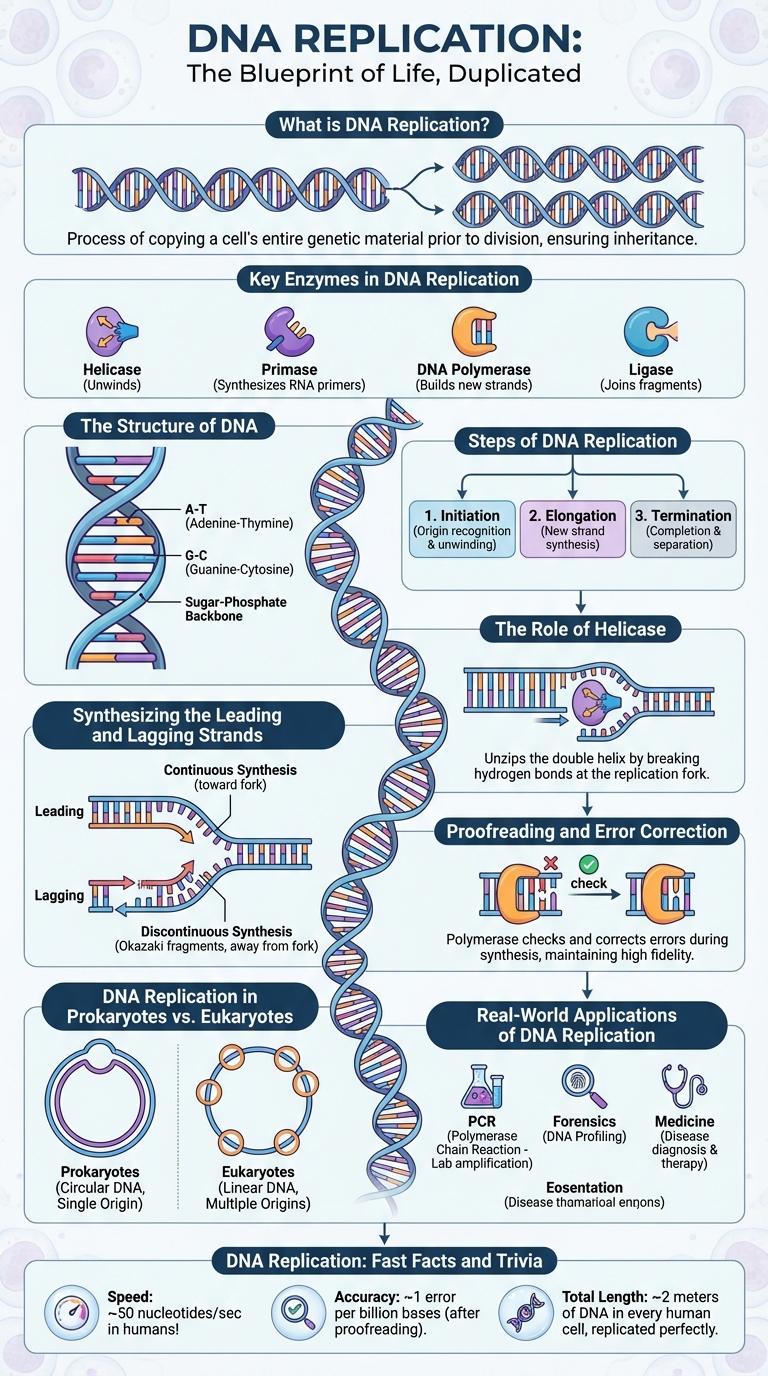
DNA replication is a vital biological process that ensures genetic information is accurately copied for cell division. This intricate mechanism involves unwinding the double helix, synthesizing new complementary strands, and proofreading to prevent errors. Understanding DNA replication provides key insights into genetics, heredity, and cellular function.
What is DNA Replication?
DNA replication is the biological process of producing two identical DNA molecules from one original DNA molecule. It occurs in the cell nucleus during the S phase of the cell cycle to ensure genetic information is accurately passed to daughter cells.
The process involves unwinding the double helix and using each strand as a template for synthesizing a complementary strand. Key enzymes like DNA helicase, DNA polymerase, and ligase play essential roles in this precise and semi-conservative replication mechanism.
Key Enzymes in DNA Replication
DNA replication is a vital process that duplicates genetic material before cell division. Key enzymes facilitate the unwinding, synthesis, and proofreading of the DNA strands to ensure accuracy.
- Helicase - Unwinds the double-stranded DNA helix to create two single strands for replication.
- DNA Polymerase - Synthesizes the new complementary DNA strand by adding nucleotides to the template strand.
- Primase - Synthesizes RNA primers to initiate DNA strand synthesis.
- Ligase - Joins Okazaki fragments on the lagging strand to form a continuous DNA strand.
- Topoisomerase - Relieves torsional strain caused by unwinding DNA strands during replication.
The Structure of DNA
DNA is a double helix composed of two long strands forming a twisted ladder-like structure. Each strand consists of nucleotides containing a sugar, phosphate group, and one of four nitrogenous bases: adenine, thymine, cytosine, and guanine.
The nitrogenous bases pair specifically, with adenine bonding to thymine and cytosine bonding to guanine, creating complementary base pairs. This complementary nature allows accurate copying during replication. The backbone of DNA strands is made of alternating sugar and phosphate molecules, providing stability to the molecule.
Steps of DNA Replication
DNA replication is a vital process that occurs in the S phase of the cell cycle, ensuring each daughter cell receives an accurate copy of genetic material. It begins with the unwinding of the double helix by helicase, creating replication forks. DNA polymerase then synthesizes new complementary strands by adding nucleotides to the original templates, following base-pairing rules.
The Role of Helicase
Helicase is an essential enzyme in DNA replication responsible for unwinding the double helix. It breaks the hydrogen bonds between complementary base pairs, creating two single strands. This unwinding allows DNA polymerase to synthesize new strands, ensuring accurate genetic duplication.
Synthesizing the Leading and Lagging Strands
DNA replication involves the precise synthesis of two strands: the leading and lagging strands. These strands are copied simultaneously but through different mechanisms to ensure accurate genetic duplication.
- Leading Strand Synthesis - DNA polymerase continuously adds nucleotides in the 5' to 3' direction following the replication fork.
- Lagging Strand Synthesis - The lagging strand is synthesized discontinuously in short segments called Okazaki fragments.
- Okazaki Fragment Joining - DNA ligase connects Okazaki fragments to form a continuous strand on the lagging side.
Both strands require coordinated enzyme activity to maintain replication accuracy and efficiency.
Proofreading and Error Correction
How does DNA replication ensure accuracy through proofreading and error correction?
DNA polymerase plays a crucial role by detecting and removing incorrectly paired nucleotides during replication. This exonuclease activity significantly reduces the error rate, maintaining genetic stability.
What mechanisms aside from DNA polymerase contribute to error correction in DNA replication?
Mismatch repair enzymes identify and correct errors missed by DNA polymerase. This system enhances replication fidelity by replacing wrong bases post-replication.
| Process | Function |
|---|---|
| Proofreading | Removal of incorrect nucleotides by DNA polymerase's exonuclease activity |
| Error Correction | Mismatch repair enzymes fix replication errors after synthesis |
| Error Rate Reduction | From 1 in 10,000 to 1 in 1 billion nucleotides incorporated |
| Enzyme Involved | DNA polymerase and mismatch repair proteins |
| Genetic Stability | Preserves DNA sequence integrity throughout cell division |
DNA Replication in Prokaryotes vs. Eukaryotes
DNA replication is a crucial biological process ensuring genetic information is accurately copied in both prokaryotes and eukaryotes. Differences in replication mechanisms reflect the complexity and cellular organization of these organisms.
Prokaryotic DNA replication occurs in the cytoplasm with a single origin of replication, while eukaryotic replication takes place in the nucleus involving multiple origins.
- Origin of Replication - Prokaryotes have a single origin; eukaryotes possess multiple replication origins to expedite DNA synthesis.
- Replication Rate - Prokaryotic replication proceeds faster, approximately 1000 nucleotides per second, compared to 50 nucleotides per second in eukaryotes.
- DNA Polymerases - Prokaryotes primarily use DNA polymerase III for elongation; eukaryotes use DNA polymerases a, d, and e for initiation and elongation processes.
- Chromosome Structure - Prokaryotes replicate circular chromosomes, while eukaryotes replicate linear chromosomes featuring telomeres.
- Replication Complexity - Eukaryotic replication involves more regulatory proteins and chromatin remodeling to manage histone-DNA interactions.
Real-World Applications of DNA Replication
| Real-World Application | Description |
|---|---|
| Medical Diagnostics | DNA replication techniques enable precise identification of genetic disorders and infectious agents through polymerase chain reaction (PCR). |
| Forensic Science | Replication of DNA from crime scene samples supports identification and criminal investigations using DNA fingerprinting. |
| Biotechnology | Gene cloning depends on DNA replication processes to produce recombinant proteins, vaccines, and gene therapies. |
| Genetic Research | Studying replication aids in understanding mutation mechanisms and genome stability, influencing cancer and hereditary disease research. |
| Agricultural Advancements | DNA replication knowledge contributes to genetic modification of crops for disease resistance and improved yields. |