
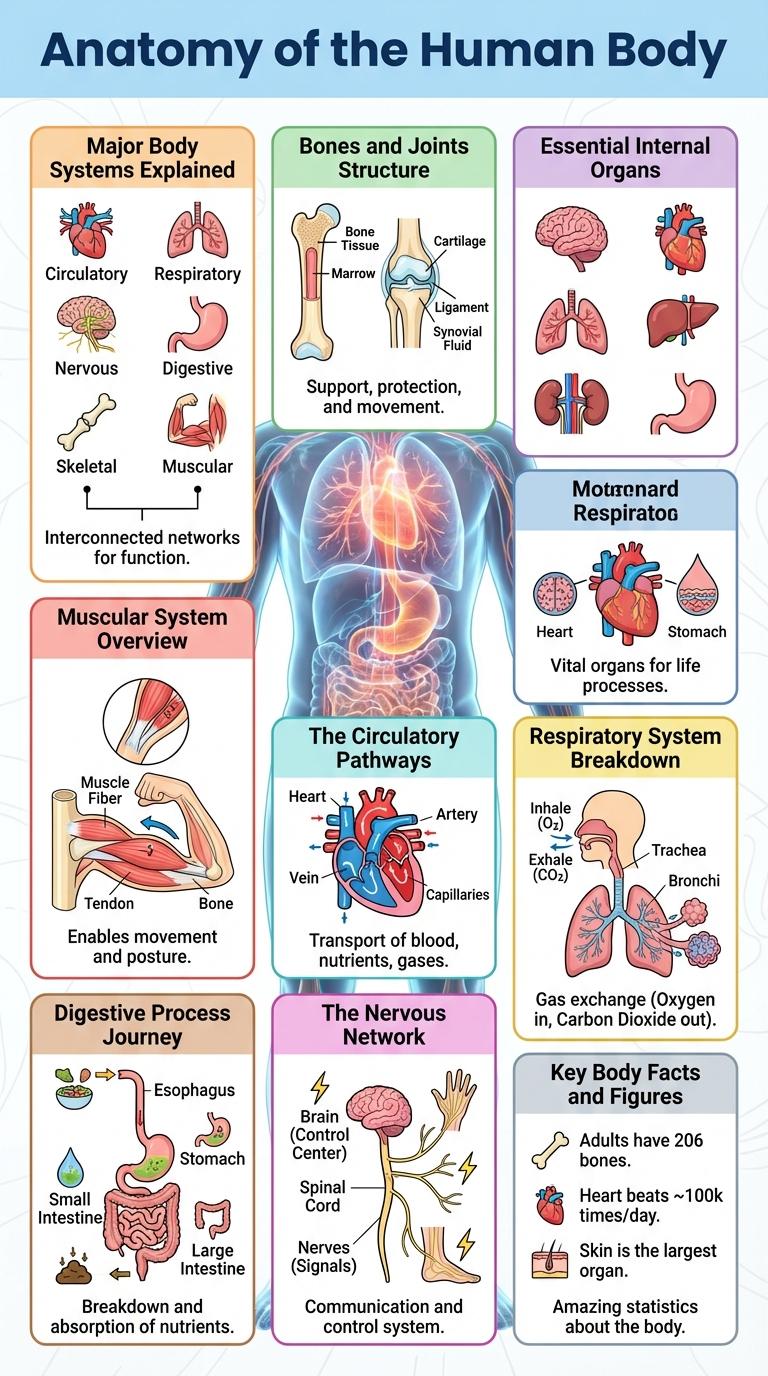
An infographic about the body visually presents crucial information on human anatomy, functions, and health in a clear and concise manner. It highlights key systems such as the skeletal, muscular, circulatory, and nervous systems, making complex concepts easier to understand. This visual tool enhances learning and promotes awareness of how the body operates to maintain overall well-being.
Anatomy of the Human Body
| Body System | Key Components |
|---|---|
| Skeletal System | 206 Bones, Joints, Cartilage |
| Muscular System | Over 600 Muscles, Tendons |
| Nervous System | Brain, Spinal Cord, Nerves |
| Circulatory System | Heart, Blood Vessels, Blood |
| Respiratory System | Lungs, Trachea, Diaphragm |
Major Body Systems Explained
The human body functions through several interconnected major systems. Each system plays a vital role in maintaining overall health and stability.
- Circulatory System - Transports blood, nutrients, and oxygen throughout the body using the heart, blood, and vessels.
- Respiratory System - Facilitates breathing by exchanging oxygen and carbon dioxide between the body and the environment.
- Nervous System - Controls body functions and responses by transmitting signals between the brain, spinal cord, and nerves.
- Digestive System - Breaks down food into nutrients that the body absorbs for energy, growth, and repair.
- Musculoskeletal System - Provides structure, support, and movement through bones, muscles, and joints.
Understanding these major body systems helps appreciate how the body sustains life and adapts to change.
Bones and Joints Structure
The human skeletal system consists of 206 bones that provide structure and protect vital organs. Joints connect bones, allowing for flexible movement and support. Different types of joints include hinge, ball-and-socket, and pivot, each providing unique motion capabilities.
Essential Internal Organs
The human body contains several essential internal organs that sustain life by performing vital functions. These organs work together to maintain health and support bodily processes.
- Heart - Pumps blood throughout the body, supplying oxygen and nutrients to tissues.
- Lungs - Facilitate gas exchange, bringing oxygen into the body and expelling carbon dioxide.
- Liver - Detoxifies chemicals, metabolizes drugs, and produces important proteins for blood clotting.
- Kidneys - Filter waste products from the blood and regulate fluid balance and electrolytes.
- Brain - Controls body functions and processes sensory information, enabling thought and coordination.
Muscular System Overview
The muscular system consists of over 600 muscles that enable movement, maintain posture, and produce heat. These muscles are categorized into three types: skeletal, smooth, and cardiac, each serving distinct functions.
Skeletal muscles attach to bones and facilitate voluntary movements. Smooth muscles control involuntary actions in organs, while cardiac muscle powers the heart's contractions.
The Circulatory Pathways
The circulatory system consists of two main pathways: systemic circulation and pulmonary circulation. Systemic circulation delivers oxygen-rich blood from the heart to the entire body.
Pulmonary circulation transports oxygen-poor blood from the heart to the lungs for oxygenation. These pathways work together to maintain efficient blood flow and oxygen delivery.
Respiratory System Breakdown
How does the respiratory system function to support life? The respiratory system is essential for exchanging oxygen and carbon dioxide between the body and the environment. It involves organs such as the lungs, trachea, and diaphragm working together to enable breathing.
What are the main components of the respiratory system? Key organs include the nasal cavity, pharynx, larynx, trachea, bronchi, and lungs. Each plays a specific role in filtering air, producing sound, and facilitating gas exchange.
| Component | Function |
|---|---|
| Nasal Cavity | Filters, warms, and moistens incoming air |
| Trachea | Conduits air to bronchi and lungs |
| Bronchi | Distribute air to each lung |
| Lungs | Site of oxygen and carbon dioxide exchange |
| Diaphragm | Muscle controlling inhalation and exhalation |
Digestive Process Journey
The digestive process begins in the mouth, where chewing and saliva break down food into smaller particles. The stomach uses acids and enzymes to further digest food, turning it into a semi-liquid substance called chyme. Nutrients are absorbed in the small intestine, while waste moves into the large intestine for water absorption before excretion.
The Nervous Network
The nervous network controls all voluntary and involuntary actions in the human body. It consists of the brain, spinal cord, and vast system of nerves transmitting signals.
- Central Nervous System (CNS) - The CNS processes information and coordinates activity by linking the brain and spinal cord.
- Peripheral Nervous System (PNS) - The PNS transmits sensory data and motor commands between the CNS and the rest of the body.
- Neurons - Neurons are specialized cells that send electrical impulses to communicate rapidly throughout the nervous system.