
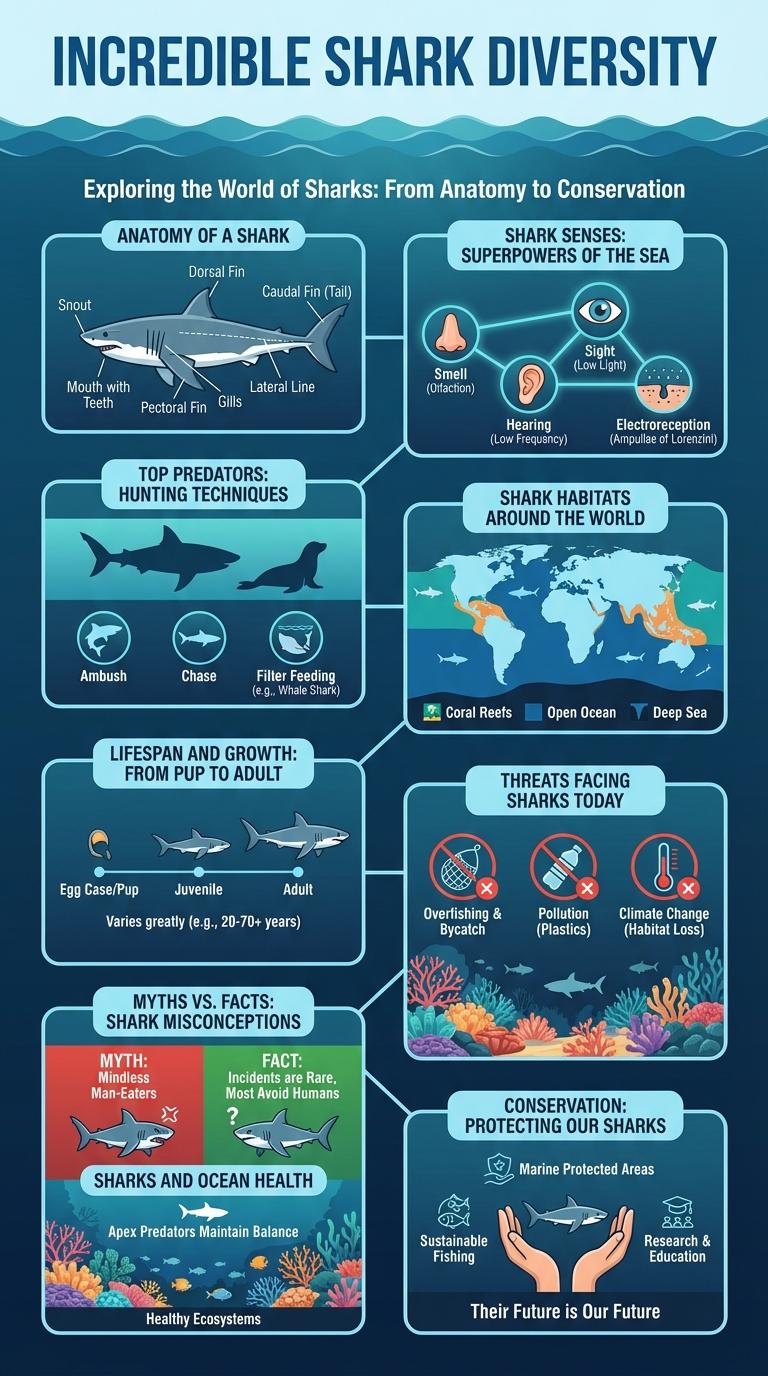
Infographics about sharks present key facts and striking visuals to enhance understanding of these marine predators. They highlight shark species diversity, behaviors, and their crucial role in ocean ecosystems. This visual format simplifies complex information to engage and educate audiences effectively.
Incredible Shark Diversity
Sharks represent an incredible diversity with over 500 known species ranging from the tiny dwarf lanternshark to the massive whale shark. These species inhabit various marine environments, from shallow coral reefs to deep ocean floors. Shark adaptations include unique sensory systems and varied feeding strategies, showcasing their evolutionary success.
Anatomy of a Shark
Sharks possess a streamlined body designed for efficient swimming and hunting. Their skeletons are made of cartilage, making them lighter and more flexible than bony fish.
Their most notable feature is the set of multiple rows of sharp teeth that constantly regenerate. Sharks also have specialized sensory organs called ampullae of Lorenzini, enabling them to detect electromagnetic fields from prey.
Shark Senses: Superpowers of the Sea
Sharks possess extraordinary sensory abilities that make them apex predators in the ocean. Their senses detect electrical fields, vibrations, and chemical signals, allowing precise hunting even in murky waters.
The ampullae of Lorenzini detect electromagnetic fields generated by prey, while their lateral line senses pressure changes and movement in the water. Sharks also have an acute sense of smell, capable of detecting blood concentration as low as one part per million.
Top Predators: Hunting Techniques
What makes sharks top predators in the ocean? Sharks possess highly developed senses such as electroreception and smell, allowing them to detect prey from great distances. Their streamlined bodies and powerful muscles enable swift, agile movements for effective hunting.
How do different shark species use unique hunting techniques? Great white sharks often use breach attacks, launching out of the water to capture seals. Hammerhead sharks employ their wide-set eyes for enhanced vision and use schools to herd fish into tight groups.
Why is ambush a preferred hunting method for some sharks? Species like the nurse shark use camouflage and patience to surprise prey hiding on the ocean floor. This tactic conserves energy while increasing the chance of a successful catch.
What role does teamwork play in shark hunting? Certain species such as the blacktip reef shark hunt in groups to corral schools of fish, improving their feeding success. Coordinated efforts allow them to outmaneuver prey that might escape a single hunter.
How do sharks adapt hunting strategies based on their environment? Deep-sea sharks rely more on sensing vibrations and changes in water pressure to locate prey in darkness. Coastal species take advantage of tidal movements and terrain to ambush or corner prey effectively.
Shark Habitats Around the World
Sharks inhabit a diverse range of aquatic environments across the globe. Their habitats vary from coastal shallows to deep oceanic waters, supporting different shark species adapted to each area.
- Coastal Waters - Many shark species thrive in warm, shallow coastal waters rich in prey and shelter.
- Open Ocean - Some sharks, like the Great White, migrate through deep pelagic zones far from land.
- Coral Reefs - Coral reefs provide abundant food sources and hiding spots for reef sharks.
Lifespan and Growth: From Pup to Adult
| Stage | Lifespan & Growth Details |
|---|---|
| Pup (Birth to 1 Year) | Sharks are born live in most species, measuring 40-70 cm. Rapid growth occurs, usually doubling in size within the first year. High vulnerability to predators during this stage. |
| Juvenile (1 to 5 Years) | Growth rate slows but remains steady. Size ranges between 1 to 3 meters depending on species. Development of hunting skills and social behaviors. |
| Adult (5+ Years) | Size stabilizes and varies by species (1.5 to over 6 meters). Sexual maturity occurs, enabling reproduction. Lifespan ranges broadly from 20 to 70 years depending on species. |
| Species Example: Great White Shark | Lifespan: Approximately 30-40 years. Growth: Pups born at about 1.2 meters grow 25 cm/year until adulthood. |
| Species Example: Whale Shark | Lifespan: Estimated up to 70 years. Growth: Pups measure about 50-60 cm at birth, reaching 12 meters or more in adulthood. |
Threats Facing Sharks Today
Sharks face numerous threats that jeopardize their survival and disrupt marine ecosystems. Understanding these dangers is critical for effective conservation efforts.
- Overfishing - Intensive fishing reduces shark populations by targeting them directly or as bycatch.
- Habitat Loss - Coastal development and pollution destroy essential habitats for shark breeding and feeding.
- Climate Change - Ocean warming and acidification affect shark migration patterns and prey availability.
Protecting sharks requires global cooperation to address these threats and promote sustainable oceans.
Myths vs. Facts: Shark Misconceptions
Sharks are often misunderstood creatures surrounded by myths that portray them as mindless killers. In reality, most shark species pose little threat to humans and play a crucial role in maintaining ocean ecosystems. Awareness of these facts helps dispel fears and promotes shark conservation efforts worldwide.
Sharks and Ocean Health
Sharks play a critical role in maintaining the balance of marine ecosystems. Healthy shark populations indicate a thriving ocean environment.
- Top Predators - Sharks regulate prey species, preventing overpopulation and ensuring biodiversity.
- Ecosystem Health - The presence of sharks supports coral reefs and seagrass beds by controlling species that damage these habitats.
- Indicator Species - Declining shark numbers signal broader ocean health issues such as pollution and overfishing.