
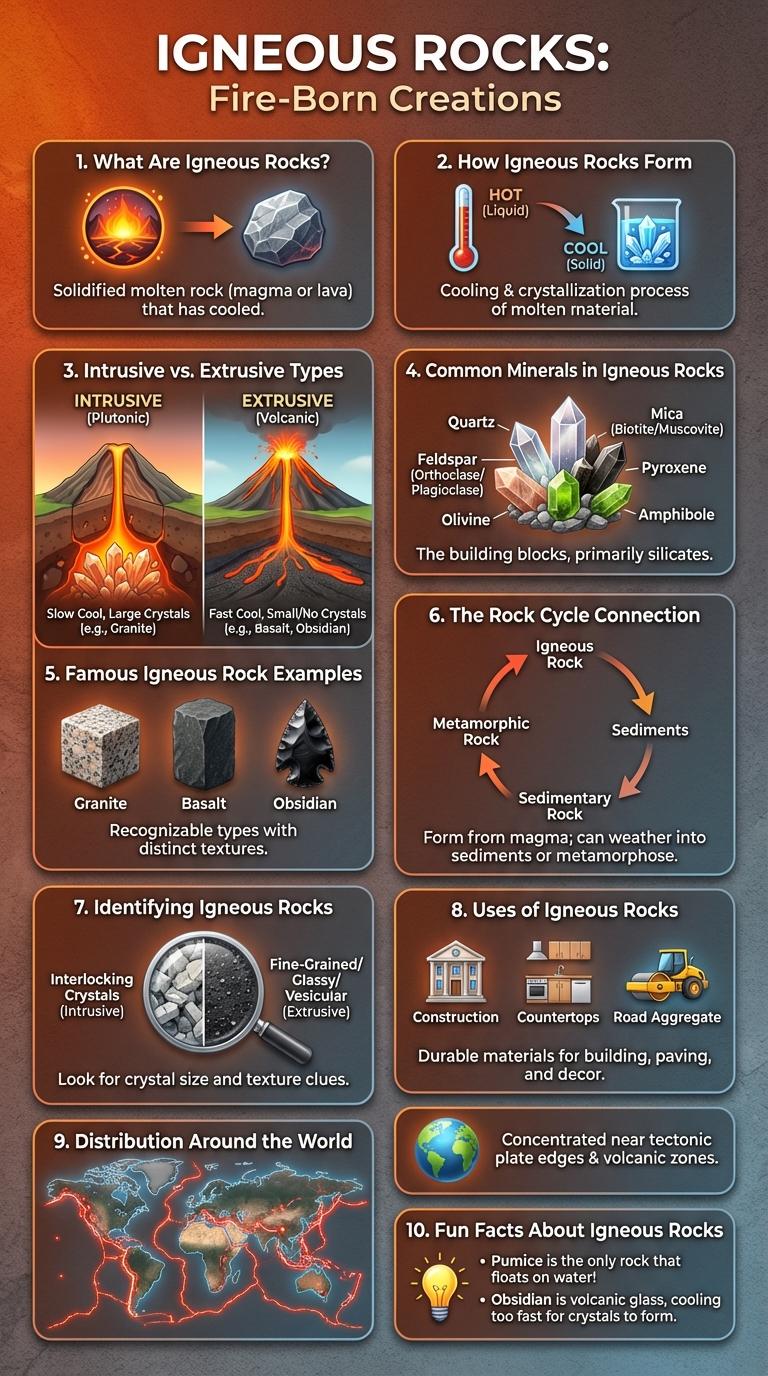
Igneous rocks form from the solidification of molten magma or lava, showcasing a variety of textures and mineral compositions. Their classification into intrusive and extrusive types depends on where the rock solidifies beneath or on Earth's surface. Understanding igneous rocks reveals key insights into volcanic activity and Earth's geological processes.
What Are Igneous Rocks?
Igneous rocks form from the solidification of molten magma or lava. They are classified into two main types: intrusive rocks, which cool slowly beneath the Earth's surface, and extrusive rocks, which cool rapidly on the surface. Common examples include granite and basalt, both essential in understanding Earth's geological processes.
How Igneous Rocks Form
Igneous rocks form from the cooling and solidification of molten rock material called magma or lava. This process occurs either beneath the Earth's surface or after a volcanic eruption.
- Intrusive Formation - Magma cools slowly beneath the Earth's surface, creating coarse-grained igneous rocks like granite.
- Extrusive Formation - Lava erupts onto the surface and cools quickly, producing fine-grained rocks such as basalt.
- Crystallization Process - Minerals crystallize in a specific order as the molten material cools, affecting the rock's texture and composition.
Understanding the formation of igneous rocks helps explain the Earth's geological history and volcanic activity.
Intrusive vs. Extrusive Types
Igneous rocks form from the solidification of molten magma or lava. They are classified into two main types based on their formation environment: intrusive and extrusive.
- Intrusive igneous rocks - Cool slowly beneath the Earth's surface, resulting in large, visible crystals.
- Extrusive igneous rocks - Form from lava that cools rapidly on the Earth's surface, producing fine-grained or glassy textures.
- Texture difference - Intrusive rocks have coarse-grained textures, while extrusive rocks are typically fine-grained or porous.
Common Minerals in Igneous Rocks
What are the common minerals found in igneous rocks? Igneous rocks primarily contain minerals such as quartz, feldspar, mica, amphibole, and pyroxene. These minerals determine the rock's texture, color, and density.
| Mineral | Characteristics |
|---|---|
| Quartz | Hard, transparent, and often clear or milky. |
| Feldspar | Common, usually white or pink, important for rock structure. |
| Mica | Sheet-like crystals, shiny and flaky in appearance. |
| Amphibole | Dark colored, needle-like crystals often present in igneous rocks. |
| Pyroxene | Dark, dense mineral with a blocky shape, common in mafic rocks. |
Famous Igneous Rock Examples
Igneous rocks form from the cooling and solidification of magma or lava. They are classified into intrusive and extrusive types based on where they crystallize.
Famous examples of igneous rocks include granite, basalt, and obsidian. Granite is a coarse-grained intrusive rock commonly used in construction and monuments. Basalt, an extrusive rock, forms the majority of the ocean floor and volcanic islands.
The Rock Cycle Connection
Igneous rocks form from the cooling and solidification of molten magma or lava. They are a key component of the rock cycle, transforming into other rock types through various geological processes.
When igneous rocks are exposed to weathering and erosion, their particles can become sediments that eventually form sedimentary rocks. Heat and pressure can also metamorphose igneous rocks into metamorphic rocks, completing their role in the rock cycle.
Identifying Igneous Rocks
Igneous rocks form from the cooling and solidification of molten magma or lava. They are primarily identified by their texture and mineral composition, ranging from coarse-grained intrusive rocks like granite to fine-grained extrusive types such as basalt. Key identification features include grain size, crystal visibility, and the presence of vesicles or glassy surfaces.
Uses of Igneous Rocks
| Use | Description |
|---|---|
| Construction Material | Granite and basalt are widely used for building roads, bridges, and monuments due to their durability and strength. |
| Countertops and Tiles | Polished granite and basalt serve as aesthetic and long-lasting surfaces in kitchens and bathrooms. |
| Sculptures and Statues | Igneous rocks like basalt are preferred for artistic carvings because of their fine grain and hardness. |
| Industrial Applications | Perlite and pumice, types of igneous rocks, are used as insulating materials and abrasive substances. |
| Dimension Stone | Blocks of granite are quarried for use as dimension stone in architecture and monumental construction. |
Distribution Around the World
Igneous rocks form from the solidification of molten magma and are distributed globally in diverse geological settings. Their presence is key to understanding Earth's volcanic and tectonic activity.
These rocks primarily occur in volcanic regions, mid-ocean ridges, and continental crust zones. Their global distribution reflects tectonic plate boundaries and hotspots.
- Mid-Ocean Ridges - Basaltic igneous rocks are abundant along underwater mountain ranges where tectonic plates diverge.
- Volcanic Arcs - Andesitic and rhyolitic rocks dominate areas near subduction zones, such as the Pacific Ring of Fire.
- Continental Shields - Granitic igneous rocks are widespread in ancient, stable parts of continents like the Canadian Shield.