
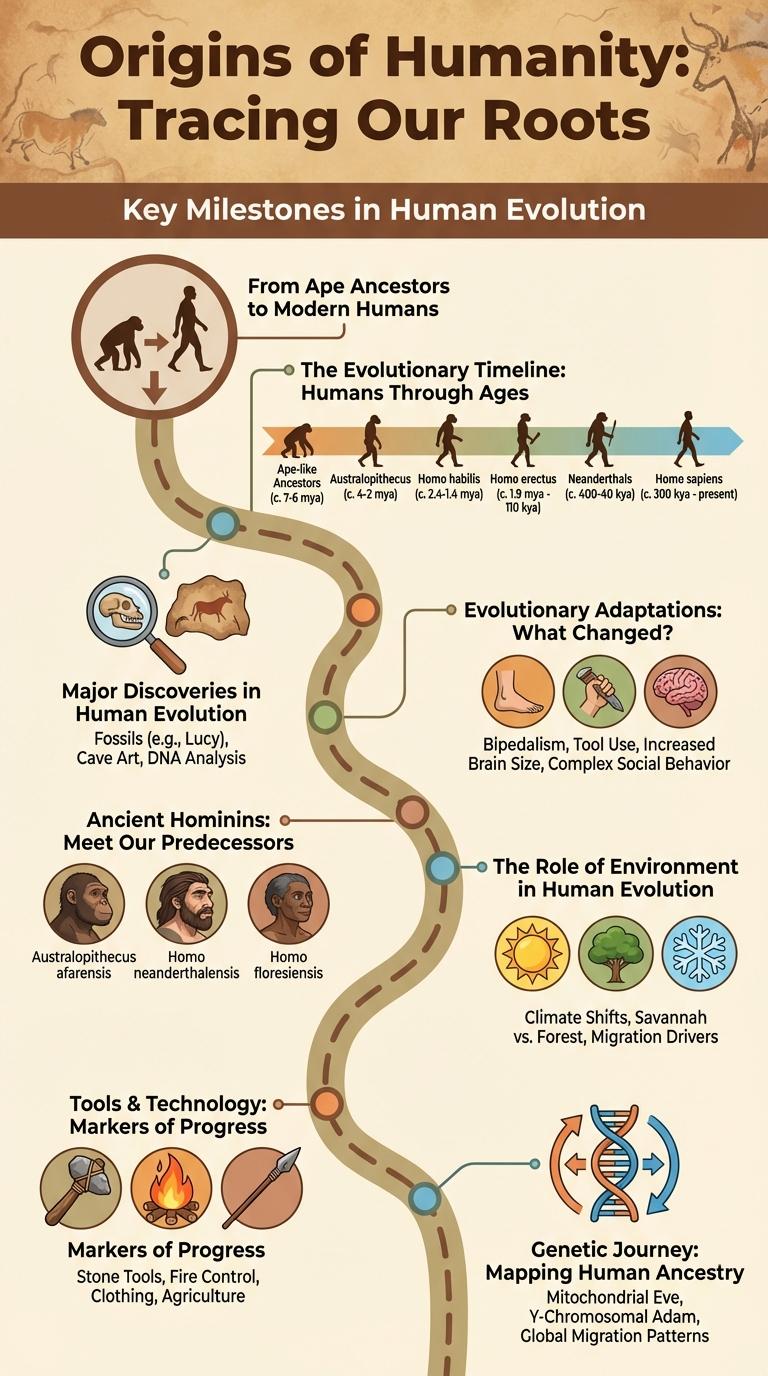
Human evolution reveals the remarkable journey of our species from early primates to modern Homo sapiens. This infographic traces key milestones in anatomical changes, cognitive development, and cultural advancements over millions of years. Understanding this evolutionary timeline provides insight into the genetic and environmental factors shaping humanity today.
Origins of Humanity: Tracing Our Roots
Human evolution traces the development of Homo sapiens from early hominins in Africa. Understanding our origins reveals the biological and cultural milestones shaping modern humanity.
- Early Hominins - Species like Australopithecus appeared around 4 million years ago and show the first signs of bipedalism.
- Homo Genus Emergence - Homo habilis, emerging around 2.4 million years ago, marks increased brain size and tool use.
- Migration Out of Africa - Homo sapiens began dispersing from Africa approximately 70,000 years ago, leading to global colonization.
Key Milestones in Human Evolution
Human evolution traces the development of Homo sapiens from early primates over millions of years. Key milestones mark significant biological and cultural changes that shaped modern humans.
The transition from Australopithecus to Homo habilis introduced tool use around 2.4 million years ago. Homo erectus showed evidence of controlled fire and more complex social structures approximately 1.9 million years ago. The emergence of Homo sapiens about 300,000 years ago involved advanced cognitive abilities and symbolic behavior.
From Ape Ancestors to Modern Humans
The journey from ape ancestors to modern humans spans millions of years, marked by significant evolutionary milestones. Early hominins developed bipedalism, enabling efficient movement and freeing hands for tool use, which played a crucial role in survival. Over time, brain size increased, leading to advanced cognitive abilities and the emergence of Homo sapiens, the species that dominates today.
The Evolutionary Timeline: Humans Through Ages
The Evolutionary Timeline of humans traces the development of Homo sapiens from early ancestors to modern humans. This timeline highlights key milestones in anatomical and cultural evolution over millions of years.
Beginning approximately 7 million years ago, early hominins such as Sahelanthropus emerged in Africa. Homo erectus appeared around 1.9 million years ago, showing advancements in tool use and migration out of Africa.
Major Discoveries in Human Evolution
Major discoveries in human evolution have reshaped our understanding of how Homo sapiens emerged and interacted with other hominin species. Fossil findings and genetic evidence reveal a complex web of evolution spanning millions of years.
Key fossils like Australopithecus afarensis ("Lucy") and Homo habilis highlight early stages of bipedalism and tool use. DNA analysis of Neanderthals and Denisovans uncovers interbreeding events that influenced modern human genetics.
Evolutionary Adaptations: What Changed?
Human evolution involved significant adaptations that shaped anatomy and behavior. These changes enhanced survival and reproduction in diverse environments.
- Brain Size Increase - The human brain tripled in size compared to early ancestors, enabling advanced cognitive functions.
- Bipedalism - Walking upright freed the hands for tool use and improved energy efficiency in locomotion.
- Reduced Jaw and Teeth Size - Diet changes led to smaller jaws and teeth, reflecting softer food consumption.
- Loss of Body Hair - Less body hair helped regulate temperature through sweating.
- Development of Complex Language - Anatomical changes in the vocal tract allowed sophisticated speech communication.
These evolutionary adaptations collectively contributed to the distinctiveness of Homo sapiens.
Ancient Hominins: Meet Our Predecessors
Who were the ancient hominins that shaped human evolution?
Ancient hominins are early human ancestors who lived millions of years ago and paved the way for modern Homo sapiens. These species showcase important evolutionary adaptations in brain size, tool use, and bipedalism.
| Species | Key Characteristics |
|---|---|
| Australopithecus afarensis | Existed 3.9-2.9 million years ago; bipedal with ape-like features |
| Homo habilis | 2.4-1.4 million years ago; early tool user with larger brain capacity |
| Homo erectus | 1.9 million-110,000 years ago; walked fully upright, used advanced tools |
| Neanderthals (Homo neanderthalensis) | 400,000-40,000 years ago; adapted to cold climates, skilled hunters |
| Denisovans | Exact timeframe unclear; genetically distinct group discovered from fossils |
The Role of Environment in Human Evolution
The environment played a crucial role in shaping human evolution by influencing physical adaptations and survival strategies. Changes in climate and habitat drove the development of key traits in early hominins.
Human evolution reflects the dynamic interaction between organisms and their surrounding ecosystems over millions of years.
- Climate Change - Fluctuating climates forced early humans to adapt to varying temperatures, affecting their physiology and behavior.
- Habitat Diversity - Transition from forests to savannas promoted bipedalism and tool use as survival strategies in open environments.
- Resource Availability - Scarcity or abundance of food sources guided dietary adaptations and social cooperation among human ancestors.
Tools & Technology: Markers of Progress
| Era | Tools & Technology |
|---|---|
| Early Hominids (2.5 million years ago) | Simple stone tools like flakes and choppers; used for cutting and scraping |
| Homo Erectus (1.8 million years ago) | Advanced hand axes, use of fire; controlled cooking and warmth |
| Neanderthals (400,000 - 40,000 years ago) | Specialized tools such as scrapers and spear points; use of medicinal plants |
| Homo Sapiens (300,000 years ago - present) | Complex toolkits including blades, bone tools, and sewing needles; development of symbolic art |
| Modern Era (Industrial Revolution onwards) | Machinery, computers, digital technology; rapid advancement in communication and industry |