
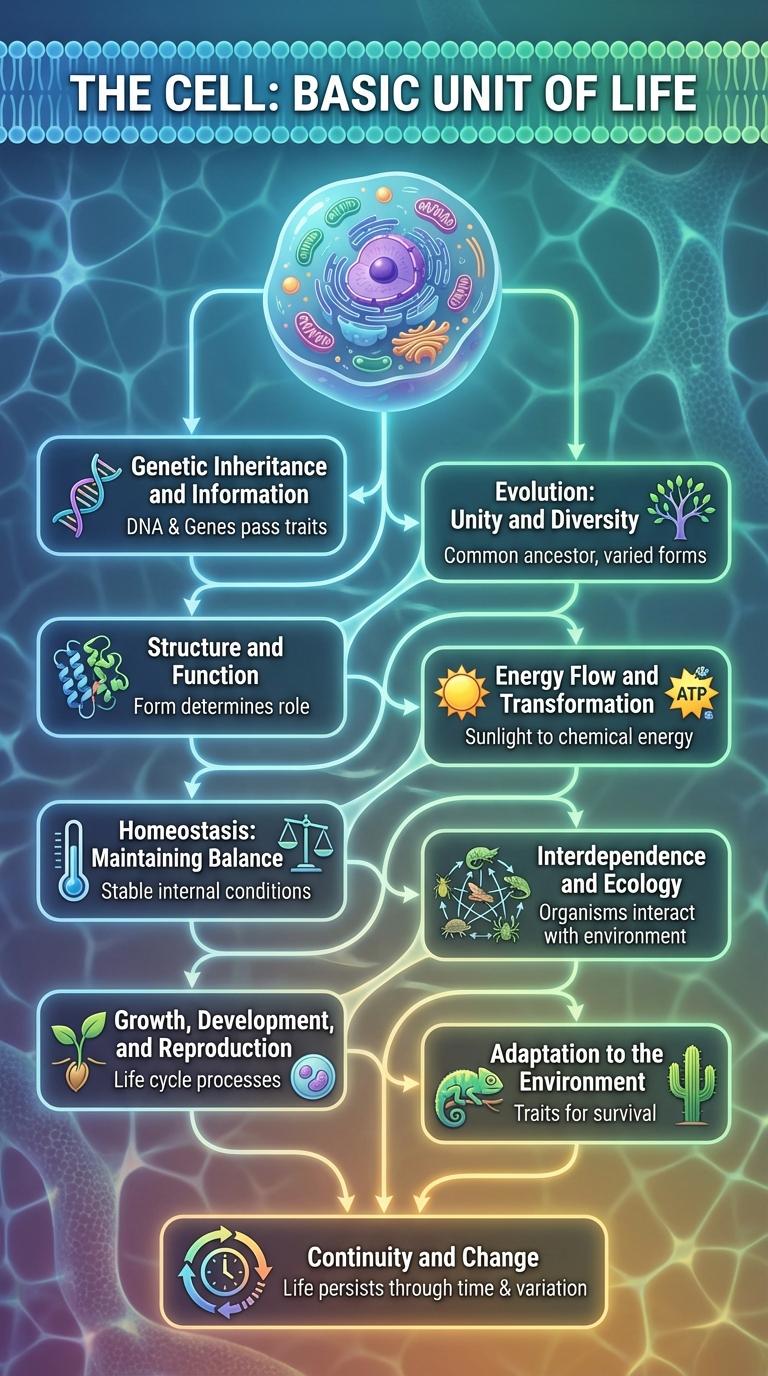
Infographics about the unifying themes of life visually highlight common patterns and principles that connect all living organisms. They emphasize concepts such as evolution, energy flow, and genetic information that unify the diversity of life on Earth. This visual approach enhances understanding by distilling complex biological ideas into clear and engaging graphics.
The Cell: Basic Unit of Life
What defines the cell as the basic unit of life? Every living organism is composed of cells, which carry out essential functions necessary for survival. Cells provide structure, energy processing, and reproduction at the most fundamental level.
How do cells maintain life processes effectively? Cellular components like the nucleus, mitochondria, and membranes ensure efficient control, energy production, and protection. This organization allows cells to sustain life and facilitate growth and repair.
Genetic Inheritance and Information
| Unifying Theme | Genetic Inheritance and Information |
|---|---|
| Definition | Transmission of genetic material from parent to offspring, carrying hereditary information. |
| Key Molecule | DNA (Deoxyribonucleic Acid) stores and transmits genetic instructions. |
| Role in Life | Controls development, functioning, growth, and reproduction of all living organisms. |
| Mechanism | Gene expression through transcription and translation creates proteins essential for life processes. |
| Evolutionary Impact | Genetic variation drives natural selection and adaptation across generations. |
Evolution: Unity and Diversity
Evolution explains the unity and diversity of life by tracing common ancestry and the adaptation of species over time. This process highlights the shared traits among organisms and the vast variety of life forms present on Earth.
- Common Ancestry - All living organisms descend from a shared ancestor, reflecting unity in life's origin.
- Genetic Variation - Differences in DNA sequences among populations drive diversity within and across species.
- Natural Selection - Environmental pressures select for traits that enhance survival, promoting both adaptation and species divergence.
Structure and Function
Life's unifying themes highlight how structure and function are intrinsically linked across all organisms. The specific design of a biological structure directly influences its role and efficiency.
For example, red blood cells have a biconcave shape that maximizes oxygen transport. Similarly, the leaf's broad surface area enhances photosynthesis by capturing more sunlight.
Energy Flow and Transformation
Energy flow and transformation are fundamental unifying themes of life, driving all biological processes. Organisms capture, convert, and use energy to maintain order, grow, and reproduce. This continuous exchange ensures ecosystems remain dynamic and balanced through various energy pathways.
Homeostasis: Maintaining Balance
Homeostasis is the process by which living organisms maintain a stable internal environment despite external changes. It involves regulating factors such as temperature, pH, and water balance to ensure optimal functioning of cells and organs. This balance is essential for survival, allowing organisms to adapt and thrive in diverse conditions.
Interdependence and Ecology
Life is a complex web of connections, where every organism relies on others for survival. Understanding interdependence and ecology reveals how species and environments maintain balance on Earth.
- Interdependence of Species - All living organisms rely on each other for food, shelter, and reproduction, forming intricate biological networks.
- Ecological Systems - Ecosystems are dynamic communities that include plants, animals, microorganisms, and their physical environment interacting as one unit.
- Impact of Human Activity - Human actions can disrupt ecological balance, impacting biodiversity and the sustainability of life-supporting systems.
Preserving interdependence and ecological integrity is essential for maintaining life's diversity and resilience.
Growth, Development, and Reproduction
Life is characterized by continuous growth, development, and reproduction, which are essential themes unifying all living organisms. These processes ensure survival, adaptation, and the perpetuation of species.
Growth involves the increase in size and number of cells, leading to physical expansion. Development refers to the physiological and functional changes during an organism's life cycle. Reproduction enables the transfer of genetic information to offspring, sustaining biodiversity and evolution.
Adaptation to the Environment
Adaptation to the environment is a fundamental theme of life, enabling organisms to survive and thrive in changing conditions. It involves genetic, behavioral, and physiological changes that enhance an organism's ability to cope with its surroundings.
Species develop adaptations through natural selection, where beneficial traits increase reproductive success. These adaptations ensure biodiversity and ecological balance by allowing life to persist across diverse habitats.