
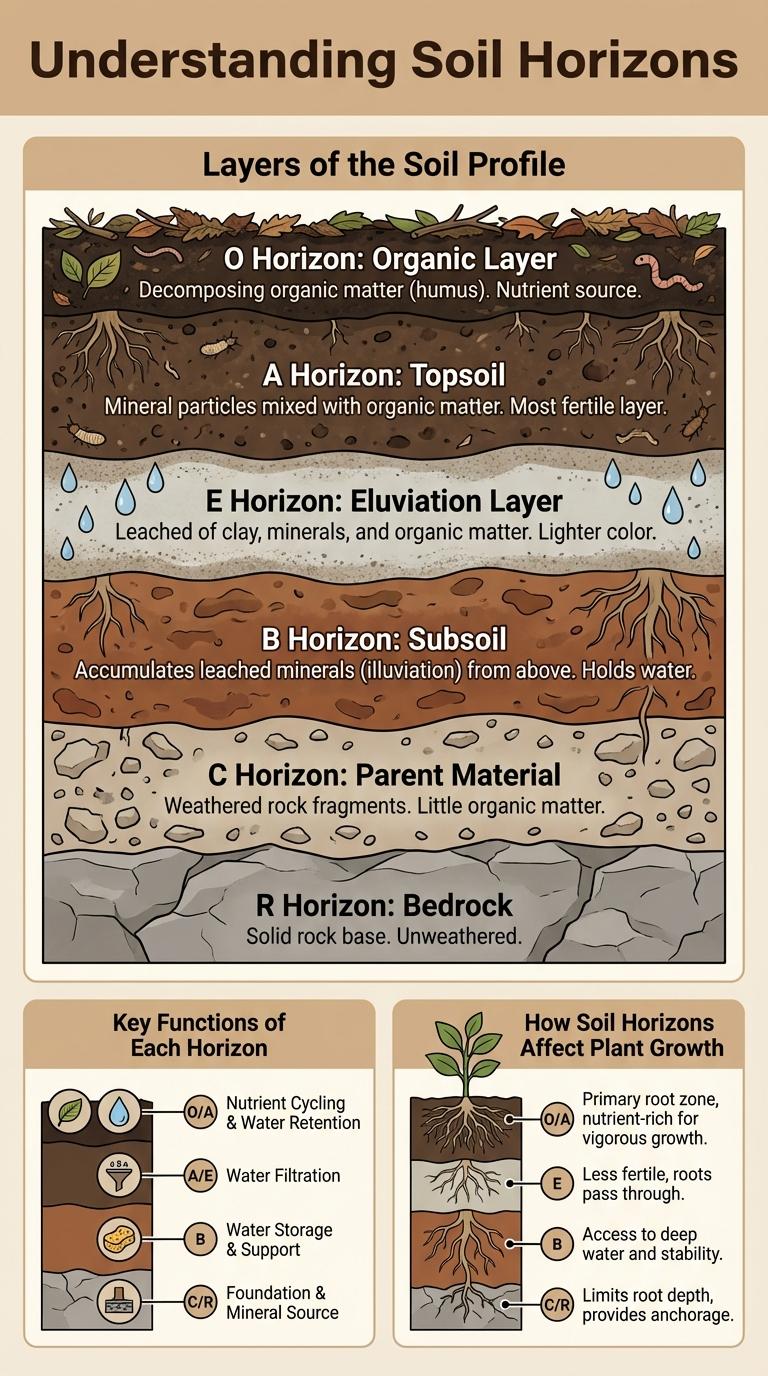
Soil horizons reveal the distinct layers within the soil profile, each varying in texture, composition, and color. These layers play a critical role in supporting plant growth, water retention, and nutrient cycling essential for ecosystems. Understanding soil horizons provides valuable insights into soil health and environmental conditions.
Understanding Soil Horizons
What are soil horizons and why are they important? Soil horizons are distinct layers of soil that differ in color, texture, and composition. These layers provide critical information about soil health, fertility, and the environment.
How many main soil horizons exist? There are typically five primary soil horizons labeled O, A, E, B, and C. Each horizon represents a specific stage in soil formation and nutrient cycling.
| Soil Horizon | Description |
|---|---|
| O Horizon | Organic layer rich in decomposed material like leaves and plants. |
| A Horizon | Topsoil containing minerals mixed with organic matter, crucial for plant roots. |
| E Horizon | Eluviation layer where minerals and nutrients are leached out. |
| B Horizon | Subsoil accumulating leached materials like clay, iron, and organic compounds. |
| C Horizon | Partially weathered parent rock material with minimal organic content. |
What factors influence the formation of soil horizons? Climate, organisms, parent material, topography, and time shape the characteristics of soil horizons. Understanding these factors helps in soil conservation and land management.
How can knowledge of soil horizons benefit agriculture? Identifying soil horizons allows for optimized crop selection, improved nutrient management, and enhanced soil conservation techniques. This knowledge supports sustainable farming practices and higher yields.
Layers of the Soil Profile
The soil profile consists of distinct layers called soil horizons, each with unique physical and chemical properties. Understanding these horizons aids in soil management and ecological studies.
- O Horizon - Composed primarily of organic matter such as decomposed leaves and plants.
- A Horizon - Known as topsoil, rich in minerals and nutrients essential for plant growth.
- B Horizon - Subsoil layer that accumulates leached materials like clay, iron, and aluminum from upper layers.
The O Horizon: Organic Layer
The O Horizon, known as the organic layer, consists primarily of decomposed leaves, plants, and other organic matter. It plays a crucial role in nutrient cycling and supports soil fertility by providing essential nutrients to lower layers. This horizon is typically dark in color and found on the soil surface in forested and grassland ecosystems.
The A Horizon: Topsoil
The A Horizon, commonly known as topsoil, is the uppermost layer of soil. It is rich in organic material and nutrients essential for plant growth.
This horizon contains a mix of minerals, decomposed organic matter, and microorganisms. Its dark color reflects the high concentration of humus, which improves soil fertility and structure.
The E Horizon: Eluviation Layer
The E Horizon, also known as the eluviation layer, is a soil stratum characterized by the leaching of minerals and organic matter. This horizon appears lighter in color due to the removal of clay, iron, or aluminum oxides.
- Leaching Process - The E Horizon undergoes eluviation, where water removes soluble substances and fine particles.
- Color Characteristics - Typically lighter or ashy gray compared to other soil horizons due to mineral loss.
- Position in Soil Profile - Found below the A Horizon and above the B Horizon, acting as a transitional layer.
The E Horizon plays a crucial role in the soil formation process by redistributing essential nutrients and minerals within the soil profile.
The B Horizon: Subsoil
The B Horizon, commonly known as the subsoil, lies beneath the topsoil (A Horizon) and above the parent material (C Horizon). It is characterized by the accumulation of minerals leached from the layers above.
The subsoil contains higher concentrations of clay, iron, and organic compounds compared to the A Horizon. This layer plays a crucial role in nutrient retention and water storage for plants. Its texture and composition influence root growth and soil drainage patterns significantly.
The C Horizon: Parent Material
The C Horizon, known as the parent material, consists of weathered rock and minerals that form the foundation of soil development. This layer influences the soil's texture, mineral composition, and drainage properties. Understanding the C Horizon is essential for studying soil formation and fertility management.
The R Horizon: Bedrock
The R Horizon is the deepest soil layer consisting of unweathered bedrock. It forms the foundation beneath all other soil horizons, influencing soil development and structure.
- Composed of solid rock - The R Horizon is primarily made up of hard, continuous bedrock such as granite or limestone.
- Supports upper soil layers - This layer provides the structural base for the overlying soil horizons.
- Minimal biological activity - Due to its density and lack of air and water, the R Horizon lacks roots, organisms, and organic material.