
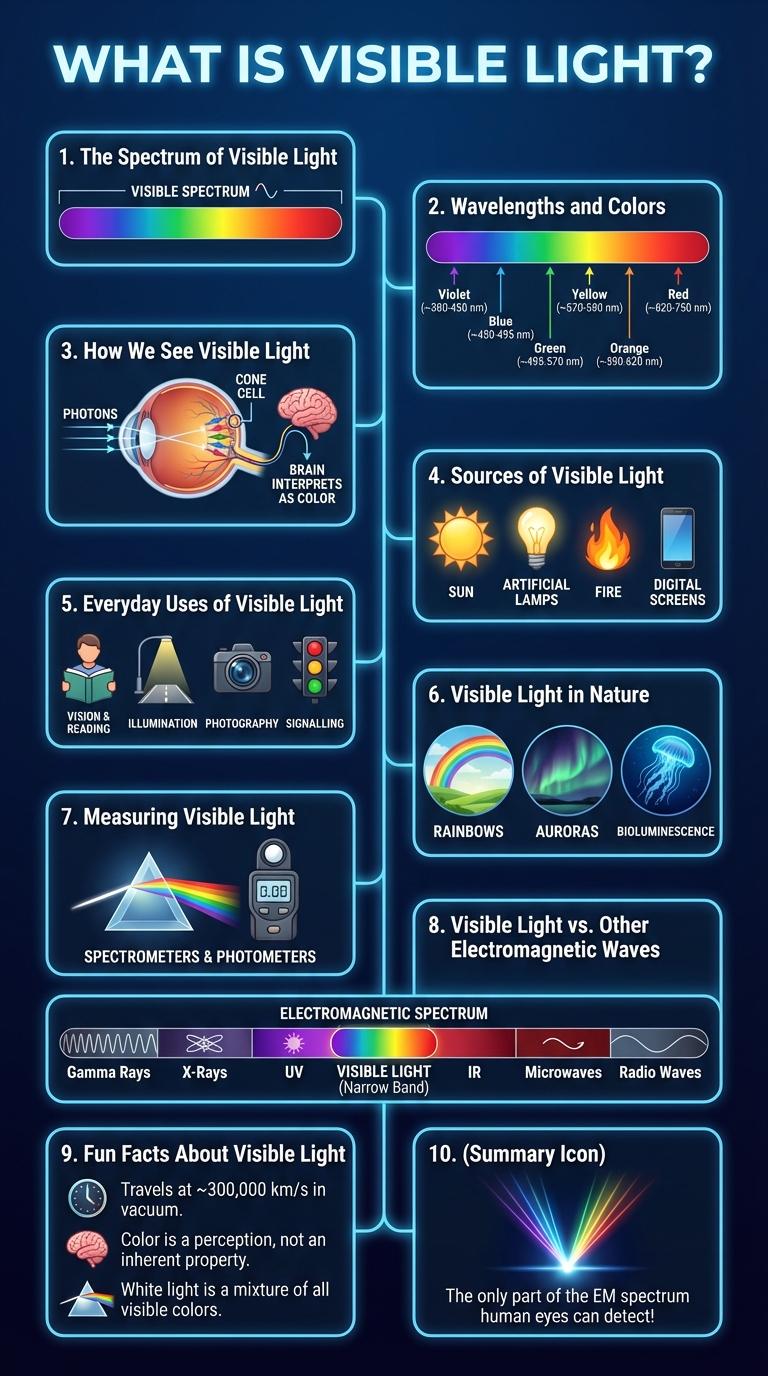
Visible light encompasses the range of electromagnetic waves detectable by the human eye, spanning wavelengths approximately from 400 to 700 nanometers. This spectrum includes all the colors visible to us, from violet through red, each with unique properties influencing its perception and application. Understanding visible light is essential for fields such as optics, photography, and visual arts, where color accuracy and light behavior play a crucial role.
What Is Visible Light?
Visible light is the portion of the electromagnetic spectrum that can be detected by the human eye. It ranges in wavelength from approximately 380 to 750 nanometers.
- Wavelength Range - Visible light includes wavelengths between 380 nm (violet) and 750 nm (red).
- Color Perception - The human eye perceives different wavelengths as distinct colors forming the visible spectrum.
- Energy Levels - Visible light photons carry energy that varies inversely with wavelength, impacting its interaction with matter.
Visible light enables humans to see and interpret the world through color and brightness.
The Spectrum of Visible Light
The spectrum of visible light ranges from approximately 380 nanometers to 750 nanometers in wavelength. It includes distinct colors such as violet, blue, green, yellow, orange, and red, each corresponding to specific wavelength ranges. Human eyes perceive these wavelengths as different colors, forming the basis for all visible imagery.
Wavelengths and Colors
Visible light consists of electromagnetic waves with wavelengths ranging from approximately 380 to 750 nanometers. Each wavelength corresponds to a specific color perceived by the human eye, from violet at the shortest wavelengths to red at the longest. This spectrum includes colors such as blue, green, yellow, orange, and red, forming the familiar rainbow sequence.
How We See Visible Light
| Step | Description |
|---|---|
| 1. Light Source | Visible light originates from natural sources like the Sun or artificial sources such as LEDs and bulbs. |
| 2. Light Enters Eye | Light passes through the cornea and pupil, regulating the amount entering the eye based on intensity. |
| 3. Lens Focuses Light | The eye's lens adjusts shape to focus light rays precisely onto the retina at the eye's back. |
| 4. Retina Converts Light to Signals | Photoreceptor cells (rods and cones) in the retina convert light into electrical impulses. |
| 5. Brain Processes Signals | The optic nerve transmits electrical signals to the visual cortex, where the brain interprets them as images. |
Sources of Visible Light
What are the primary sources of visible light? Visible light is emitted by natural and artificial sources, enabling human vision. Sunlight is the most significant natural source, while light bulbs are common artificial sources.
Everyday Uses of Visible Light
Visible light is the portion of the electromagnetic spectrum that the human eye can detect. It plays a crucial role in daily life by enabling us to see and interpret our surroundings.
Everyday uses of visible light include lighting homes and workplaces with LED and fluorescent bulbs. It supports communication technologies such as fiber optics, which use light signals to transmit data. In healthcare, visible light assists in diagnostic imaging and phototherapy, enhancing patient care.
Visible Light in Nature
Visible light is the portion of the electromagnetic spectrum that human eyes can detect. It ranges from approximately 400 to 700 nanometers in wavelength, encompassing all the colors we perceive.
In nature, visible light plays a crucial role in processes such as photosynthesis, enabling plants to convert sunlight into energy. It also influences animal behavior, from navigation to communication through color signals.
Measuring Visible Light
Visible light is the portion of the electromagnetic spectrum detectable by the human eye, ranging from approximately 380 to 750 nanometers in wavelength. Measuring visible light involves quantifying its intensity and spectral composition using specialized instruments.
Photometers and spectroradiometers are commonly used devices for measuring visible light. Photometers measure the luminous intensity in units of lumens or lux, while spectroradiometers provide detailed spectral data across different wavelengths.
Visible Light vs. Other Electromagnetic Waves
Visible light is the portion of the electromagnetic spectrum that human eyes can detect. It ranges in wavelength from approximately 400 to 700 nanometers, sitting between ultraviolet and infrared waves.
- Wavelength Range - Visible light spans from about 400 nm (violet) to 700 nm (red), shorter than infrared and longer than ultraviolet waves.
- Energy Levels - Visible light photons carry more energy than infrared but less than ultraviolet radiation.
- Applications - Visible light enables human vision and is widely used in photography, illumination, and optical communication.