
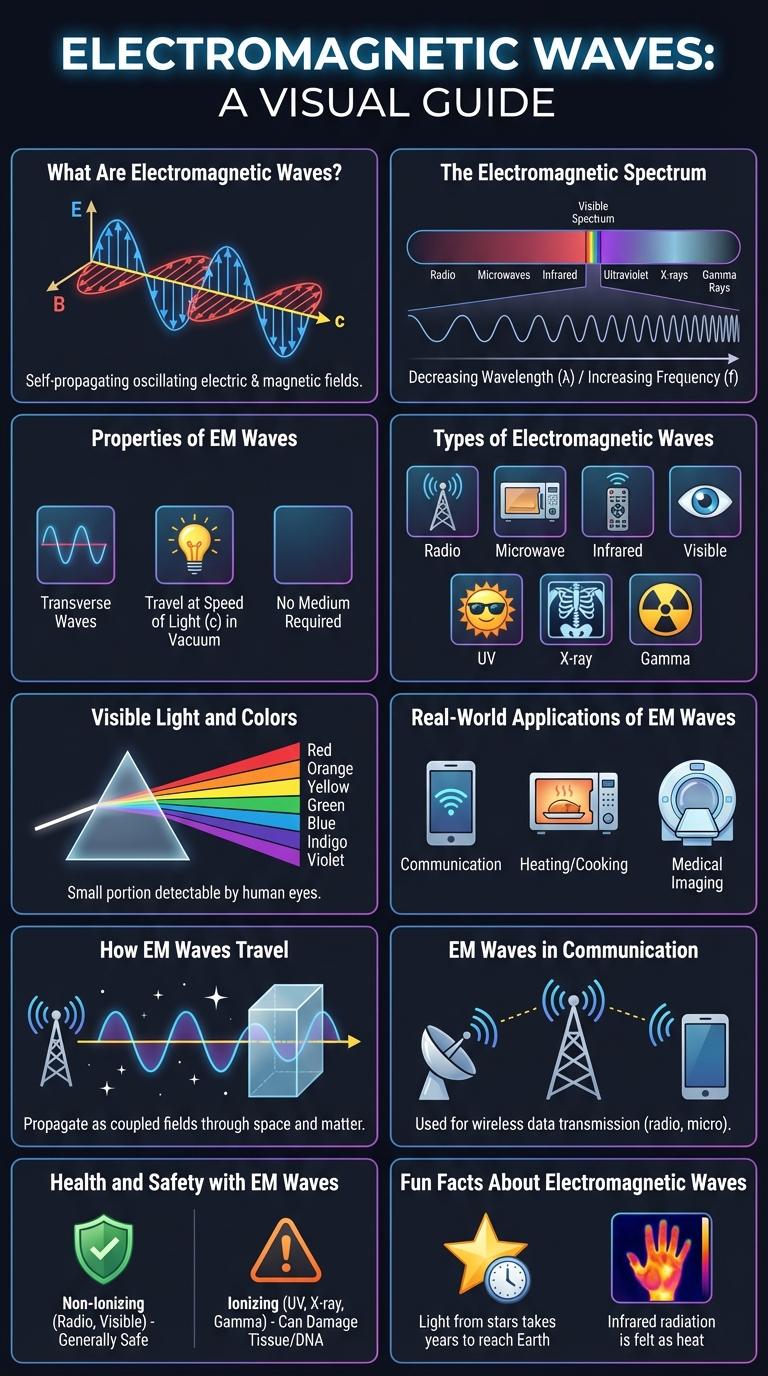
Electromagnetic waves are energy waves that travel through space at the speed of light, carrying electrical and magnetic fields oscillating perpendicular to each other. They encompass a broad spectrum, including radio waves, microwaves, infrared, visible light, ultraviolet, X-rays, and gamma rays, each with distinct wavelengths and frequencies. Understanding these waves is crucial for applications in communication, medical imaging, and everyday technology.
What Are Electromagnetic Waves?
What are electromagnetic waves? Electromagnetic waves are waves of energy that propagate through space at the speed of light. They consist of oscillating electric and magnetic fields perpendicular to each other.
The Electromagnetic Spectrum
The electromagnetic spectrum encompasses all types of electromagnetic radiation, ranging from low-frequency radio waves to high-frequency gamma rays. Each type of wave varies in wavelength and energy, influencing its applications in technology and science. Understanding the spectrum helps in utilizing waves for communication, medical imaging, and more.
| Type of EM Wave | Wavelength Range |
|---|---|
| Radio Waves | > 1 meter |
| Microwaves | 1 meter - 1 millimeter |
| Visible Light | 400-700 nanometers |
| Ultraviolet | 10-400 nanometers |
| X-rays & Gamma Rays | < 10 nanometers |
Properties of EM Waves
Electromagnetic (EM) waves are oscillations of electric and magnetic fields that travel through space carrying energy. They exhibit unique properties that differentiate them from other wave types.
- Transverse Nature - EM waves oscillate perpendicular to the direction of wave propagation.
- Speed in Vacuum - EM waves travel at the speed of light, approximately 299,792 kilometers per second.
- No Medium Required - EM waves can propagate through the vacuum of space without needing a physical medium.
These properties enable EM waves to play a crucial role in communication, medical imaging, and various scientific applications.
Types of Electromagnetic Waves
Electromagnetic waves are energy waves that travel through space at the speed of light. They consist of oscillating electric and magnetic fields perpendicular to each other.
There are several types of electromagnetic waves, each differing in wavelength and frequency. These types form the electromagnetic spectrum, ranging from very long radio waves to extremely short gamma rays.
| Type | Wavelength Range |
|---|---|
| Radio Waves | > 1 meter |
| Microwaves | 1 mm to 1 meter |
| Infrared | 700 nm to 1 mm |
| Visible Light | 400 nm to 700 nm |
| Ultraviolet, X-rays, Gamma Rays | < 400 nm |
Visible Light and Colors
Electromagnetic waves encompass a spectrum of energies, among which visible light is the portion perceptible to the human eye. Visible light is responsible for the colors we see in the world around us.
Visible light ranges from approximately 400 to 700 nanometers in wavelength. Each wavelength corresponds to a different color, from violet at the shortest wavelengths to red at the longest. When light interacts with objects, it can be absorbed, reflected, or transmitted, producing the colors perceived by the observer.
Real-World Applications of EM Waves
Electromagnetic (EM) waves play a crucial role in modern technology, enabling wireless communication through radio and microwave signals. Medical imaging techniques such as X-rays and MRI scans utilize specific EM wave frequencies to visualize the human body's internal structures. Solar panels convert sunlight, a form of EM radiation, into electrical energy, supporting renewable energy solutions worldwide.
How EM Waves Travel
| Wave Type | Travel Mechanism |
| Radio Waves | Propagation through atmosphere, reflect off ionosphere |
| Microwaves | Line-of-sight transmission, penetrate clouds and fog |
| Infrared Waves | Radiate heat energy, absorbed and emitted by objects |
| Visible Light | Travel in straight lines through transparent media |
| X-rays & Gamma Rays | Penetrate materials, attenuated by dense substances |
EM Waves in Communication
Electromagnetic waves are fundamental to modern communication systems, enabling data transmission over long distances without physical connections. These waves carry information through various frequencies, facilitating wireless communication, broadcasting, and satellite links.
- Radio Waves - Used for AM/FM radio broadcasting, cellular phones, and Wi-Fi networks due to their long wavelength and ability to travel through obstacles.
- Microwaves - Essential for satellite communications, radar systems, and point-to-point telecommunication links because of their high frequency and directional propagation.
- Infrared Waves - Employed in remote controls and short-range wireless communication, offering secure data transfer within limited distances.
Health and Safety with EM Waves
Electromagnetic (EM) waves are present in various forms such as radio waves, microwaves, and X-rays, impacting daily life. Understanding health and safety measures related to EM waves is crucial to minimize risks and protect well-being.
Exposure to high levels of EM waves can cause tissue damage and increase cancer risk according to scientific studies.
- Low-frequency EM waves are generally safe - They produce non-ionizing radiation that does not damage DNA.
- High-frequency EM waves require caution - Ionizing radiation such as X-rays can lead to cellular damage and mutations.
- Regulatory standards limit exposure - Agencies set safe limits for EM wave exposure in workplaces and consumer products.