
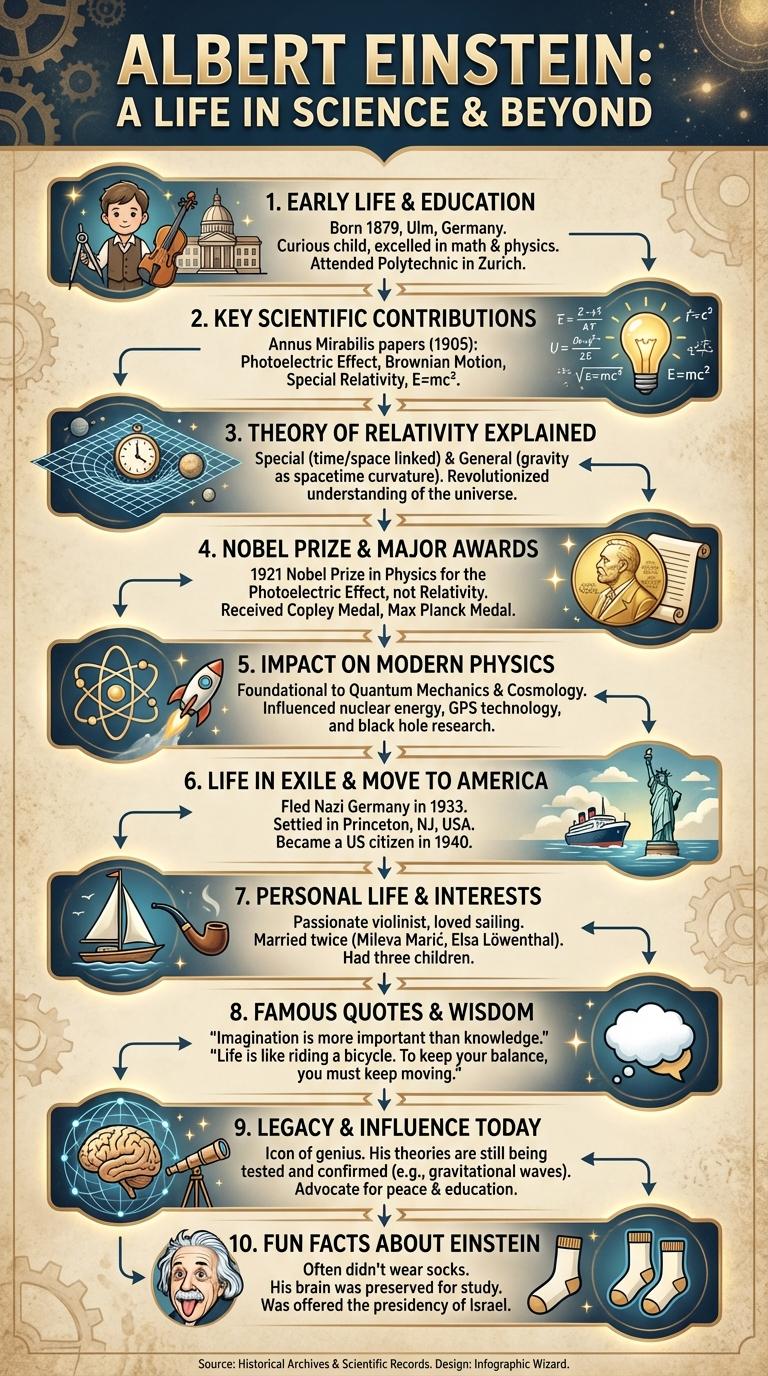
Albert Einstein revolutionized physics with his groundbreaking theories, including relativity, which reshaped our understanding of time and space. His contributions to science extend beyond equations, influencing technology and inspiring generations of researchers. This infographic highlights key milestones, discoveries, and fascinating facts about Einstein's life and legacy.
Early Life & Education
Albert Einstein was born in Ulm, Germany, in 1879. His early curiosity about science and mathematics shaped his future groundbreaking contributions.
- Birthplace and Date - Born on March 14, 1879, in Ulm, Kingdom of Wurttemberg, German Empire.
- Family Background - Raised in a secular Jewish family with a strong emphasis on education and intellectual curiosity.
- Formal Education - Attended the Luitpold Gymnasium in Munich but struggled with rigid teaching methods.
- Higher Studies - Enrolled at the Swiss Federal Polytechnic School in Zurich in 1896 to study physics and mathematics.
- Early Interests - Developed a deep interest in theoretical physics and philosophical reflection during his education.
Key Scientific Contributions
Albert Einstein revolutionized physics with his theory of relativity, which introduced the concept that time and space are interconnected. His famous equation, E=mc2, showed the relationship between mass and energy, laying the foundation for modern nuclear physics.
Einstein also made significant contributions to quantum theory, explaining the photoelectric effect that demonstrated light's particle properties. His work earned him the Nobel Prize in Physics in 1921, highlighting his impact on both theoretical and experimental science.
Theory of Relativity Explained
The Theory of Relativity, developed by Albert Einstein, revolutionized our understanding of space, time, and gravity. It consists of two parts: Special Relativity, which addresses objects moving at constant high speeds, and General Relativity, which explains gravity as the curvature of spacetime caused by mass. This theory has critical applications in modern physics, including GPS technology and black hole research.
Nobel Prize & Major Awards
Albert Einstein received the Nobel Prize in Physics in 1921 for his discovery of the photoelectric effect, a pivotal step in quantum theory. Throughout his lifetime, he earned numerous major awards, including the Copley Medal in 1925 and the Max Planck Medal in 1929. His scientific contributions continue to influence physics and award recognitions worldwide.
Impact on Modern Physics
Albert Einstein revolutionized modern physics with his theories of relativity and contributions to quantum mechanics. His work fundamentally changed the understanding of space, time, and energy.
- Theory of Relativity - Introduced concepts of special and general relativity that reshaped physics by describing the relationship between space, time, and gravity.
- Photoelectric Effect - Explained the particle nature of light, providing critical evidence for quantum theory and earning him the Nobel Prize in Physics.
- Mass-Energy Equivalence - The famous equation E=mc2 showed that mass and energy are interchangeable, influencing nuclear physics and energy research.
Einstein's scientific legacy continues to influence modern physics, technology, and cosmology today.
Life in Exile & Move to America
Albert Einstein's life in exile began with his escape from Nazi Germany due to his Jewish heritage and outspoken political views. Relocating to America, he continued his scientific work while advocating for peace and civil rights.
- Fleeing Nazi Persecution - Einstein left Germany in 1933 as the Nazi regime targeted Jews and intellectuals.
- Settlement in Princeton - He accepted a position at the Institute for Advanced Study in Princeton, New Jersey, where he worked until his death.
- American Citizenship - Einstein became a U.S. citizen in 1940, fully embracing his new country while influencing American science and politics.
Personal Life & Interests
Albert Einstein was born in Ulm, Germany, in 1879 and developed an early fascination with mathematics and physics. He married Mileva Maric in 1903, and they had two sons before their eventual separation.
Einstein enjoyed playing the violin, which he considered a key part of his creative process. He was deeply interested in philosophy and often corresponded with leading thinkers of his time. His passions extended to humanitarian causes, advocating for peace and civil rights throughout his life.
Famous Quotes & Wisdom
| Famous Quote | Wisdom Insight |
|---|---|
| "Imagination is more important than knowledge." | Creativity drives innovation beyond factual learning. |
| "Life is like riding a bicycle. To keep your balance, you must keep moving." | Persistence is essential to maintaining progress and stability. |
| "Insanity is doing the same thing over and over again and expecting different results." | Change and adaptation are necessary for success. |
| "Try not to become a man of success, but rather try to become a man of value." | Focus on contributing meaningfully rather than just pursuing wealth or fame. |
| "The important thing is not to stop questioning." | Curiosity fuels learning and discovery throughout life. |
Legacy & Influence Today
What is Albert Einstein's legacy in the modern world? Albert Einstein revolutionized physics with his theory of relativity, fundamentally changing our understanding of space, time, and gravity. His groundbreaking work continues to influence scientific research and technological advancements today.
How does Einstein's influence manifest in today's technology? Einstein's theories underpin the development of GPS systems, ensuring accurate location tracking by accounting for time dilation effects. His contributions also paved the way for innovations in quantum mechanics and nuclear energy.
In what ways does Einstein inspire current scientific thought? Einstein's curiosity and emphasis on questioning established norms motivate physicists and researchers worldwide. His approach to problem-solving fosters innovation and critical thinking across various scientific disciplines.
Why is Einstein considered a cultural icon beyond science? Einstein symbolizes intellectual freedom and creativity, inspiring education, art, and popular culture. His image and quotes remain powerful tools for promoting curiosity and perseverance.
How is Einstein's legacy preserved and celebrated today? Numerous institutions, awards, and scholarships honor his contributions to science. Museums and educational programs worldwide continue to engage new generations in exploring his groundbreaking ideas.