
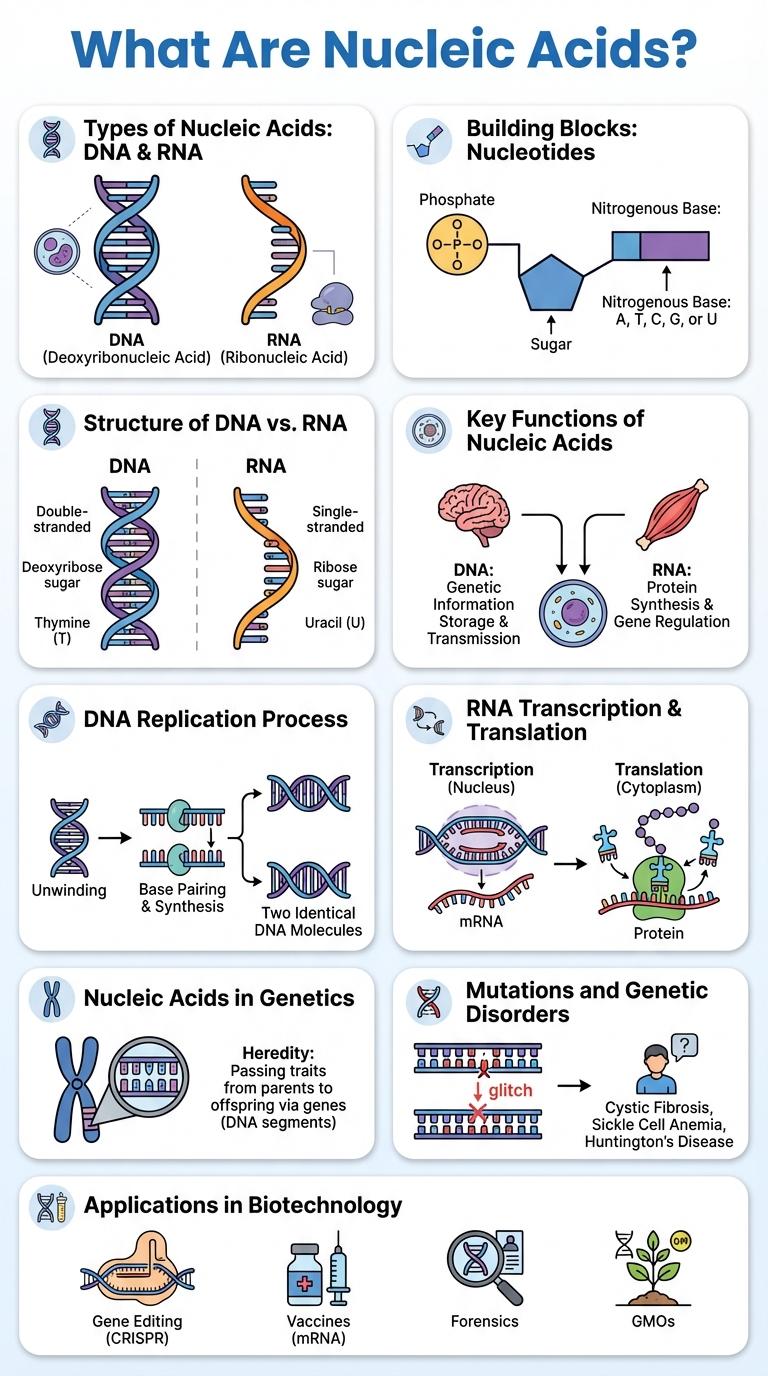
Nucleic acids are essential biomolecules responsible for storing and transmitting genetic information in all living organisms. DNA and RNA, the two primary types, play crucial roles in cellular processes such as replication, transcription, and protein synthesis. Understanding their structure and function provides key insights into genetics, molecular biology, and biotechnology advancements.
What Are Nucleic Acids?
Nucleic acids are biomolecules essential for storing and transmitting genetic information. They play a critical role in the synthesis of proteins and the regulation of cellular activities.
- DNA (Deoxyribonucleic Acid) - Contains the genetic blueprint for organism development and function.
- RNA (Ribonucleic Acid) - Acts as a messenger carrying instructions from DNA for protein synthesis.
- Nucleotide Units - Building blocks of nucleic acids composed of a sugar, phosphate group, and nitrogenous base.
Nucleic acids are fundamental molecules in all living cells, enabling heredity and biochemical processes.
Types of Nucleic Acids: DNA & RNA
| Type of Nucleic Acid | Key Characteristics |
|---|---|
| DNA (Deoxyribonucleic Acid) |
|
| RNA (Ribonucleic Acid) |
|
Building Blocks: Nucleotides
Nucleic acids, including DNA and RNA, are essential biomolecules responsible for storing and transmitting genetic information. Their fundamental building blocks are nucleotides, which consist of three components.
Each nucleotide is composed of a phosphate group, a five-carbon sugar, and a nitrogenous base. Variations in the nitrogenous bases define the nucleotide types and their role in genetic coding.
Structure of DNA vs. RNA
Nucleic acids, DNA and RNA, are essential biomolecules that store and transmit genetic information. Both molecules consist of nucleotides but differ in structure and function.
DNA is a double-stranded helix with a sugar-phosphate backbone and nitrogenous bases adenine, thymine, cytosine, and guanine. RNA is typically single-stranded and contains ribose sugar instead of deoxyribose. RNA uses uracil in place of thymine, making its base pairing distinct from DNA.
Key Functions of Nucleic Acids
What are the primary roles of nucleic acids in living organisms? Nucleic acids, including DNA and RNA, store and transmit genetic information essential for cell function and reproduction. They also guide protein synthesis, ensuring proper cellular activities and organism development.
| Key Function | Description |
|---|---|
| Genetic Information Storage | DNA holds hereditary instructions for organism traits and cell operation. |
| Protein Synthesis | RNA translates genetic codes into proteins necessary for cellular processes. |
| Gene Expression Regulation | Certain RNA molecules control gene activity and expression levels. |
| Transmission of Genetic Material | DNA replicates to pass genetic information during cell division. |
| Supporting Cellular Metabolism | RNA participates in enzymatic functions critical for metabolism. |
DNA Replication Process
DNA replication is a vital process that ensures genetic information is accurately copied before cell division. This highly coordinated mechanism involves multiple enzymes working together to create two identical DNA molecules from one original strand.
- Initiation - DNA helicase unwinds the double helix, creating replication forks where the process begins.
- Elongation - DNA polymerase synthesizes new complementary strands by adding nucleotides to the existing template strands.
- Termination - Replication ends when DNA polymerase reaches the end of the strand, resulting in two identical DNA molecules.
RNA Transcription & Translation
Nucleic acids are essential biomolecules that store and transmit genetic information. RNA plays a crucial role in translating genetic codes into functional proteins.
RNA transcription involves copying a DNA sequence into messenger RNA (mRNA). Translation occurs when mRNA is decoded by ribosomes to synthesize proteins from amino acids.
Nucleic Acids in Genetics
Nucleic acids, primarily DNA and RNA, are essential molecules that encode genetic information in living organisms. DNA stores hereditary instructions, while RNA translates these instructions into proteins, driving cellular functions. Understanding nucleic acids is crucial for genetic research, diagnostics, and biotechnology advancements.
Mutations and Genetic Disorders
Nucleic acids store and transmit genetic information essential for cellular function. Mutations in nucleic acid sequences can lead to various genetic disorders by altering protein production.
- Point mutations - Single nucleotide changes that can disrupt gene function and cause diseases like sickle cell anemia.
- Insertions and deletions - Additions or losses of nucleotides that can result in frameshift mutations, often leading to severe genetic disorders.
- Chromosomal mutations - Large-scale changes such as duplications or translocations that contribute to complex conditions like Down syndrome.