
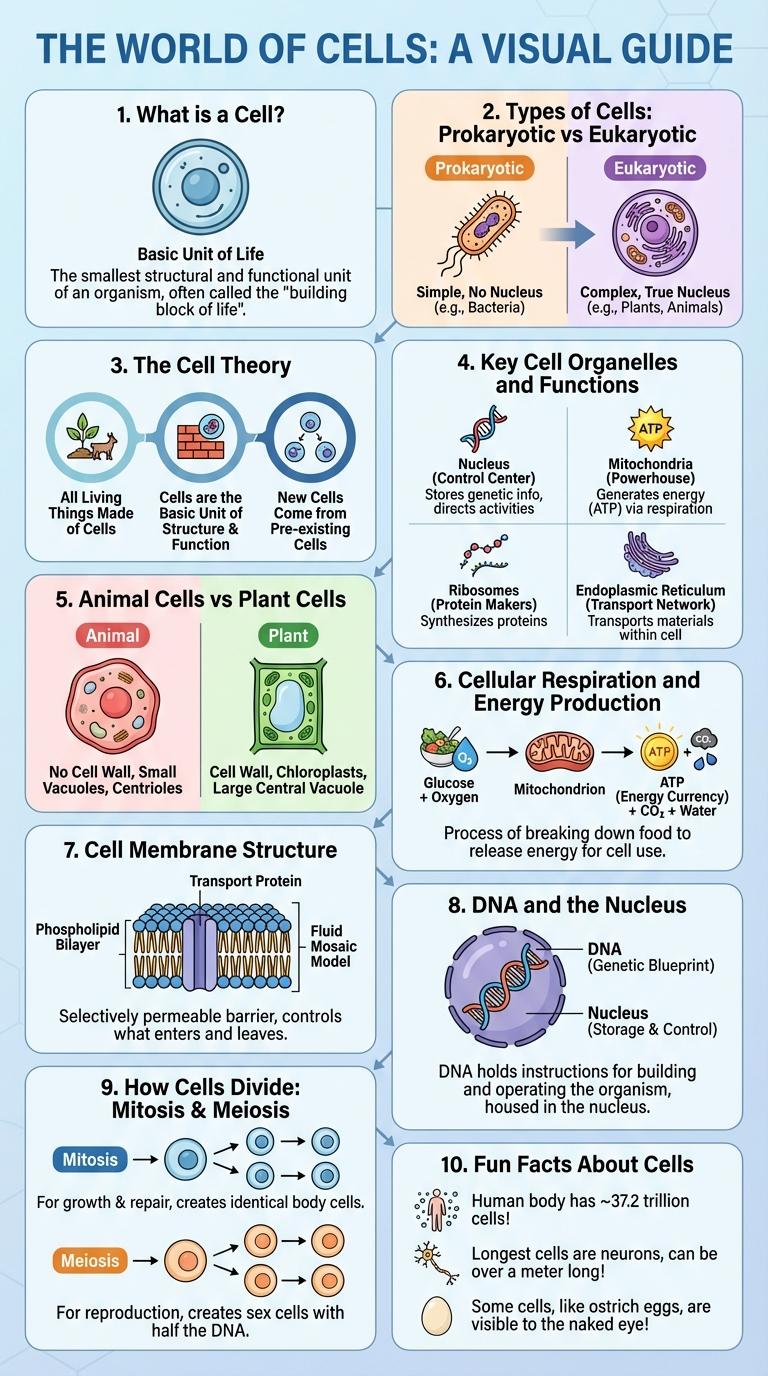
Cells are the fundamental units of life, each performing vital functions that sustain organisms. This infographic visually breaks down the complex structure and roles of cell components, from the nucleus to the mitochondria. Understanding these parts clarifies how cells maintain life processes and support growth, repair, and energy production.
What is a Cell?
A cell is the basic structural and functional unit of all living organisms. It is the smallest unit capable of independent life and performs essential processes such as energy production, waste elimination, and reproduction. Cells contain specialized components called organelles that carry out specific tasks to maintain cellular health and function.
Types of Cells: Prokaryotic vs Eukaryotic
Cells are the basic structural and functional units of all living organisms. They are broadly classified into prokaryotic and eukaryotic types based on their complexity and organization.
- Prokaryotic Cells - These cells lack a true nucleus and membrane-bound organelles.
- Eukaryotic Cells - These cells have a defined nucleus and specialized organelles enclosed by membranes.
- Genetic Material - Prokaryotic DNA is circular and floats freely in the cytoplasm, while eukaryotic DNA is linear and contained within the nucleus.
The Cell Theory
The Cell Theory is a fundamental principle in biology that describes the properties of cells. It states that all living organisms are composed of one or more cells.
Cells are the basic unit of structure and function in organisms. New cells arise only from pre-existing cells through cell division.
Key Cell Organelles and Functions
Cells contain specialized organelles that perform essential functions for life. Key organelles include the nucleus, mitochondria, endoplasmic reticulum, Golgi apparatus, and lysosomes. Each organelle contributes to processes such as genetic information storage, energy production, protein synthesis, and waste management.
| Organelle | Function |
|---|---|
| Nucleus | Stores DNA and controls cell activities |
| Mitochondria | Generates cellular energy (ATP) through respiration |
| Endoplasmic Reticulum | Synthesizes proteins and lipids |
| Golgi Apparatus | Modifies, sorts, and packages proteins for transport |
| Lysosomes | Break down waste and cellular debris |
Animal Cells vs Plant Cells
Animal cells and plant cells are the basic building blocks of life in animals and plants, respectively. Both types of cells share common structures such as the nucleus, cytoplasm, and cell membrane.
Plant cells have unique features like a rigid cell wall, chloroplasts for photosynthesis, and large central vacuoles. Animal cells lack these structures but contain centrioles and smaller vacuoles instead.
Cellular Respiration and Energy Production
Cellular respiration is a vital process in cells that converts biochemical energy from nutrients into adenosine triphosphate (ATP). ATP serves as the main energy currency for various cellular functions and activities.
- Glycolysis - This initial stage breaks down glucose into pyruvate, producing a small amount of ATP and NADH in the cytoplasm.
- Krebs Cycle - Occurs in mitochondria, where pyruvate is further processed to generate NADH, FADH2, and ATP molecules.
- Electron Transport Chain - Uses electrons from NADH and FADH2 to create a proton gradient that drives ATP synthesis in the inner mitochondrial membrane.
Cell Membrane Structure
| Component | Description |
|---|---|
| Phospholipid Bilayer | Double layer of phospholipids with hydrophilic heads facing outwards and hydrophobic tails inward, creating a semi-permeable membrane. |
| Proteins | Integral and peripheral proteins embedded in the membrane facilitate transport, signal transduction, and structural support. |
| Cholesterol | Molecules interspersed within the bilayer that maintain fluidity and stability across temperature variations. |
| Carbohydrates | Attached to proteins and lipids on the extracellular surface; involved in cell recognition and communication. |
| Function | Regulates substance entry and exit, protects the cell, and supports cell communication. |
DNA and the Nucleus
What is the role of DNA within the cell nucleus?
DNA contains the genetic instructions essential for cell function and development. The nucleus protects DNA and controls gene expression.
How Cells Divide: Mitosis & Meiosis
Cell division is a fundamental biological process that allows organisms to grow, repair tissues, and reproduce. Two primary types of cell division are mitosis and meiosis, each with unique roles and mechanisms.
- Mitosis Produces Identical Cells - Mitosis results in two genetically identical daughter cells for growth and tissue repair.
- Meiosis Generates Genetic Diversity - Meiosis creates four genetically distinct gametes essential for sexual reproduction.
- Phases of Mitosis and Meiosis - Both processes include stages like prophase, metaphase, anaphase, and telophase, but meiosis involves two sequential divisions.
Understanding mitosis and meiosis clarifies how organisms develop, maintain themselves, and pass genetic information to offspring.