
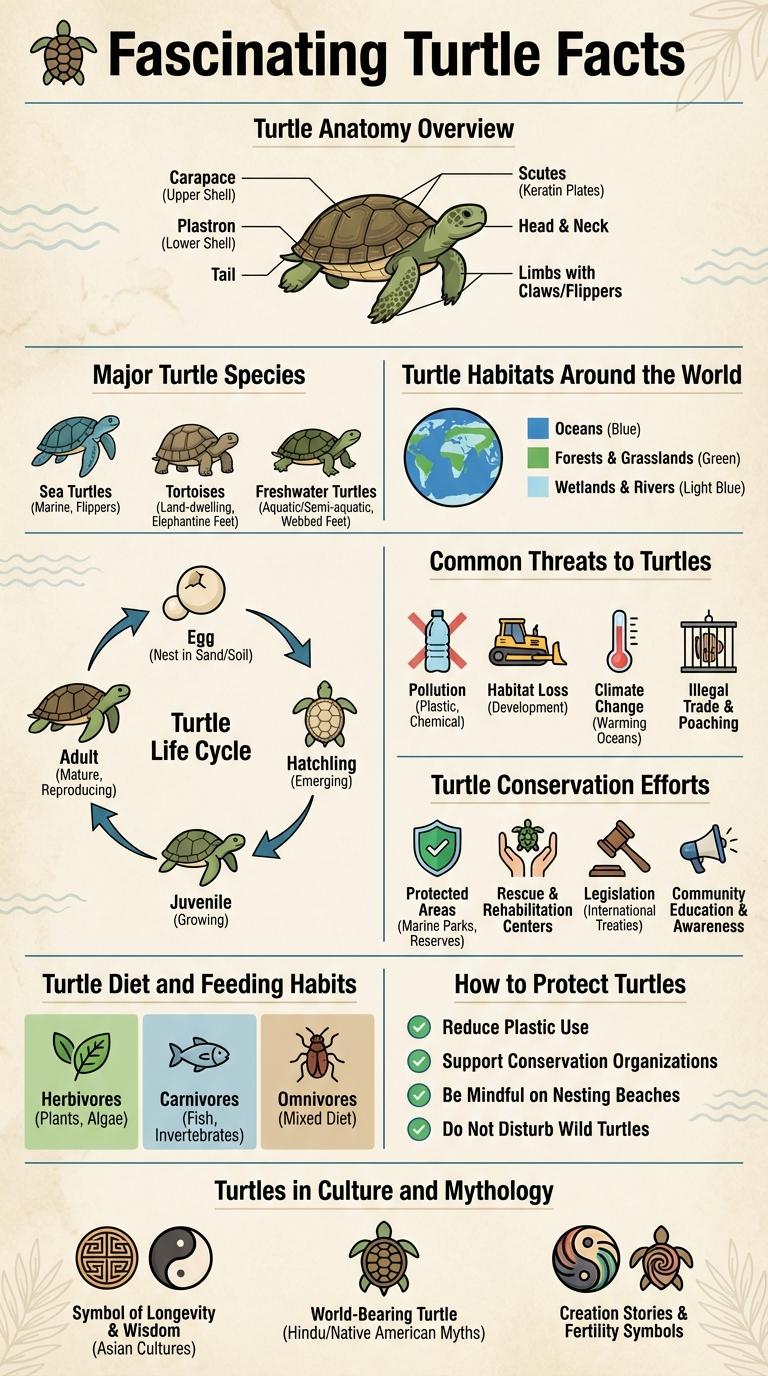
Turtles are fascinating reptiles known for their hard shells and slow movements, playing vital roles in various ecosystems. Infographics about turtles visually highlight their unique anatomy, diverse species, and conservation status, making complex facts easy to understand. Exploring these visuals can deepen appreciation for turtle behavior and the importance of protecting their habitats.
Fascinating Turtle Facts
What makes turtles unique among reptiles? Turtles are distinguished by their hard shells, which provide protection from predators. Their shells are made of bone covered by scutes formed of keratin, the same material as human nails.
How long can turtles live? Many turtle species have impressive lifespans, often exceeding 50 years. Some giant tortoises have been known to live over 150 years, making them some of the longest-living vertebrates on Earth.
Where do turtles spend most of their time? Aquatic species spend a majority of their time in water, while terrestrial turtles prefer dry land habitats. Sea turtles, for example, migrate thousands of miles between feeding grounds and nesting beaches.
What do turtles eat? Turtle diets vary widely between species, including plants, insects, fish, and even jellyfish. Their varied diet supports their adaptability across diverse environments worldwide.
How do turtles reproduce? Female turtles lay eggs on sandy beaches or in hidden nests on land. Hatchlings instinctively head to the water shortly after emerging, guided by natural light cues.
Turtle Anatomy Overview
Turtles are reptiles known for their distinctive hard shells that protect their bodies. Their anatomy is uniquely adapted for both aquatic and terrestrial environments.
- Carapace - The top part of the shell provides protection and is fused with the turtle's ribs and spine.
- Plastron - The bottom shell shields the turtle's underside and varies in shape among species.
- Limbs - Adapted for swimming or walking, turtle limbs can be webbed or clawed depending on habitat.
- Head - Equipped with a beak instead of teeth, used for feeding and defense.
- Respiratory System - Turtles have lungs but can also absorb oxygen through their skin and cloaca while submerged.
Understanding turtle anatomy highlights their evolutionary adaptations for survival in diverse ecosystems.
Major Turtle Species
Turtles are ancient reptiles with over 350 species worldwide, inhabiting diverse environments from oceans to deserts. They play vital ecological roles, such as controlling jellyfish populations and dispersing seeds.
Major turtle species include the Leatherback Sea Turtle, the largest and most migratory, and the Green Sea Turtle, known for its herbivorous diet. Freshwater species like the Red-eared Slider are common in ponds, while the Desert Tortoise adapts to arid climates.
Turtle Habitats Around the World
Turtles inhabit diverse environments across the globe, ranging from oceans to freshwater and terrestrial habitats. These resilient reptiles have adapted to thrive in various climates and ecosystems.
Marine turtles predominantly live in warm ocean waters, nesting on sandy beaches. Freshwater turtles are commonly found in rivers, lakes, and ponds worldwide. Terrestrial turtles prefer forests, grasslands, and deserts, depending on the species and geographical location.
Turtle Life Cycle
Turtles undergo a unique life cycle that begins on sandy beaches. Understanding each stage helps in conservation efforts and protecting their natural habitats.
The turtle life cycle consists of four main stages, from egg to adulthood.
- Egg Stage - Female turtles lay eggs in nests dug into the sand, which incubate for several weeks.
- Hatchling Stage - Baby turtles emerge from eggs and make a dangerous journey to the ocean.
- Juvenile Stage - Young turtles grow in the ocean, learning to find food and avoid predators.
- Adult Stage - Mature turtles return to nesting beaches to reproduce and continue the cycle.
Common Threats to Turtles
Turtles face numerous threats that endanger their survival across the globe. Many of these threats stem from human activities and environmental changes.
- Habitat Destruction - Urban development and deforestation reduce natural habitats essential for turtles' nesting and feeding.
- Pollution - Chemicals and plastic waste contaminate water bodies, causing health hazards and entanglement for turtles.
- Illegal Poaching - Turtles are captured for their shells, meat, and as pets, significantly reducing wild populations.
Turtle Conservation Efforts
| Conservation Strategy | Impact |
|---|---|
| Habitat Protection | Preserves critical nesting beaches and foraging areas, preventing habitat loss. |
| Anti-Poaching Measures | Reduces illegal hunting and trade, increasing wild turtle populations. |
| Community Engagement | Raises awareness and involves locals in monitoring and protection activities. |
| Research & Monitoring | Provides valuable data on turtle migration, reproduction, and threats for informed decisions. |
| Legislation & Policy | Enforces legal protection and international agreements like CITES to safeguard species. |
Turtle Diet and Feeding Habits
Turtles are primarily omnivores, consuming a diverse diet that includes plants, insects, and small aquatic animals. Their feeding habits vary significantly based on species and habitat.
Freshwater turtles often graze on algae and aquatic vegetation while also hunting for insects and fish. Marine turtles, like the green turtle, shift from carnivorous diets in youth to herbivorous diets as adults.
How to Protect Turtles
Protecting turtles starts with preserving their natural habitats such as beaches and wetlands. Avoid disturbing nesting sites and reduce plastic waste to prevent ingestion and entanglement. Support conservation programs and educate communities about the importance of turtle protection for ecosystem balance.