
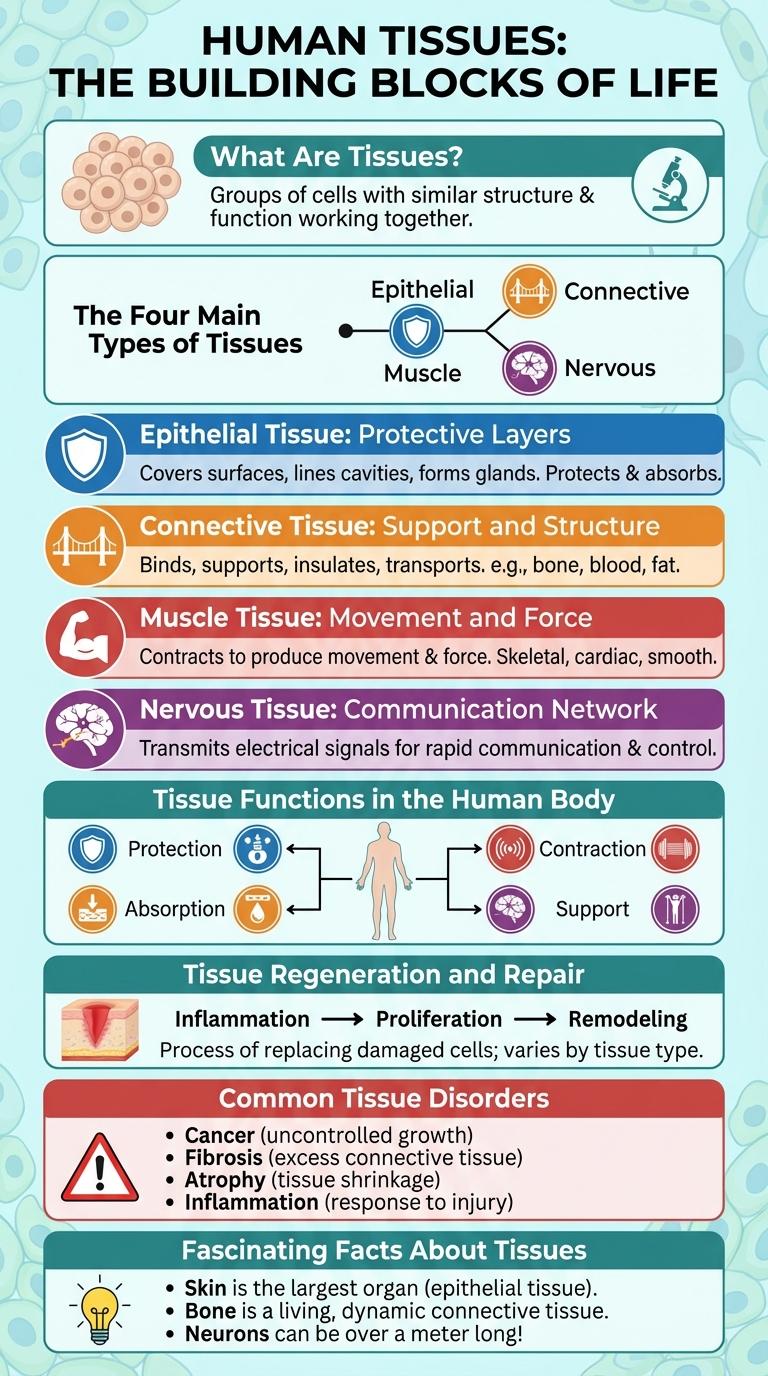
Tissues are groups of similar cells that work together to perform specific functions essential for the body's structure and support. Understanding the different types of tissues--epithelial, connective, muscle, and nervous--reveals how organs operate efficiently and maintain overall health. This infographic visually breaks down tissue types, functions, and examples to enhance comprehension.
What Are Tissues?
| What Are Tissues? | Tissues are groups of similar cells working together to perform specific functions within an organism. They are essential building blocks of organs and systems. |
|---|---|
| Types of Tissues | There are four primary tissue types: epithelial, connective, muscle, and nervous tissues, each serving unique roles. |
| Epithelial Tissue | Covers body surfaces, lines cavities, and forms glands. Functions include protection, absorption, and secretion. |
| Connective Tissue | Supports and binds other tissues. Includes bone, blood, cartilage, and adipose tissues. |
| Function Overview | Tissues collaborate to maintain homeostasis, enable movement, protect organs, and facilitate communication within the body. |
The Four Main Types of Tissues
Tissues are groups of cells that perform specific functions in the body. The four main types of tissues are epithelial, connective, muscle, and nervous tissue.
- Epithelial Tissue - Covers body surfaces and lines cavities, providing protection and absorption.
- Connective Tissue - Supports and binds other tissues, including bone, blood, and cartilage.
- Muscle Tissue - Responsible for movement through contraction, including skeletal, cardiac, and smooth muscle.
Epithelial Tissue: Protective Layers
Epithelial tissue forms protective layers covering body surfaces and lining internal organs. It acts as a barrier against physical damage, pathogens, and dehydration.
This tissue type is tightly packed with minimal space between cells, enhancing its protective function. Different shapes and arrangements of epithelial cells allow specialization for protection and absorption.
Connective Tissue: Support and Structure
Connective tissue plays a vital role in providing support and structure to the body. It connects, protects, and insulates different tissues and organs.
There are several types of connective tissue, including bone, cartilage, tendons, ligaments, and adipose tissue. Each type has a unique composition of cells and extracellular matrix that determines its specific function. Connective tissue also facilitates nutrient and waste exchange between blood and cells, ensuring overall tissue health.
Muscle Tissue: Movement and Force
What role does muscle tissue play in the body?
Muscle tissue is responsible for producing movement and generating force. It enables actions such as walking, lifting, and maintaining posture through contraction.
How many types of muscle tissue exist?
There are three main types of muscle tissue: skeletal, cardiac, and smooth. Each type serves distinct functions essential for voluntary and involuntary movements.
What characterizes skeletal muscle tissue?
Skeletal muscle tissue is attached to bones and controls voluntary movements. It is striated and can contract rapidly to produce forceful motions.
What makes cardiac muscle tissue unique?
Cardiac muscle tissue is found only in the heart and contracts involuntarily. Its rhythmic contractions pump blood throughout the body continuously.
Where is smooth muscle tissue found and what is its function?
Smooth muscle tissue exists in walls of internal organs like the stomach and blood vessels. It facilitates slow, involuntary movements such as digestion and blood flow regulation.
Nervous Tissue: Communication Network
Nervous tissue acts as the body's communication network, transmitting signals rapidly between different body parts. It consists primarily of neurons and supporting glial cells.
Neurons generate and conduct electrical impulses, enabling sensory input, motor function, and cognitive processes. Glial cells provide structural support, protection, and nourishment to neurons.
Tissue Functions in the Human Body
Tissues are groups of cells that work together to perform specific functions essential for the human body. They provide structure, support, and facilitate vital physiological processes.
- Epithelial Tissue - Covers body surfaces and cavities, protecting organs and regulating exchange of substances.
- Connective Tissue - Supports and binds other tissues, storing energy and facilitating immune responses.
- Muscle Tissue - Enables movement through contraction, maintaining posture and generating heat.
- Nervous Tissue - Transmits electrical signals for communication between different body parts, controlling activities.
- Blood Tissue - Transports oxygen, nutrients, and waste products throughout the body, aiding in immune defense.
Tissue functions are critical in maintaining homeostasis and overall health within the human body.
Tissue Regeneration and Repair
Tissue regeneration and repair are critical biological processes that restore damaged tissues to their original structure and function. Stem cells play a vital role by differentiating into various cell types necessary for healing. Efficient repair mechanisms minimize scarring and promote recovery in organs such as skin, liver, and muscles.
Common Tissue Disorders
Tissues in the human body are vulnerable to various disorders that impact their function and structure. Common tissue disorders include fibrosis, characterized by excessive connective tissue growth; muscular dystrophy, which leads to muscle degeneration; and eczema, affecting skin tissue with inflammation and irritation. Early diagnosis and treatment are essential to manage symptoms and improve patient outcomes effectively.