
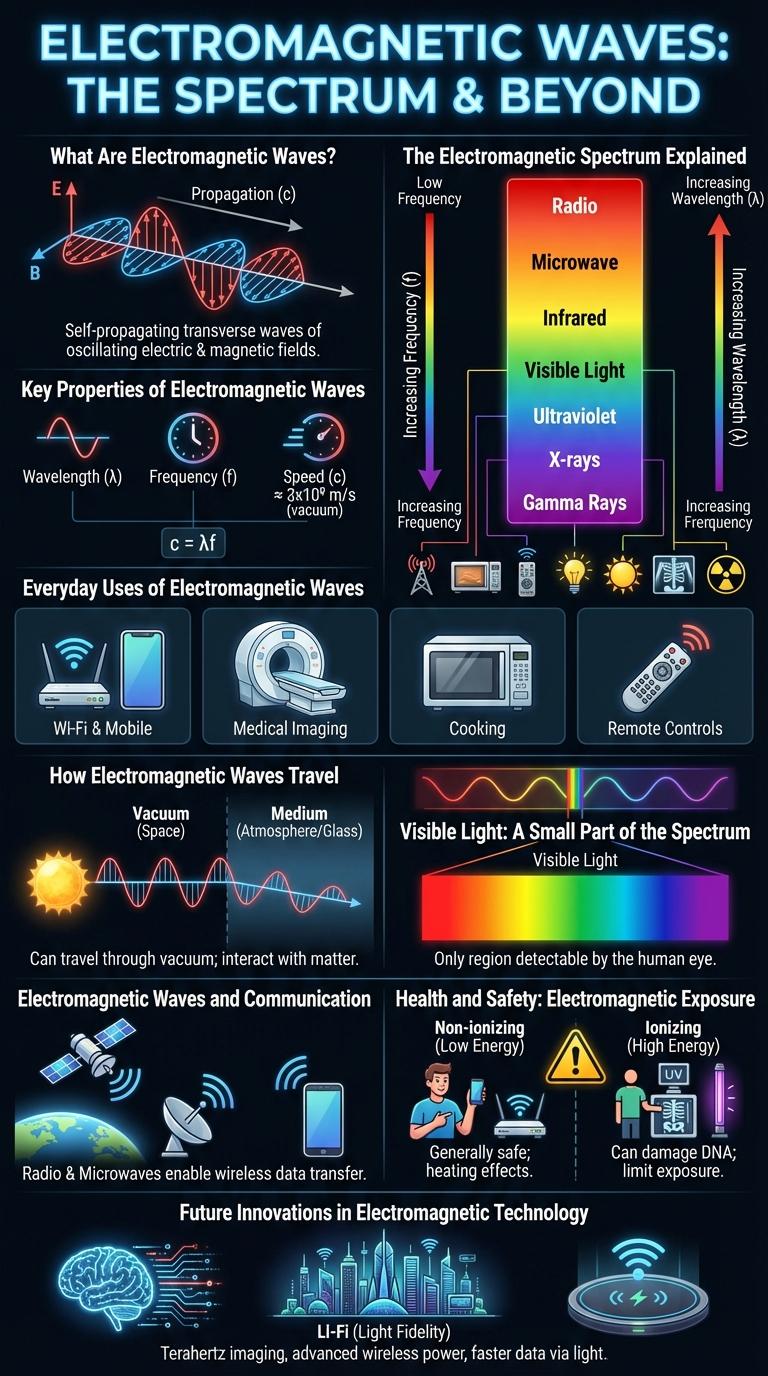
Electromagnetic fields are fundamental to understanding how energy transfers through space. This infographic visually explains the properties and interactions of electromagnetic waves, including their frequency, wavelength, and spectrum. It highlights practical applications such as communication technologies, medical imaging, and everyday household devices.
What Are Electromagnetic Waves?
Electromagnetic waves are waves of energy that travel through space at the speed of light. These waves consist of oscillating electric and magnetic fields that propagate perpendicular to each other.
- Nature - Electromagnetic waves do not require a medium and can travel through a vacuum.
- Spectrum - The electromagnetic spectrum ranges from radio waves to gamma rays, each with different wavelengths and frequencies.
- Applications - Electromagnetic waves are used in communication, medical imaging, and energy transmission.
Electromagnetic waves are fundamental to understanding light, radio signals, and many technological innovations.
The Electromagnetic Spectrum Explained
The electromagnetic spectrum encompasses all types of electromagnetic radiation, ranging from radio waves to gamma rays. Each type varies in wavelength and frequency, influencing its energy and applications. Understanding the spectrum reveals its vital role in communication, medical imaging, and scientific research.
Key Properties of Electromagnetic Waves
| Property | Description |
|---|---|
| Speed | Electromagnetic waves travel at the speed of light in a vacuum, approximately 299,792 kilometers per second (km/s). |
| Frequency | The number of wave oscillations per second, measured in hertz (Hz), determines the wave's energy and type. |
| Wavelength | The distance between successive peaks of the wave, inversely proportional to frequency, measured in meters. |
| Transverse Nature | Electric and magnetic fields oscillate perpendicular to each other and to the direction of wave propagation. |
| Propagation Medium | Can travel through vacuum as well as various media without needing a physical medium for transmission. |
Types of Electromagnetic Radiation
What are the different types of electromagnetic radiation? Electromagnetic radiation consists of waves with varying wavelengths and frequencies. These types include radio waves, microwaves, infrared, visible light, ultraviolet, X-rays, and gamma rays.
| Type | Wavelength Range |
|---|---|
| Radio Waves | Above 1 meter |
| Microwaves | 1 meter to 1 millimeter |
| Infrared | 1 millimeter to 700 nm |
| Visible Light | 700 nm to 400 nm |
| Ultraviolet | 400 nm to 10 nm |
Everyday Uses of Electromagnetic Waves
Electromagnetic waves are essential in everyday technology, enabling communication, energy transfer, and medical applications. These waves span a wide spectrum, from radio waves to gamma rays, each serving unique purposes.
Radio waves power wireless communication like Wi-Fi and mobile phones. Microwaves heat food and aid satellite transmissions, while infrared waves are used in remote controls and thermal imaging.
How Electromagnetic Waves Travel
Electromagnetic waves travel through the vacuum of space and various media by oscillating electric and magnetic fields perpendicular to each other. These waves do not require a medium, allowing them to move at the speed of light, approximately 299,792 kilometers per second.
The direction of the wave propagation is perpendicular to both the electric and magnetic field oscillations. Different types of electromagnetic waves include radio waves, microwaves, infrared, visible light, ultraviolet, X-rays, and gamma rays. Their ability to travel through space enables communication, energy transfer, and numerous technological applications.
Visible Light: A Small Part of the Spectrum
The electromagnetic spectrum encompasses a wide range of wavelengths, from radio waves to gamma rays. Visible light represents only a tiny portion of this spectrum, ranging from approximately 400 to 700 nanometers.
Visible light is the segment responsible for human vision, allowing us to perceive colors. Despite its small range, it plays a crucial role in daily life, science, and technology.
Electromagnetic Waves and Communication
Electromagnetic waves are integral to modern communication systems, enabling the wireless transmission of information over vast distances. These waves vary in frequency and wavelength, allowing for different communication technologies such as radio, television, and cellular networks. Understanding the properties of electromagnetic waves enhances the efficiency and quality of data transfer in wireless communication.
Health and Safety: Electromagnetic Exposure
Exposure to electromagnetic fields (EMF) is a growing concern due to its potential impact on health. Understanding safety guidelines helps minimize risks associated with electromagnetic radiation.
- EMF Exposure Limits - Regulatory bodies set exposure limits to protect the public from harmful electromagnetic radiation levels.
- Common Sources of EMF - Household devices such as cell phones, Wi-Fi routers, and microwaves emit low-level electromagnetic fields.
- Health Risks - Prolonged exposure to high EMF levels may cause symptoms like headaches, fatigue, and in rare cases, tissue damage.