
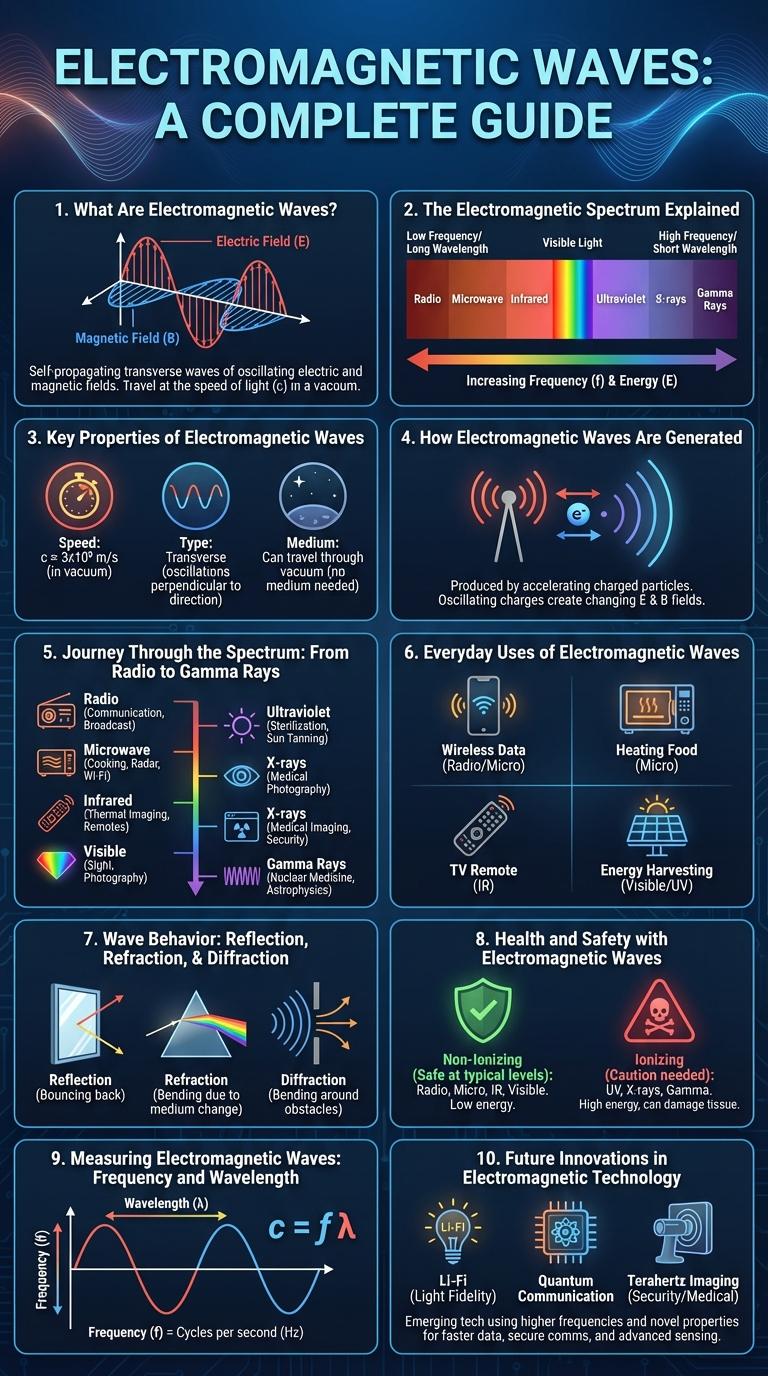
Electromagnetic waves are essential for transmitting energy through space, encompassing a wide spectrum from radio waves to gamma rays. These waves travel at the speed of light and exhibit wave-like behaviors such as reflection, refraction, and diffraction. Understanding their properties and applications is crucial in fields like communication, medicine, and astronomy.
What Are Electromagnetic Waves?
Electromagnetic waves are energy waves that travel through space without requiring a medium. They consist of oscillating electric and magnetic fields perpendicular to each other.
- Nature - Electromagnetic waves are transverse waves with electric and magnetic components oscillating at right angles.
- Speed - These waves travel at the speed of light, approximately 299,792 kilometers per second in a vacuum.
- Spectrum - The electromagnetic spectrum includes radio waves, microwaves, infrared, visible light, ultraviolet, X-rays, and gamma rays.
The Electromagnetic Spectrum Explained
Electromagnetic waves carry energy through space at the speed of light, enabling various forms of communication and technology. These waves differ in wavelength and frequency, forming the electromagnetic spectrum.
- Radio Waves - Used for broadcasting and wireless communication with the longest wavelengths in the spectrum.
- Microwaves - Utilized in cooking and radar systems, featuring shorter wavelengths than radio waves.
- Infrared Waves - Emitted by warm objects and used in night-vision equipment.
- Visible Light - The only part of the spectrum detectable by the human eye, allowing us to see colors.
- Ultraviolet, X-rays, and Gamma Rays - These have the highest frequencies and shortest wavelengths, used in medical imaging and sterilization.
The electromagnetic spectrum encompasses all types of electromagnetic radiation, each with distinct properties and practical applications.
Key Properties of Electromagnetic Waves
Electromagnetic waves are transverse waves that consist of oscillating electric and magnetic fields perpendicular to each other and the direction of wave propagation. These waves travel at the speed of light in a vacuum, approximately 299,792 kilometers per second.
Electromagnetic waves exhibit properties such as wavelength, frequency, and amplitude, which determine their energy and behavior. They can propagate through a vacuum and do not require a medium. The spectrum ranges from radio waves with long wavelengths to gamma rays with extremely short wavelengths.
How Electromagnetic Waves Are Generated
Electromagnetic waves are generated by the acceleration of charged particles, such as electrons. These waves propagate through space carrying electromagnetic energy without the need for a medium.
- Acceleration of Charges - Moving electric charges produce varying electric and magnetic fields that generate electromagnetic waves.
- Oscillating Currents - Alternating currents in antennas cause electrons to oscillate, creating continuous electromagnetic wave emission.
- Energy Transmission - The generated waves carry energy through space at the speed of light, enabling wireless communication and radiation.
Journey Through the Spectrum: From Radio to Gamma Rays
Electromagnetic waves travel through space and vary in wavelength and frequency, forming the electromagnetic spectrum. This journey spans from low-frequency radio waves to high-frequency gamma rays, each serving unique functions in communication, medicine, and astronomy. Understanding the spectrum enables advancements in technology and scientific discovery across numerous fields.
Everyday Uses of Electromagnetic Waves
Electromagnetic waves play a crucial role in daily life through applications like communication, cooking, and medical imaging. Radio waves enable wireless communication, facilitating phone calls and internet access. Microwaves heat food efficiently, while X-rays help doctors diagnose medical conditions safely and accurately.
Wave Behavior: Reflection, Refraction, & Diffraction
Electromagnetic waves exhibit unique behaviors when interacting with different materials, including reflection, refraction, and diffraction. These behaviors govern how waves travel, change direction, and spread around obstacles.
Reflection occurs when waves bounce off a surface, while refraction involves the bending of waves as they pass through different media. Diffraction happens when waves bend around corners or spread out after passing through narrow openings, influencing wave propagation in various environments.
Health and Safety with Electromagnetic Waves
Electromagnetic waves encompass a range of frequencies, including radio waves, microwaves, infrared, visible light, ultraviolet, X-rays, and gamma rays. Exposure to certain types of electromagnetic waves, particularly high-frequency waves like X-rays and gamma rays, can pose health risks due to their ionizing nature.
Safety guidelines limit exposure levels to non-ionizing waves such as radiofrequency and microwaves to prevent tissue heating and other biological effects. Using protective gear and maintaining appropriate distance from sources reduces potential health hazards related to electromagnetic wave exposure.
Measuring Electromagnetic Waves: Frequency and Wavelength
| Property | Details |
|---|---|
| Frequency (f) | Number of wave cycles per second, measured in Hertz (Hz). Determines the energy and type of electromagnetic wave. |
| Wavelength (l) | Distance between two consecutive wave peaks, measured in meters (m). Inversely proportional to frequency. |
| Relationship | Speed of light (c) = Frequency (f) x Wavelength (l); c 3 x 10^8 m/s in a vacuum. |
| Measurement Tools | Frequency: Spectrum analyzers and oscilloscopes. Wavelength: Interference and diffraction methods. |
| Applications | Used in wireless communication, medical imaging, and spectroscopy for wave characterization. |