
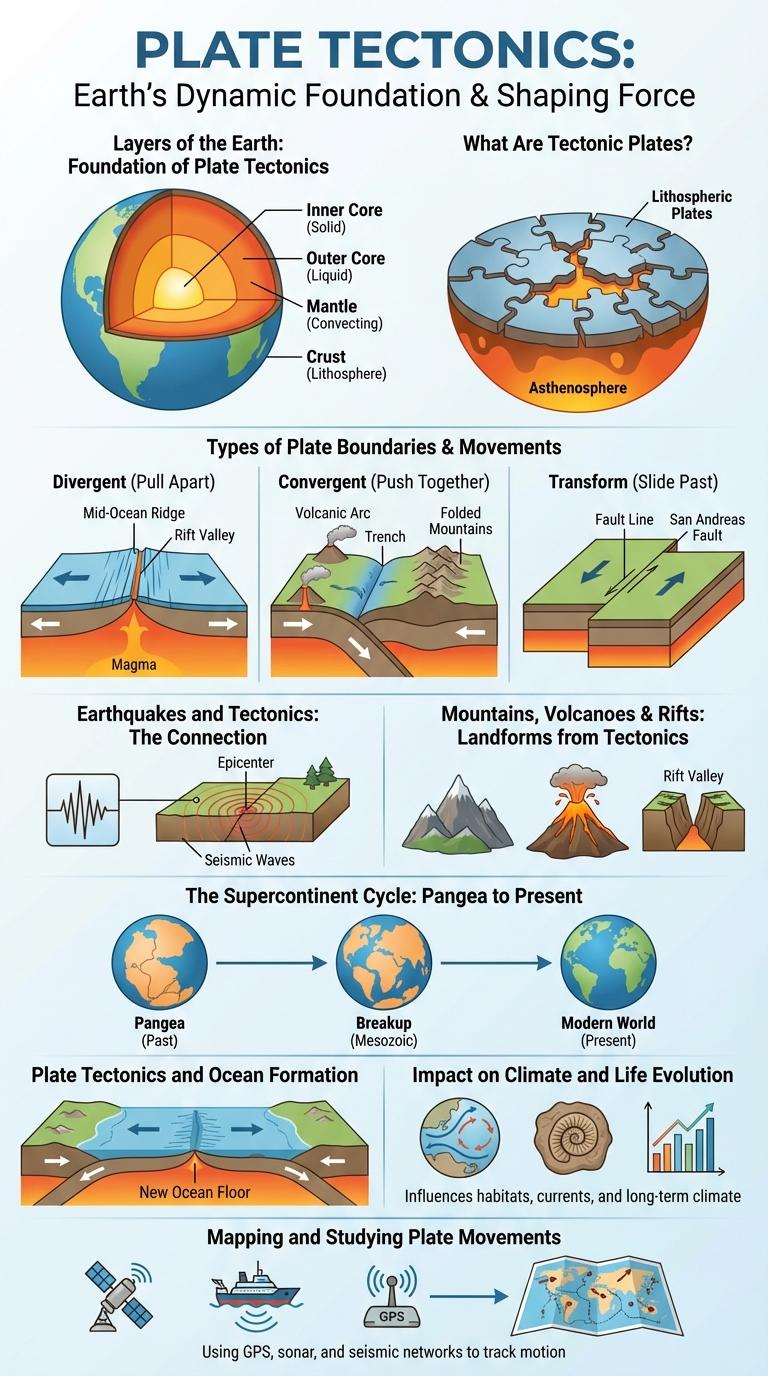
Plate tectonics explains the movement of Earth's lithospheric plates and the natural phenomena they cause, such as earthquakes, volcanic activity, and mountain formation. This infographic visualizes the structure of tectonic plates, their boundaries, and the dynamic processes driving continental drift. Understanding plate tectonics is essential for comprehending Earth's geological history and predicting seismic events.
Layers of the Earth: Foundation of Plate Tectonics
Plate tectonics is driven by the dynamic layers of the Earth, each playing a crucial role in the movement of tectonic plates. The Earth consists of the crust, mantle, outer core, and inner core, with the lithosphere and asthenosphere being key to tectonic activity.
The rigid lithosphere includes the crust and the uppermost mantle, forming the tectonic plates. Beneath it, the semi-fluid asthenosphere allows these plates to move, leading to earthquakes, volcanic activity, and mountain building.
What Are Tectonic Plates?
Tectonic plates are massive slabs of Earth's lithosphere that move over the asthenosphere. Their interactions shape the planet's surface and cause geological phenomena such as earthquakes and volcanoes.
Understanding tectonic plates is essential for studying Earth's dynamic crust and its changes over geological time.
- Composition - Tectonic plates consist of the crust and the uppermost mantle, forming the rigid lithosphere.
- Movement - Plates float on the semi-fluid asthenosphere and shift due to mantle convection currents.
- Boundaries - Plate edges are zones of significant geological activity where plates diverge, converge, or slide past each other.
Types of Plate Boundaries
Plate tectonics explains the movement of Earth's lithospheric plates and their interactions. These interactions occur primarily at plate boundaries, where most geological activity happens.
- Divergent Boundaries - Plates move apart, creating new crust as magma rises from below the Earth's surface.
- Convergent Boundaries - Plates move towards each other, causing subduction or mountain formation depending on the crust types involved.
- Transform Boundaries - Plates slide horizontally past one another, often resulting in earthquakes along fault lines.
Understanding these boundaries helps explain earthquakes, volcanic activity, and the formation of various geological features worldwide.
Plate Movements: Divergent, Convergent, Transform
| Plate Movement | Description & Examples |
|---|---|
| Divergent | Plates move apart, creating new crust. Occurs at mid-ocean ridges like the Mid-Atlantic Ridge. Leads to seafloor spreading and volcanic activity. |
| Convergent | Plates move toward each other causing subduction or mountain formation. Examples include the Andes Mountains (oceanic-continental) and Himalayas (continental-continental). |
| Transform | Plates slide past one another horizontally. Associated with earthquakes along faults such as the San Andreas Fault in California. |
Earthquakes and Tectonics: The Connection
What is the relationship between earthquakes and plate tectonics? Earthquakes occur primarily along plate boundaries where tectonic plates interact. These interactions cause stress accumulation and sudden energy release, resulting in seismic activity.
How do different plate boundary types affect earthquakes? Convergent boundaries produce powerful earthquakes from one plate subducting under another. Divergent boundaries generate moderate earthquakes as plates pull apart, while transform boundaries cause earthquakes from plates sliding past each other horizontally.
Why are earthquake zones clustered around tectonic plates? Earthquake zones align with plate boundaries because these are regions of intense mechanical stress. The Earth's lithosphere fractures along these zones, facilitating the movement that triggers earthquakes.
Can plate tectonics help predict earthquake-prone areas? Mapping tectonic plates and their boundaries enables scientists to identify high-risk seismic zones. This knowledge supports earthquake preparedness and risk mitigation strategies worldwide.
What role does fault movement play in earthquake generation? Faults are fractures where tectonic plates slide, collide, or separate. Sudden fault slippage releases built-up strain energy, causing ground shaking known as an earthquake.
Mountains, Volcanoes & Rifts: Landforms from Tectonics
Plate tectonics shapes Earth's surface by creating mountains, volcanoes, and rifts through the movement of lithospheric plates. Mountains form mainly at convergent boundaries where plates collide and push the crust upward. Volcanoes and rifts develop at divergent boundaries where plates pull apart, allowing magma to rise and form new landforms.
The Supercontinent Cycle: Pangea to Present
The Supercontinent Cycle describes the formation and breakup of Earth's supercontinents over hundreds of millions of years. Pangea was the most recent supercontinent, existing around 335 to 175 million years ago before breaking apart into today's continents.
This cycle involves plate tectonics, where Earth's lithospheric plates move and reorganize the surface. After Pangea split, the continents drifted to their current positions, shaping ocean basins and mountain ranges. The process will continue, potentially forming a new supercontinent in the future.
Plate Tectonics and Ocean Formation
Plate tectonics drives the dynamic processes that shape Earth's surface, including the formation and evolution of oceans. The movement and interaction of tectonic plates lead to the creation of new ocean basins through seafloor spreading and subduction zones.
- Seafloor Spreading - Occurs at mid-ocean ridges where tectonic plates diverge, allowing magma to rise and create new oceanic crust.
- Subduction Zones - Locations where one tectonic plate sinks beneath another, recycling oceanic crust into the mantle and often forming deep ocean trenches.
- Plate Boundaries and Ocean Formation - Divergent, convergent, and transform plate boundaries collectively shape ocean basins by expanding, shrinking, or reshaping them.
Impact on Climate and Life Evolution
Plate tectonics shapes Earth's surface by moving continents and ocean basins, influencing global climate patterns over millions of years. The repositioning of landmasses affects ocean currents, atmospheric circulation, and the distribution of heat around the planet.
These climatic shifts drive evolutionary processes by creating new habitats and ecological niches. Changes in sea levels, mountain formation, and volcanic activity further impact biodiversity and species adaptation throughout geological history.