
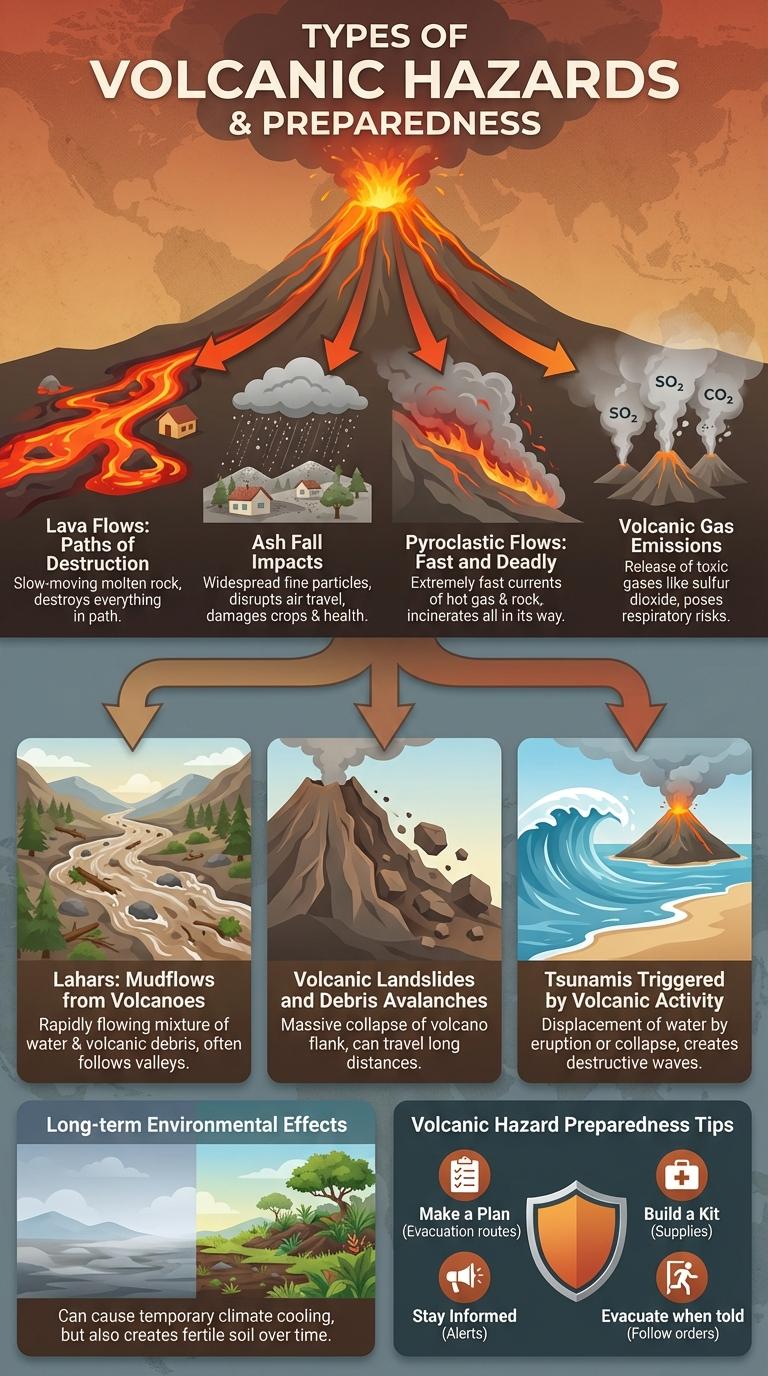
Volcanic hazards include a range of dangerous phenomena such as lava flows, ashfall, pyroclastic flows, and volcanic gas emissions that threaten lives and property. Understanding these hazards helps communities prepare and respond effectively to volcanic eruptions. Infographics visually summarize key information about the types, impacts, and safety measures related to volcanic activity.
Types of Volcanic Hazards
Volcanic hazards pose significant threats to life, property, and the environment. Understanding the types of volcanic hazards is crucial for disaster preparedness and risk mitigation.
- Lava Flows - Streams of molten rock that can destroy anything in their path but usually move slowly enough for evacuation.
- Pyroclastic Flows - Fast-moving currents of hot gas and volcanic matter that can cause severe burns and fatalities due to their high speed and temperature.
- Volcanic Ash - Fine particles ejected into the air that can disrupt air travel, damage respiratory systems, and contaminate water supplies.
- Lahars - Volcanic mudflows formed by mixing volcanic ash with water, capable of burying communities under thick mud.
- Volcanic Gas Emissions - Release of gases such as sulfur dioxide and carbon dioxide that can be toxic to humans and animals.
Effective monitoring and public education help reduce the impact of volcanic hazards on communities.
Lava Flows: Paths of Destruction
Lava flows are streams of molten rock that erupt from a volcano during an eruption. They move downhill, following paths of least resistance, causing destruction in their way.
The temperature of lava can reach up to 1,200degC (2,192degF), incinerating everything in its path. Lava flows destroy buildings, roads, and vegetation by burning, burying, or crushing them. Their speed varies from slow-moving rivers to faster flows that can threaten nearby communities.
Ash Fall Impacts
What are the primary impacts of volcanic ash fall on the environment and communities?
Volcanic ash fall can severely disrupt daily life, damaging buildings, contaminating water supplies, and causing respiratory health problems. It also affects agriculture by smothering crops and degrading soil quality, leading to long-term economic challenges.
Pyroclastic Flows: Fast and Deadly
Pyroclastic flows are fast-moving currents of hot gas and volcanic matter that can reach speeds over 700 km/h (435 mph). Temperatures within these flows can exceed 1,000degC (1,832degF), incinerating everything in their path.
The density and speed of pyroclastic flows make them one of the deadliest volcanic hazards, causing widespread destruction and loss of life. These flows can travel several kilometers from the eruption site, devastating nearby communities and landscapes.
Volcanic Gas Emissions
Volcanic gas emissions release a mixture of harmful gases that pose significant hazards to human health and the environment. These gases can lead to respiratory issues, acid rain, and contribute to climate change.
- Carbon Dioxide (CO2) - A dense, colorless gas that can accumulate in low-lying areas, posing a suffocation risk to humans and animals.
- Sulfur Dioxide (SO2) - Causes acid rain and respiratory problems, impacting vegetation, water sources, and air quality near volcanic sites.
- Hydrogen Sulfide (H2S) - A toxic, flammable gas with a distinctive rotten egg smell, harmful even at low concentrations.
Lahars: Mudflows from Volcanoes
| Hazard | Lahars |
|---|---|
| Description | Rapidly flowing mudflows composed of volcanic ash, debris, and water, descending from volcano slopes |
| Origin | Triggered by volcanic eruptions melting snow/ice, heavy rainfall saturating loose volcanic material, or sudden dam breaches |
| Speed & Distance | Speeds up to 60 mph (100 km/h); can travel tens of kilometers downstream |
| Impact | Destruction of infrastructure, burial of communities, loss of life, contamination of waterways, alteration of landscapes |
| Preparedness | Early warning systems, community education, hazard mapping, emergency evacuation plans |
Volcanic Landslides and Debris Avalanches
Volcanic landslides and debris avalanches occur when large masses of rock, soil, and volcanic material rapidly slide down the slopes of a volcano. These events can reshape landscapes, block rivers, and cause severe flooding due to the sudden displacement of water and sediment. They pose significant risks to nearby communities by causing destruction and triggering secondary hazards like lahars and tsunamis.
Tsunamis Triggered by Volcanic Activity
Tsunamis triggered by volcanic activity occur when underwater or coastal volcanic eruptions displace large volumes of water. These waves can reach heights exceeding 30 meters, causing widespread flooding and destruction along shorelines. Key volcanic events such as flank collapses or explosive eruptions are primary triggers for these powerful and sudden tsunamis.
Long-term Environmental Effects
Volcanic eruptions release large amounts of ash and gases that can alter climate patterns for years. Sulfur dioxide emitted contributes to acid rain, impacting soil and water quality long after the eruption.
Lava flows and ash deposits can destroy vegetation, leading to habitat loss and changes in local ecosystems. Over time, these environmental changes may reduce biodiversity and disrupt agricultural productivity.