
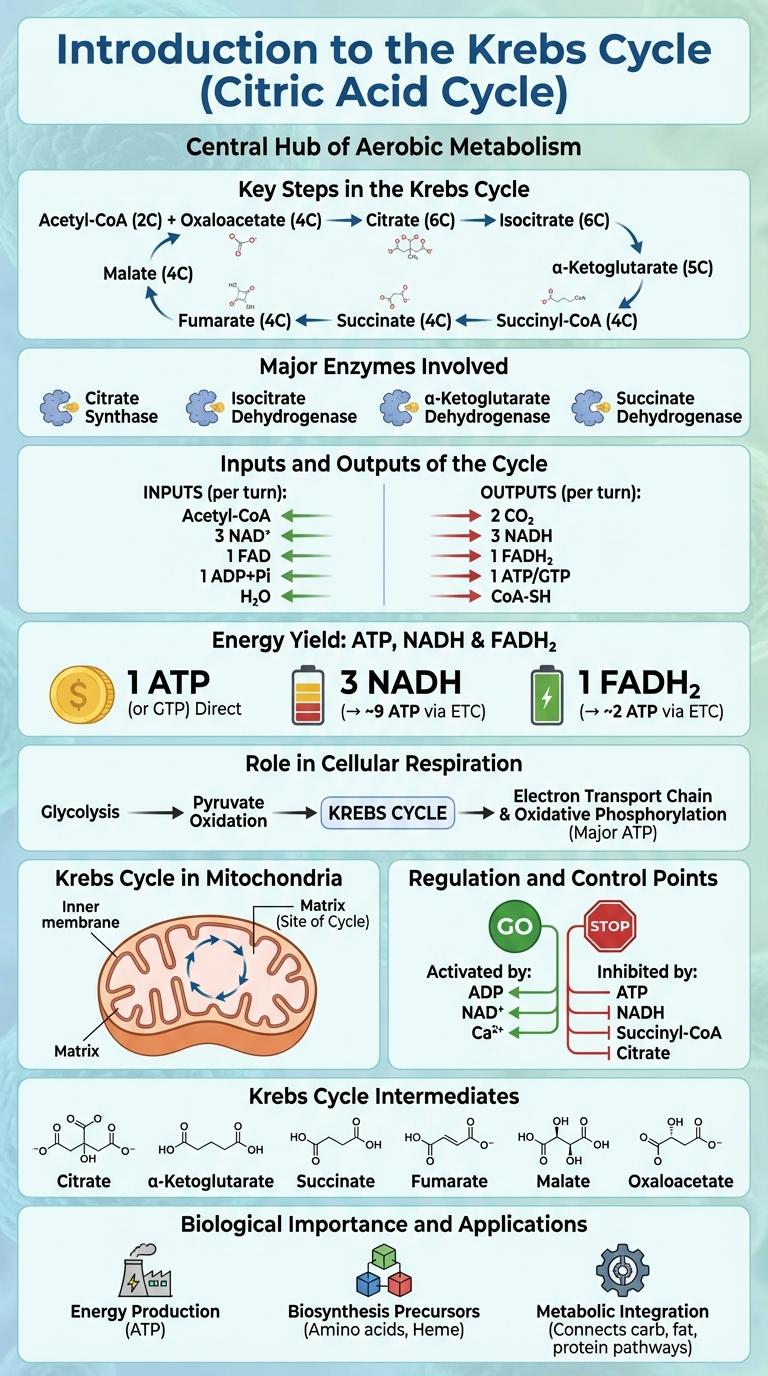
The Krebs cycle, also known as the citric acid cycle, is a crucial metabolic pathway that generates energy through the oxidation of acetyl-CoA. This infographic visually breaks down each step of the cycle, highlighting key molecules and enzymatic reactions involved in cellular respiration. Understanding the Krebs cycle provides insight into how cells convert nutrients into usable energy in the form of ATP.
Introduction to the Krebs Cycle
The Krebs Cycle, also known as the Citric Acid Cycle, is a key metabolic pathway that takes place in the mitochondria of cells. It plays a crucial role in cellular respiration by converting acetyl-CoA into energy-rich molecules like NADH and FADH2. These molecules then fuel the production of ATP, the cell's main energy currency.
Key Steps in the Krebs Cycle
The Krebs cycle, also known as the citric acid cycle, is a crucial metabolic pathway that generates energy through the oxidation of acetyl-CoA. It occurs in the mitochondria and produces ATP, NADH, and FADH2, which are essential for cellular respiration.
- Acetyl-CoA combines with oxaloacetate - This forms citrate, initiating the Krebs cycle.
- Citrate undergoes transformation - It is rearranged and loses two CO2 molecules, producing NADH.
- Regeneration of oxaloacetate - The cycle ends by regenerating oxaloacetate to continue processing acetyl-CoA.
Major Enzymes Involved
The Krebs cycle, also known as the citric acid cycle, is a crucial metabolic pathway in cellular respiration. Major enzymes facilitate each step, ensuring efficient energy production from carbohydrates, fats, and proteins.
- Citrate synthase - catalyzes the condensation of acetyl-CoA and oxaloacetate to form citrate, initiating the cycle.
- Aconitase - converts citrate into isocitrate through an intermediate, cis-aconitate.
- Isocitrate dehydrogenase - catalyzes the oxidative decarboxylation of isocitrate to alpha-ketoglutarate, producing NADH.
- Alpha-ketoglutarate dehydrogenase - converts alpha-ketoglutarate into succinyl-CoA, releasing CO2 and generating NADH.
- Succinate dehydrogenase - oxidizes succinate to fumarate while transferring electrons to the electron transport chain via FADH2.
These enzymes collectively enable the Krebs cycle to produce high-energy molecules essential for ATP synthesis.
Inputs and Outputs of the Cycle
What are the primary inputs and outputs of the Krebs cycle?
The Krebs cycle begins with acetyl-CoA as the main input, derived from carbohydrates, fats, and proteins. The key outputs include carbon dioxide, NADH, FADH2, and ATP, which play critical roles in cellular respiration and energy production.
| Inputs | Outputs |
|---|---|
| Acetyl-CoA | CO2 (Carbon Dioxide) |
| 3 NAD+ | 3 NADH |
| 1 FAD | 1 FADH2 |
| 1 ADP + Pi | 1 ATP (or GTP) |
| H2O (Water) | Regenerated Oxaloacetate |
Energy Yield: ATP, NADH & FADH₂
The Krebs cycle, also known as the citric acid cycle, plays a crucial role in cellular respiration by generating high-energy molecules. Each turn of the cycle produces 1 ATP, 3 NADH, and 1 FADH2, which are essential for energy production in cells. NADH and FADH2 then donate electrons to the electron transport chain, driving the synthesis of additional ATP molecules.
Role in Cellular Respiration
The Krebs cycle, also known as the citric acid cycle, is a crucial metabolic pathway in cellular respiration. It takes place in the mitochondria and plays a central role in energy production by oxidizing acetyl-CoA.
This cycle generates high-energy electron carriers NADH and FADH2, which are essential for the electron transport chain. The Krebs cycle also produces ATP and releases carbon dioxide as a waste product during the process.
Krebs Cycle in Mitochondria
The Krebs cycle, also known as the citric acid cycle, takes place in the mitochondria's matrix. This cycle plays a crucial role in cellular respiration by generating energy-rich molecules.
Enzymes within the mitochondrial matrix facilitate a series of chemical reactions that convert acetyl-CoA into carbon dioxide and high-energy electron carriers.
- Energy Production - The Krebs cycle produces NADH and FADH2, which donate electrons to the electron transport chain for ATP synthesis.
- Carbon Dioxide Release - During the cycle, two molecules of CO2 are released as waste products from the breakdown of acetyl groups.
- Metabolic Intermediates - Intermediates from the Krebs cycle serve as precursors for amino acids, nucleotide bases, and other biomolecules.
Regulation and Control Points
The Krebs cycle, also known as the citric acid cycle, is tightly regulated to meet cellular energy demands. Key control points ensure efficient production of ATP and metabolic intermediates.
Isocitrate dehydrogenase and a-ketoglutarate dehydrogenase serve as primary regulation enzymes, sensitive to energy status indicators. High levels of ATP and NADH inhibit these enzymes, slowing the cycle.
Krebs Cycle Intermediates
| Intermediate | Description |
|---|---|
| Citrate | First product formed when acetyl-CoA combines with oxaloacetate, initiating the cycle. |
| Isocitrate | Isomer of citrate, converted through aconitase enzyme, ready for oxidative decarboxylation. |
| a-Ketoglutarate | Five-carbon molecule formed after isocitrate oxidation, key for nitrogen metabolism. |
| Succinyl-CoA | High-energy thioester intermediate, links energy production with biosynthesis. |
| Oxaloacetate | Final intermediate regenerated to combine with acetyl-CoA, perpetuating the cycle. |