
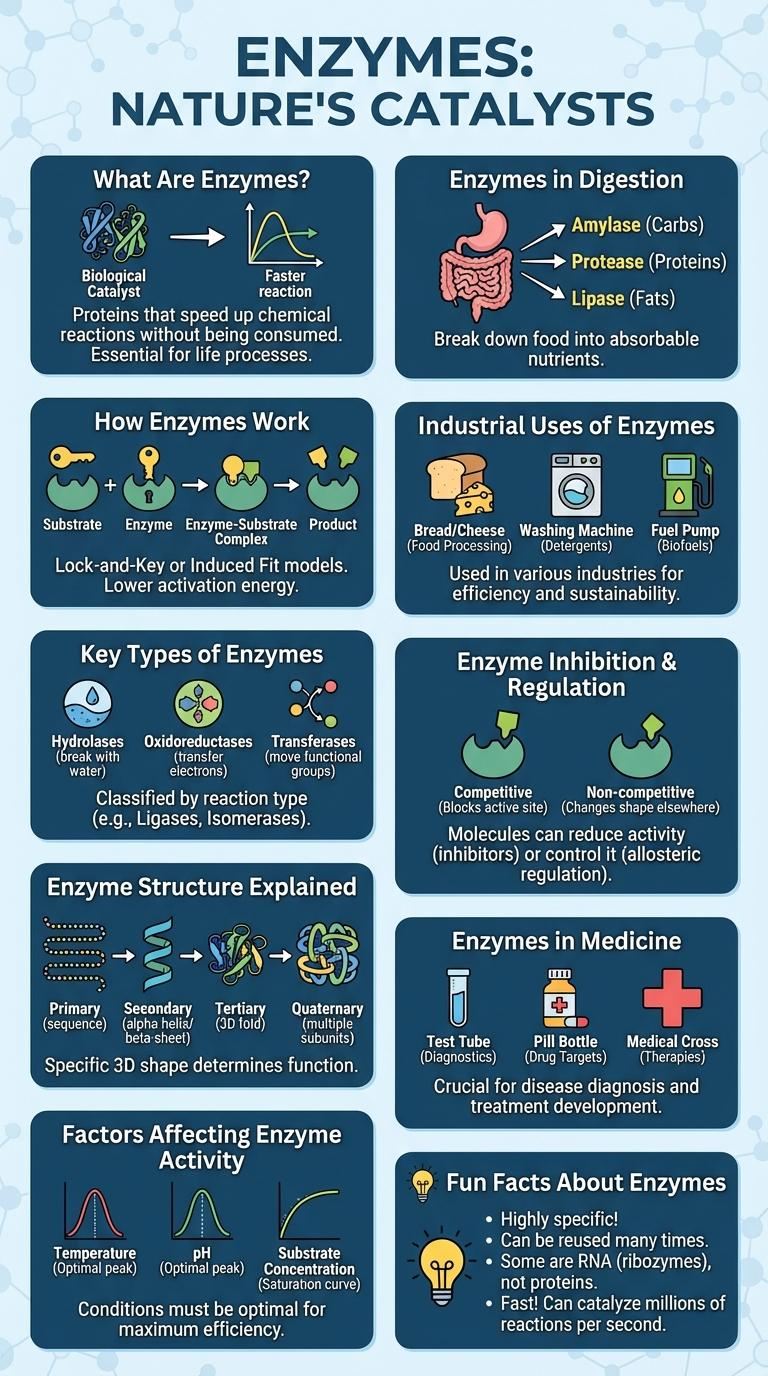
Enzymes accelerate chemical reactions by lowering activation energy, playing a crucial role in biological processes. This infographic visually breaks down enzyme structure, function, and types to simplify complex biochemical concepts. Understanding these catalysts enhances insights into metabolism, digestion, and bioengineering applications.
What Are Enzymes?
Enzymes are biological catalysts that speed up chemical reactions in living organisms. They are essential for processes such as digestion, metabolism, and DNA replication.
- Protein Composition - Enzymes are primarily made of proteins that have unique three-dimensional structures.
- Specificity - Each enzyme catalyzes a specific reaction by binding to a particular substrate.
- Activation Energy - Enzymes lower the activation energy required for chemical reactions, making processes faster and more efficient.
How Enzymes Work
| Aspect | Explanation |
|---|---|
| Enzyme Definition | Biological catalysts that speed up chemical reactions without being consumed. |
| Active Site | Specific region where substrates bind and reactions occur. |
| Substrate Binding | Substrates fit precisely into the enzyme's active site, forming an enzyme-substrate complex. |
| Catalytic Process | Enzymes lower activation energy, enabling faster conversion of substrates to products. |
| Product Release | After reaction, products detach from the enzyme, which is ready for another cycle. |
Key Types of Enzymes
What are the key types of enzymes and their functions? Enzymes are biological catalysts that speed up chemical reactions in living organisms. Key types of enzymes include oxidoreductases, transferases, hydrolases, lyases, isomerases, and ligases, each specializing in specific biochemical reactions.
| Enzyme Type | Function |
|---|---|
| Oxidoreductases | Catalyze oxidation-reduction reactions by transferring electrons. |
| Transferases | Transfer functional groups such as methyl or phosphate groups. |
| Hydrolases | Break chemical bonds using water, aiding in digestion and metabolism. |
| Lyases | Remove groups to form double bonds without hydrolysis or oxidation. |
| Isomerases & Ligases | Isomerases rearrange molecules; ligases join molecules using energy from ATP. |
Enzyme Structure Explained
Enzymes are biological catalysts made up of complex protein structures composed of amino acid chains folded into unique three-dimensional shapes. The active site, a specific region on the enzyme, binds to substrates and facilitates chemical reactions by lowering activation energy. Structural components such as the primary, secondary, tertiary, and quaternary levels determine enzyme specificity and functionality.
Factors Affecting Enzyme Activity
Enzyme activity is influenced by various factors that determine the rate at which biochemical reactions occur. Understanding these factors is essential for optimizing enzyme performance in industrial and biological processes.
Temperature affects enzyme activity by increasing reaction rates up to an optimum point, beyond which enzymes denature and lose function. pH levels also impact enzyme shape and charge, with each enzyme having an optimal pH range for maximum activity.
Enzymes in Digestion
Enzymes play a crucial role in digestion by breaking down complex food molecules into simpler forms that the body can absorb. Key digestive enzymes include amylase, protease, and lipase, which target carbohydrates, proteins, and fats, respectively. These enzymes optimize nutrient absorption and support overall digestive health.
Industrial Uses of Enzymes
Enzymes are biological catalysts that accelerate chemical reactions in various industrial processes. They enhance efficiency, reduce energy consumption, and promote environmentally friendly practices.
Industries such as food and beverage, textiles, and biofuels rely heavily on enzymes like amylases, proteases, and lipases for optimized production. Enzymes improve product quality by enabling precise reactions, such as starch breakdown in brewing or fabric softening in textiles. Their application decreases the need for harsh chemicals, lowering environmental impact and operational costs.
Enzyme Inhibition & Regulation
Enzymes are biological catalysts that accelerate chemical reactions in cells. Enzyme inhibition and regulation control enzyme activity to maintain cellular balance and respond to environmental changes.
- Competitive Inhibition - Inhibitors bind to the active site, blocking substrate access without altering enzyme structure.
- Non-Competitive Inhibition - Inhibitors bind to an allosteric site, changing enzyme shape and reducing activity regardless of substrate presence.
- Allosteric Regulation - Effectors bind to specific sites, enhancing or inhibiting enzyme activity by inducing conformational changes.
Enzymes in Medicine
Enzymes play a crucial role in modern medicine by enabling targeted biochemical reactions. Their specificity and efficiency improve diagnosis, treatment, and drug development.
- Diagnostic Enzymes - Used to identify diseases through enzyme-linked assays that detect biomarkers in blood and tissues.
- Therapeutic Enzymes - Applied to treat conditions such as enzyme deficiencies, cancer, and blood clots by supplementing or altering enzyme activity.
- Enzyme Inhibitors - Serve as drugs that block harmful enzyme activities, critical in managing diseases like hypertension and HIV.
Advancements in enzyme technology continue to transform personalized medicine and precision therapies.