
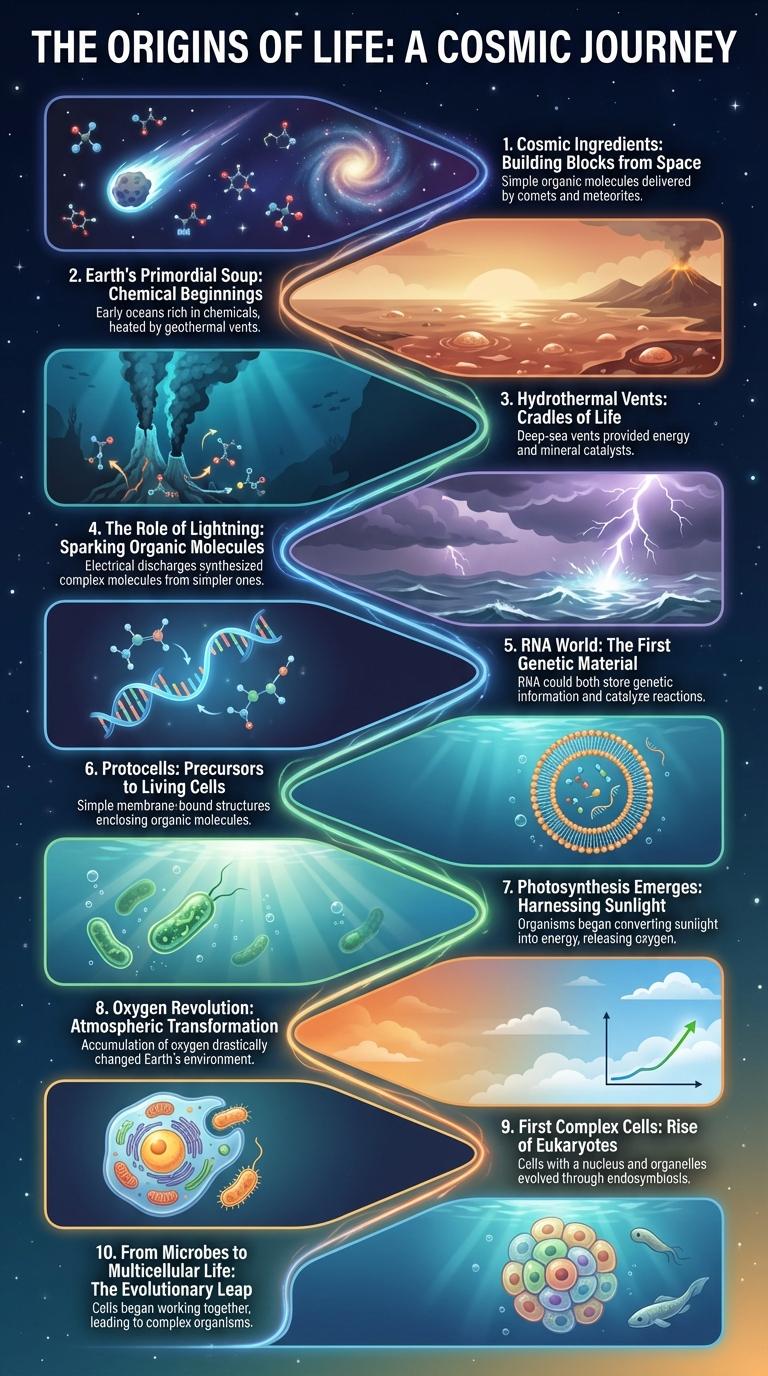
Exploring the origin of life on Earth reveals a fascinating journey from simple molecules to complex organisms. Scientific research uncovers how conditions on the early planet fostered the emergence of life through chemical reactions and environmental factors. Understanding these processes helps decode the biological history that shaped all living beings today.
Cosmic Ingredients: Building Blocks from Space
The origin of life on Earth is closely linked to cosmic ingredients delivered from space. Organic molecules, such as amino acids and nucleotides, were likely formed in interstellar clouds and comets.
These building blocks arrived on early Earth via meteorites and comet impacts, providing essential materials for prebiotic chemistry. This influx of cosmic matter helped kickstart the complex processes that eventually led to life.
Earth's Primordial Soup: Chemical Beginnings
The origin of life on Earth is believed to have started in a chemical-rich environment known as the primordial soup. This environment provided the essential building blocks for the first organic molecules necessary for life.
- Primordial Soup Concept - The term describes the early Earth's oceans filled with simple organic compounds formed by volcanic gases and energy sources.
- Miller-Urey Experiment - This experiment demonstrated how amino acids, the building blocks of proteins, could form from simple gases under early Earth conditions.
- Energy Sources - Lightning, ultraviolet radiation, and hydrothermal vents provided the energy required for chemical reactions in the primordial soup.
The chemical interactions within the primordial soup set the stage for the development of more complex molecules, eventually leading to the emergence of life.
Hydrothermal Vents: Cradles of Life
The origin of life on Earth is closely linked to hydrothermal vents on the ocean floor. These vents provide the unique conditions that may have fostered the earliest biological molecules and cells.
Hydrothermal vents release mineral-rich, superheated water that creates an energy-rich environment suitable for chemical reactions essential to life.
- Mineral Nutrients - Hydrothermal vents emit minerals like iron and sulfur that serve as catalysts for organic molecule formation.
- Stable Environment - The constant temperature and chemical gradients provide a stable habitat for early life forms to develop.
- Energy Source - Chemical energy from vent fluids supports chemosynthetic microbes, fueling primitive ecosystems.
The Role of Lightning: Sparking Organic Molecules
How did lightning contribute to the origin of life on Earth?
Lightning provided the energy necessary to spark chemical reactions that formed organic molecules. These molecules are the essential building blocks of life and played a critical role in early prebiotic chemistry.
RNA World: The First Genetic Material
| Aspect | Description |
|---|---|
| RNA World Hypothesis | Proposes RNA as the first genetic material before DNA and proteins evolved |
| Self-Replication | RNA molecules capable of catalyzing their own replication and some biochemical reactions |
| Catalytic Activity | Ribozymes demonstrate RNA's ability to act as both genetic carrier and enzyme |
| Origin Timeline | RNA world likely existed around 4 billion years ago, during early Earth conditions |
| Transition to DNA | Evolution toward DNA and protein-based life improved stability and complexity of organisms |
Protocells: Precursors to Living Cells
Protocells are simple, membrane-bound structures that formed around 4 billion years ago and are considered the precursors to living cells. These early formations encapsulated organic molecules, allowing chemical reactions to occur in a controlled environment, which was crucial for the development of life. Studying protocells helps scientists understand the transition from non-living chemistry to biological life on Earth.
Photosynthesis Emerges: Harnessing Sunlight
Life on Earth began over 3.5 billion years ago, with simple microorganisms evolving the ability to harness sunlight. Photosynthesis emerged as a revolutionary process, enabling organisms to convert sunlight into energy.
Photosynthetic bacteria, like cyanobacteria, used sunlight to split water molecules, releasing oxygen as a byproduct. This oxygen gradually accumulated in the atmosphere, transforming Earth's environment. The rise of photosynthesis paved the way for complex life forms by producing essential energy and oxygen essential for respiration.
Oxygen Revolution: Atmospheric Transformation
The Oxygen Revolution, also known as the Great Oxidation Event, occurred around 2.4 billion years ago. This period marked a significant increase in atmospheric oxygen due to photosynthetic cyanobacteria activity.
Oxygen accumulation transformed Earth's atmosphere, enabling the development of aerobic life forms. This shift led to the formation of the ozone layer, protecting organisms from harmful ultraviolet radiation.
First Complex Cells: Rise of Eukaryotes
The origin of life on Earth began with simple prokaryotic cells, but the first complex cells, known as eukaryotes, emerged around 1.6 to 2 billion years ago. Eukaryotic cells are characterized by membrane-bound organelles, including a nucleus, which allowed for greater cellular complexity and specialization. This evolution marked a significant step in the development of multicellular organisms and the diversification of life on our planet.