
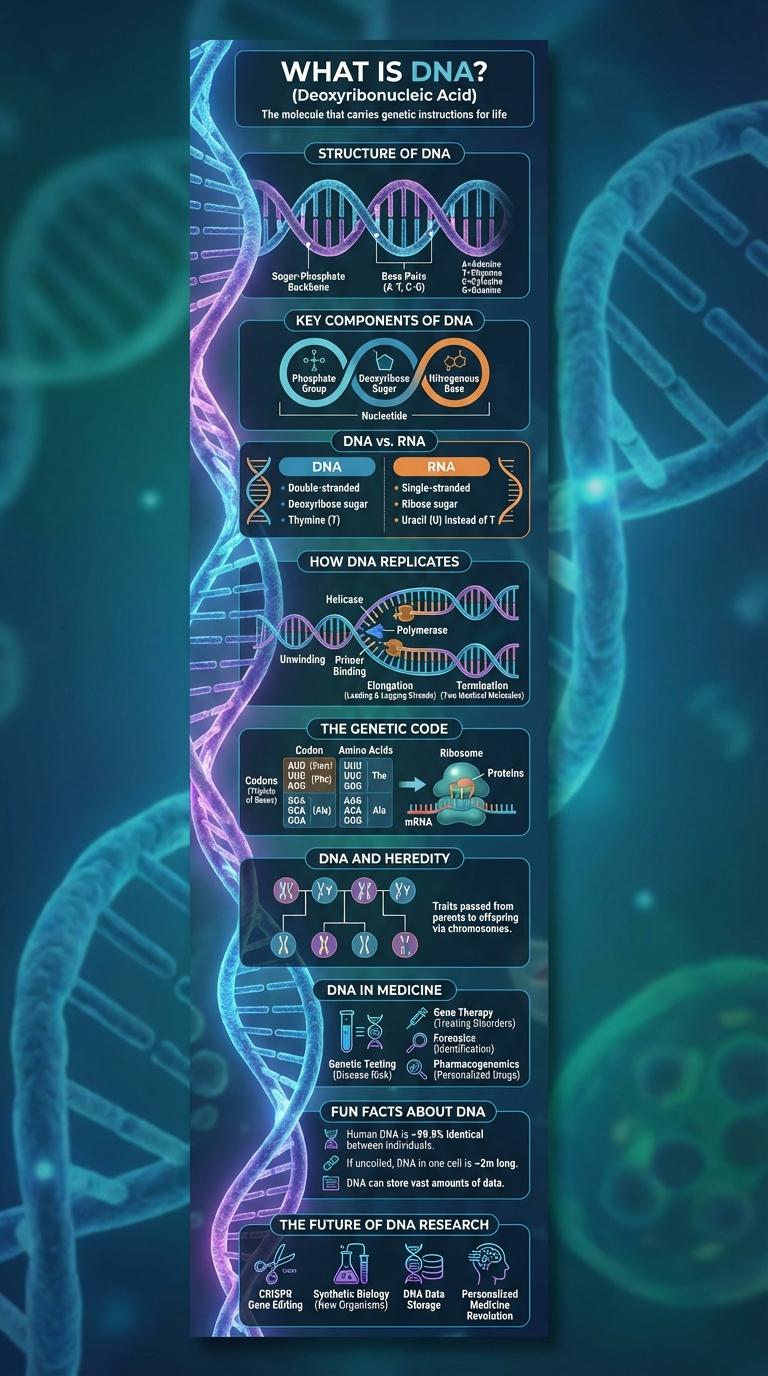
DNA infographics visually represent the complex structure and function of deoxyribonucleic acid, highlighting its role in genetics and heredity. They simplify concepts like the double helix, nucleotide sequences, and gene expression to enhance understanding. These visuals are essential tools for education in biology and genetic research.
What is DNA?
DNA, or deoxyribonucleic acid, is the hereditary material in almost all living organisms. It contains the biological instructions that make each species unique.
- Double Helix Structure - DNA consists of two strands twisted into a spiral shape called a double helix.
- Genetic Code - DNA sequences are composed of four nucleotide bases: adenine, thymine, cytosine, and guanine.
- Function - DNA stores genetic information used for growth, development, and cellular function.
Structure of DNA
DNA, or deoxyribonucleic acid, is a double helix structure composed of two long strands of nucleotides twisted around each other. Each nucleotide consists of a sugar molecule, a phosphate group, and one of four nitrogenous bases: adenine, thymine, cytosine, or guanine.
The strands are held together by hydrogen bonds between complementary bases: adenine pairs with thymine, and cytosine pairs with guanine. This structure encodes genetic information essential for the development and functioning of all living organisms.
Key Components of DNA
DNA, or deoxyribonucleic acid, consists of four key components: adenine, thymine, cytosine, and guanine. These nitrogenous bases pair specifically, with adenine pairing with thymine and cytosine pairing with guanine, forming the rungs of the DNA double helix. The backbone of DNA is made of alternating sugar (deoxyribose) and phosphate groups, providing structural support.
DNA vs. RNA
DNA and RNA are essential nucleic acids in biological systems, each playing distinct roles in genetic information storage and processing. DNA stores the hereditary blueprint, while RNA converts this blueprint into proteins.
DNA stands for deoxyribonucleic acid, containing a double helix structure with thymine as one of its bases. RNA, or ribonucleic acid, is usually single-stranded and contains uracil instead of thymine. Both molecules are composed of nucleotides but differ in sugar components, with DNA containing deoxyribose and RNA containing ribose.
How DNA Replicates
| Process | Description |
|---|---|
| Initiation | DNA replication begins at specific locations called origins of replication where the double helix unwinds. |
| Unwinding | Helicase enzyme separates the two strands by breaking hydrogen bonds between base pairs. |
| Primer Binding | Primase synthesizes RNA primers that provide a starting point for DNA synthesis. |
| Elongation | DNA polymerase adds complementary nucleotides to each template strand in a 5' to 3' direction. |
| Termination | Replication ends when DNA polymerase reaches the end of the strand or encounters another replication fork. |
The Genetic Code
What is the genetic code in DNA? The genetic code is a set of rules by which information encoded in DNA sequences is translated into proteins. It uses combinations of four nucleotide bases: Adenine (A), Thymine (T), Cytosine (C), and Guanine (G).
| Key Component | Function |
|---|---|
| Codon | A sequence of three nucleotides that corresponds to a specific amino acid. |
| Amino Acid | Building blocks of proteins determined by codons. |
| Start Codon (AUG) | Signals the beginning of protein synthesis and codes for Methionine. |
| Stop Codons (UAA, UAG, UGA) | Signal the termination of protein synthesis. |
DNA and Heredity
DNA is the fundamental molecule responsible for transmitting genetic information from parents to offspring. It encodes hereditary traits that define individual organisms.
Heredity involves the transfer of genetic characteristics through DNA sequences passed down across generations.
- Chromosomes carry DNA - Chromosomes are structures within cells that organize and contain DNA strands, facilitating genetic inheritance.
- Genes determine traits - Genes are specific segments of DNA that encode instructions for producing proteins influencing physical and biochemical characteristics.
- Genetic variation arises by mutation - Mutations introduce changes in DNA sequences contributing to diversity within populations.
DNA in Medicine
DNA plays a crucial role in modern medicine by enabling personalized treatment plans based on an individual's genetic profile. Genetic testing helps identify predispositions to diseases, allowing for early intervention and targeted therapies.
Advancements in DNA sequencing technology have revolutionized drug development and precision medicine. Gene therapy harnesses DNA to correct genetic disorders, offering new hope for previously incurable conditions.
Fun Facts About DNA
DNA, or deoxyribonucleic acid, carries the genetic blueprint for all living organisms. Human DNA is 99.9% identical across all individuals, with only minor variations contributing to unique traits. If unwound, the DNA in one human cell would stretch about 2 meters long, yet it fits into a microscopic nucleus.