
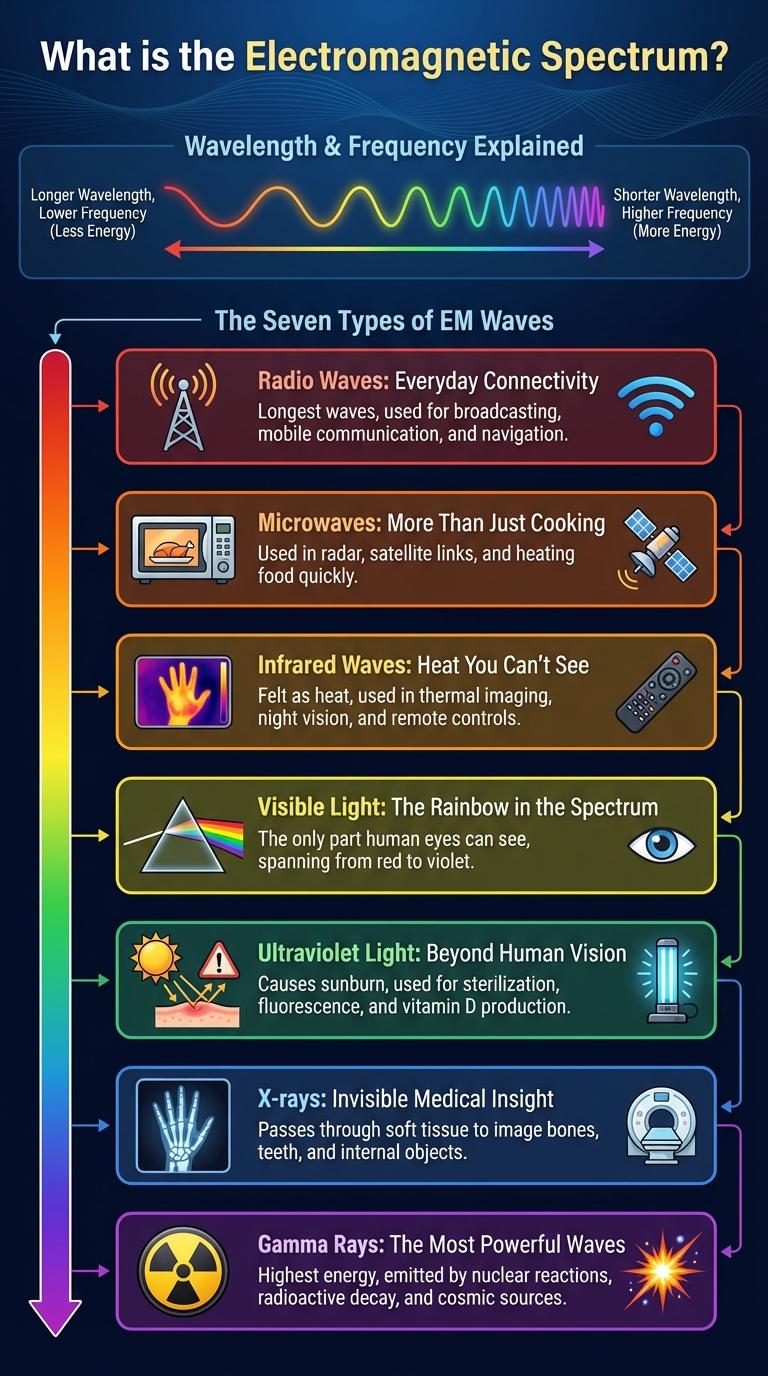
The electromagnetic spectrum encompasses a wide range of wavelengths and frequencies that define various types of electromagnetic radiation, from radio waves to gamma rays. Understanding the spectrum is essential for applications in communication, medical imaging, and scientific research. This infographic visually breaks down the spectrum's segments, highlighting their unique characteristics and practical uses.
What is the Electromagnetic Spectrum?
The Electromagnetic Spectrum represents the entire range of electromagnetic radiation frequencies. It includes all types of waves from radio to gamma rays, organized by wavelength and energy.
- Broad Range - Covers frequencies from extremely low radio waves to extremely high gamma rays.
- Wave Properties - Characterized by wavelength, frequency, and energy, which determine their behavior and application.
- Applications - Used in communication, medical imaging, and scientific research due to diverse properties.
The Electromagnetic Spectrum is fundamental to understanding energy transmission and wave interactions across various technologies.
The Seven Types of EM Waves
The electromagnetic (EM) spectrum consists of seven distinct types of waves, each varying in wavelength and frequency. These waves carry energy and information across different mediums and distances.
The seven types of EM waves include radio waves, microwaves, infrared rays, visible light, ultraviolet rays, X-rays, and gamma rays. Each type serves unique functions in technology, medicine, and communication.
Wavelength & Frequency Explained
The electromagnetic (EM) spectrum encompasses all types of electromagnetic radiation, characterized by varying wavelengths and frequencies. Wavelength is the distance between successive peaks of a wave, measured in meters, while frequency indicates how many wave cycles pass a point per second, measured in hertz (Hz). Higher frequencies correspond to shorter wavelengths, and this inverse relationship governs the properties and applications of EM waves across radio waves, microwaves, infrared, visible light, ultraviolet, X-rays, and gamma rays.
Visible Light: The Rainbow in the Spectrum
Visible light is the portion of the electromagnetic spectrum that human eyes can detect. It consists of a range of colors commonly represented as the rainbow from red to violet.
- Wavelength Range - Visible light wavelengths span approximately 380 to 750 nanometers.
- Color Spectrum - The spectrum includes red, orange, yellow, green, blue, indigo, and violet.
- Energy Levels - Violet light has the highest energy and shortest wavelength, while red has the lowest energy and longest wavelength.
Radio Waves: Everyday Connectivity
Radio waves are a type of electromagnetic radiation with the longest wavelength and lowest frequency in the EM spectrum. They enable wireless communication by transmitting signals over long distances without physical connections.
Everyday connectivity relies heavily on radio waves for technologies such as Wi-Fi, mobile phones, and broadcast radio. These waves facilitate real-time data transfer, making modern communication fast and accessible worldwide.
Microwaves: More Than Just Cooking
Microwaves are a key part of the electromagnetic spectrum with diverse applications beyond cooking. Their unique properties enable communication, medical, and industrial uses.
- Wireless Communication - Microwaves transmit data for Wi-Fi, satellite, and cellular networks due to their ability to carry large amounts of information.
- Radar Technology - Used in aviation and weather forecasting, microwaves help detect objects and atmospheric conditions by reflecting signals.
- Medical Treatments - Microwaves assist in cancer therapy by targeting and heating tissues to destroy malignant cells safely.
Infrared Waves: Heat You Can't See
| Infrared Waves | Details |
|---|---|
| Wavelength Range | 700 nm to 1 mm |
| Position in EM Spectrum | Between Visible Light and Microwaves |
| Source | Objects emitting heat, like the sun, fire, and warm bodies |
| Detection | Sensed as heat but invisible to the human eye |
| Applications | Thermal imaging, remote controls, night-vision cameras, and weather forecasting |
Ultraviolet Light: Beyond Human Vision
Ultraviolet (UV) light is a type of electromagnetic radiation with wavelengths shorter than visible light, ranging from 10 nm to 400 nm. It lies beyond the violet end of the visible spectrum, invisible to the human eye. UV light plays a crucial role in sterilization, fluorescent lighting, and detecting counterfeit currency.
X-rays: Invisible Medical Insight
X-rays are a form of electromagnetic radiation with wavelengths ranging from 0.01 to 10 nanometers. They penetrate soft tissues in the human body, providing critical imaging details not visible to the naked eye.
Used extensively in medical diagnostics, X-rays produce images of bones, teeth, and internal organs to detect fractures, infections, and abnormalities. They operate at high frequencies, enabling deep tissue penetration without invasive procedures. Safety measures and controlled exposure minimize risks associated with X-ray use in healthcare.