
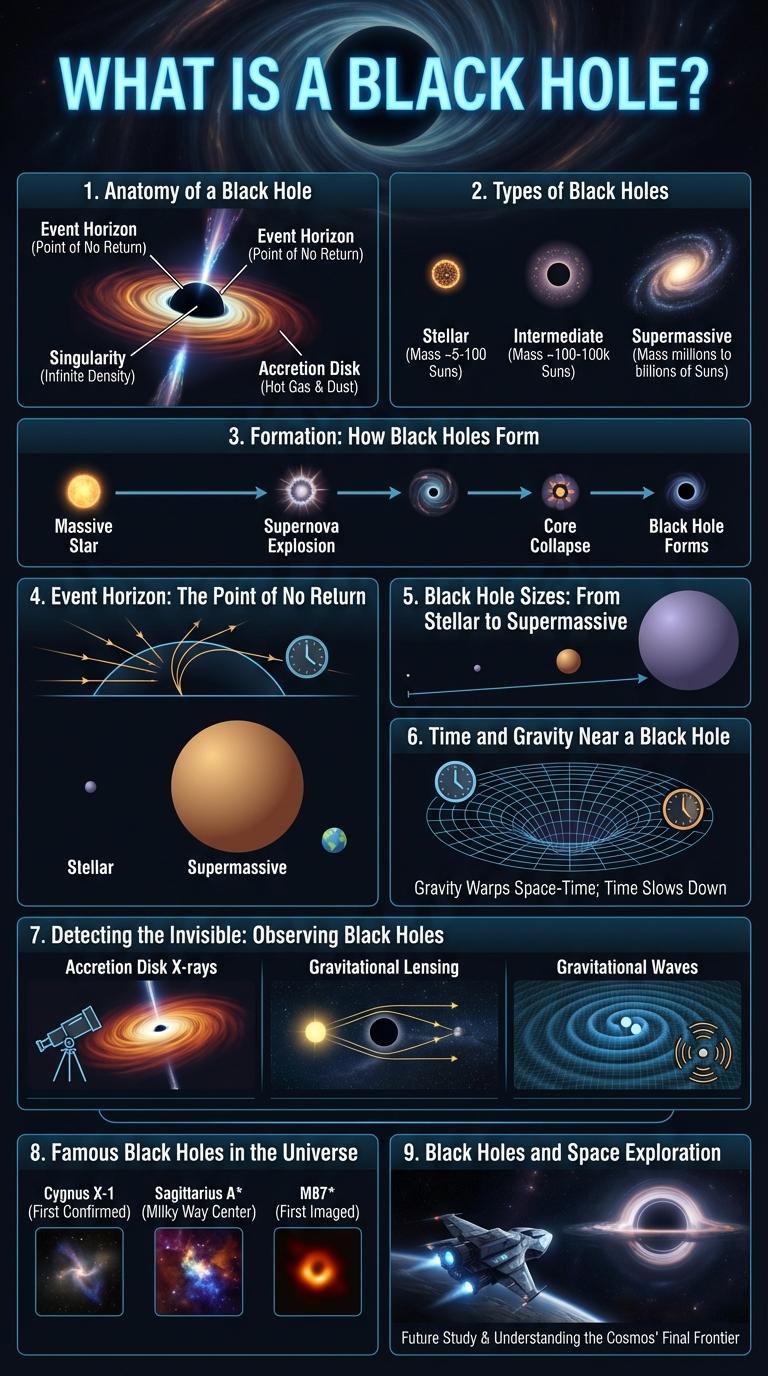
Black holes are regions in space where gravity is so strong that nothing, not even light, can escape. These cosmic phenomena are formed from collapsed stars and play a crucial role in understanding the universe's structure. The infographic visually breaks down their properties, types, and the science behind their mysterious existence.
What is a Black Hole?
A black hole is a region in space where gravity pulls so strongly that nothing, not even light, can escape. Black holes form when massive stars collapse under their own gravity after exhausting their nuclear fuel.
- Event Horizon - The boundary around a black hole beyond which no information or matter can return.
- Singularity - The core point within a black hole where density becomes infinite and space-time curves infinitely.
- Accretion Disk - A ring of gas and dust spiraling into a black hole, emitting intense radiation as it heats up.
Anatomy of a Black Hole
| Component | Description |
|---|---|
| Event Horizon | The boundary around a black hole beyond which no light or information can escape. |
| Singularity | A point of infinite density where the black hole's mass is concentrated. |
| Accretion Disk | A rotating disk of gas and dust spiraling into the black hole, emitting intense radiation. |
| Jets | High-energy beams of particles ejected from the regions near the black hole along its rotational poles. |
| Photon Sphere | The region where gravity bends light into orbit around the black hole. |
Types of Black Holes
Black holes are categorized mainly into three types based on their mass: stellar, intermediate, and supermassive black holes. Stellar black holes form from the gravitational collapse of massive stars, typically between 3 to 20 times the mass of the Sun. Supermassive black holes, found at the centers of galaxies, can contain millions to billions of solar masses, while intermediate black holes fall in between and remain less understood.
Formation: How Black Holes Form
How do black holes form in space? Black holes form when massive stars collapse under their own gravity at the end of their life cycle. This collapse compresses the star's core into an incredibly dense point known as a singularity.
What triggers the collapse of a massive star into a black hole? When a star exhausts its nuclear fuel, it can no longer counterbalance gravitational forces, leading to a rapid inward collapse. The outer layers may explode as a supernova, while the core becomes a black hole.
Can black holes form without a supernova explosion? Yes, certain stars with extremely high masses can collapse directly into black holes without a visible supernova event. This process is known as direct collapse.
Do all black holes originate from stars? Most black holes form from stellar remnants, but supermassive black holes arise from the merging of smaller black holes and accreting matter in galactic centers. These supermassive black holes contain millions to billions of solar masses.
Event Horizon: The Point of No Return
The event horizon is the boundary surrounding a black hole beyond which nothing can escape, not even light. It marks the "point of no return," where gravitational pull becomes infinitely strong. This invisible surface defines the limits of the black hole's influence on space and time.
Black Hole Sizes: From Stellar to Supermassive
Black holes vary greatly in size, ranging from small stellar black holes to massive supermassive black holes. Stellar black holes form from collapsing stars and typically have masses between 5 and 30 times that of our sun.
Supermassive black holes reside at the centers of galaxies and can be millions to billions of times more massive than the sun. These enormous entities influence galaxy formation and the motion of stars around them.
Time and Gravity Near a Black Hole
Black holes are regions in space where gravity is so strong that nothing, not even light, can escape. Time behaves differently near a black hole due to the intense gravitational forces affecting its flow.
- Time dilation - Time slows down significantly near a black hole compared to an observer far away.
- Event horizon - The boundary around a black hole where gravity prevents anything from escaping, marking the point of no return.
- Spacetime curvature - Gravity near a black hole warps spacetime, causing extreme gravitational effects and influencing time's passage.
Detecting the Invisible: Observing Black Holes
Black holes cannot be seen directly because they emit no light, making their detection a challenge for astronomers. Scientists rely on indirect methods to observe the effects of black holes on their surroundings.
- Gravitational Waves - Ripples in spacetime caused by black hole mergers are detected by observatories like LIGO and Virgo.
- Accretion Disks - Hot gas swirling around a black hole emits X-rays that telescopes can capture.
- Stellar Motions - Observing stars orbiting invisible massive objects helps locate black holes.
Advanced technologies and multi-wavelength astronomy enhance the ability to detect and study these invisible cosmic phenomena.
Famous Black Holes in the Universe
Black holes are regions in space where gravity is so strong that not even light can escape. They form from the remnants of massive stars that have collapsed under their own gravity.
Famous black holes include Sagittarius A*, the supermassive black hole at the center of the Milky Way galaxy. Another well-known black hole is Cygnus X-1, one of the first discovered stellar-mass black holes. M87*, captured in the first-ever black hole image by the Event Horizon Telescope, is a supermassive black hole in the galaxy Messier 87.