
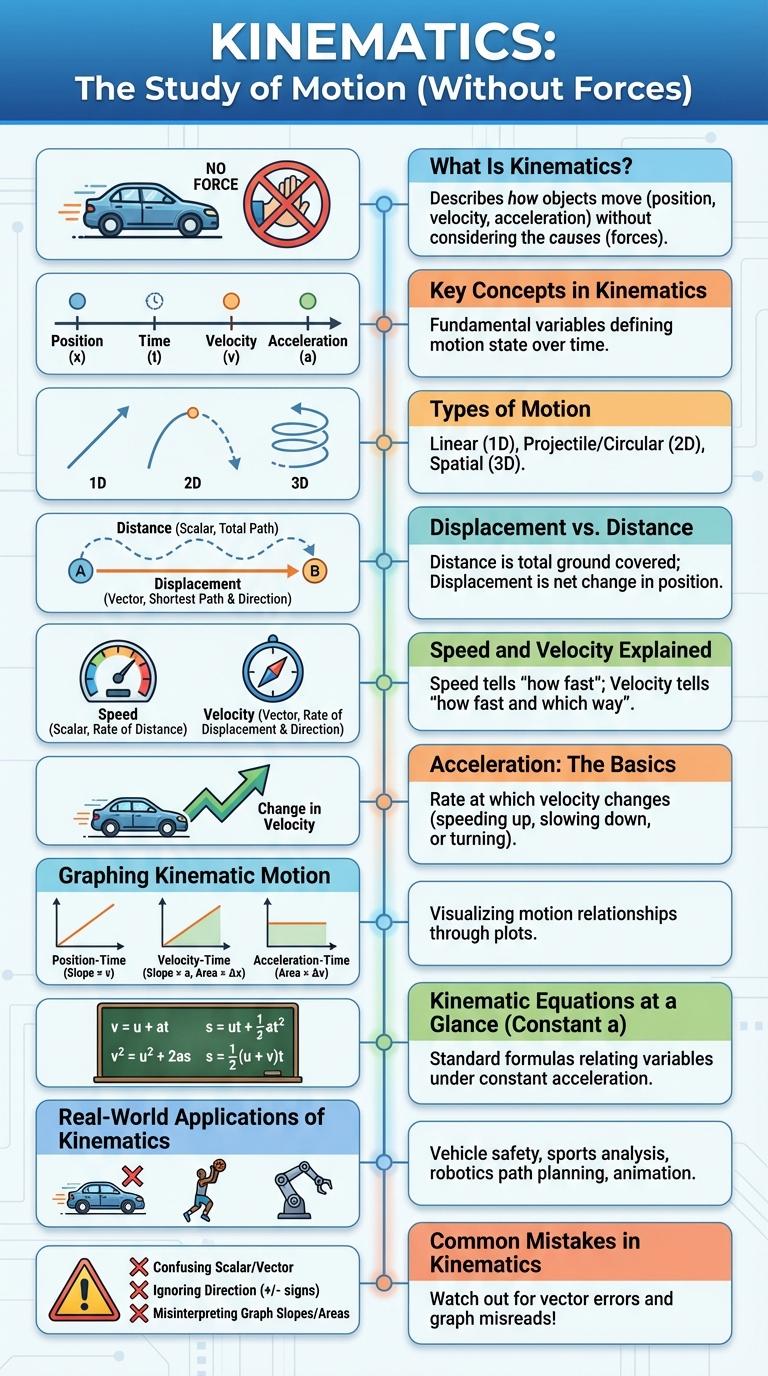
Kinematics explores the motion of objects, focusing on displacement, velocity, and acceleration without considering forces. Infographics simplify complex concepts by visually representing key formulas and motion graphs. This approach enhances understanding of linear, projectile, and circular motion for students and enthusiasts alike.
What Is Kinematics?
Kinematics is the branch of physics that studies the motion of objects without considering the forces causing the motion. It focuses on parameters like displacement, velocity, and acceleration to describe how objects move.
- Displacement - Represents the change in position of an object from its initial point to its final point.
- Velocity - Defines the rate of change of displacement with respect to time, including direction.
- Acceleration - Measures how quickly velocity changes over time for a moving object.
Key Concepts in Kinematics
Kinematics is the branch of physics that describes the motion of objects without considering the forces causing the motion. Key concepts include displacement, velocity, acceleration, and time, which are essential for analyzing an object's trajectory. Graphs and equations help visualize and calculate these parameters for various types of motion such as linear, projectile, and circular.
Types of Motion
Kinematics studies the motion of objects without considering the forces that cause the motion. Understanding types of motion is essential for analyzing how objects move in space and time.
There are three primary types of motion: linear, rotational, and oscillatory. Linear motion occurs in a straight line, rotational motion involves spinning around an axis, and oscillatory motion features repeated back-and-forth movement.
Displacement vs. Distance
Displacement and distance are fundamental concepts in kinematics used to describe motion. Displacement refers to the change in position of an object, considering direction, while distance measures the total length of the path traveled.
Displacement is a vector quantity, meaning it has both magnitude and direction. Distance is a scalar, representing only the magnitude of the path taken. Understanding the difference between displacement and distance helps in analyzing motion accurately in physics.
Speed and Velocity Explained
Kinematics is the branch of physics that studies the motion of objects without considering the forces causing the motion. Speed and velocity are fundamental concepts used to describe how fast an object moves and in what direction.
Speed is a scalar quantity representing the rate of change of distance over time, measured in meters per second (m/s). Velocity is a vector quantity that includes both speed and direction, making it essential for understanding motion fully.
Acceleration: The Basics
Acceleration is a fundamental concept in kinematics describing how an object's velocity changes over time. It is a vector quantity with both magnitude and direction.
- Definition - Acceleration measures the rate at which velocity increases or decreases per unit time.
- Formula - Calculated as a = Dv / Dt, where Dv is change in velocity and Dt is change in time.
- Units - Standard units of acceleration are meters per second squared (m/s2).
Graphing Kinematic Motion
| Graph Type | Purpose |
|---|---|
| Position vs. Time | Shows displacement over time; slope indicates velocity |
| Velocity vs. Time | Indicates how velocity changes; slope represents acceleration |
| Acceleration vs. Time | Displays acceleration magnitude; area under curve gives change in velocity |
| Slope | Rate of change; key to interpreting velocity and acceleration |
| Area Under Curve | Represents cumulative change, such as displacement or velocity |
Kinematic Equations at a Glance
Kinematics describes the motion of objects using mathematical equations without considering the forces causing the motion. The kinematic equations provide essential formulas to calculate displacement, velocity, acceleration, and time in linear motion with constant acceleration.
- v = v0 + at - Calculates final velocity based on initial velocity, acceleration, and time elapsed.
- s = v0t + 1/2at2 - Determines displacement using initial velocity, acceleration, and time.
- v2 = v02 + 2as - Relates velocity and displacement without involving time.
These kinematic equations are fundamental for solving problems related to uniform acceleration in physics.
Real-World Applications of Kinematics
Kinematics plays a crucial role in fields such as robotics, where precise motion planning ensures efficient and accurate movements. In sports science, analyzing athletes' motions helps enhance performance and reduce injury risks. Automotive industries utilize kinematics to design safer and more efficient vehicle suspension systems.