
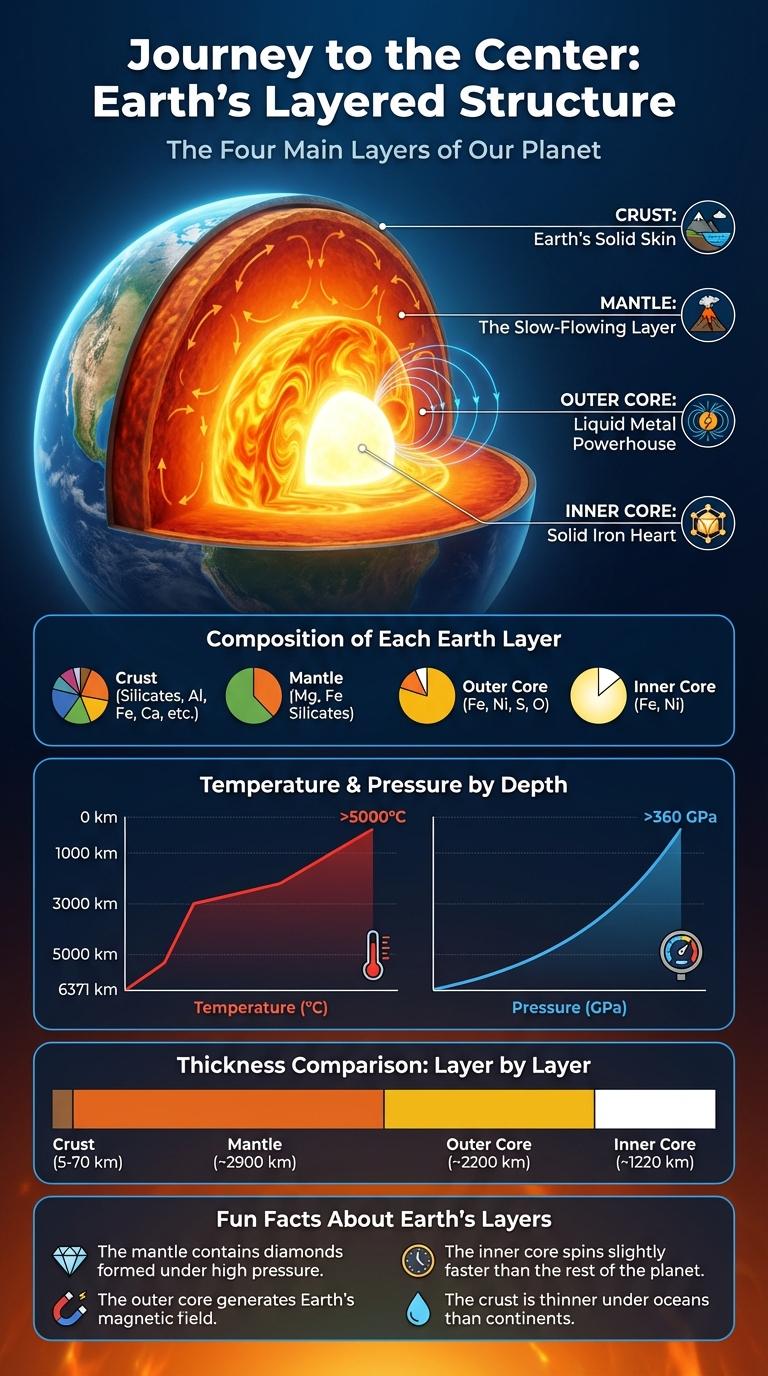
The Earth's structure consists of multiple distinct layers, each with unique properties and compositions. These layers include the crust, mantle, outer core, and inner core, which interact to influence geological activity and the planet's magnetic field. Understanding these layers provides insight into Earth's dynamic processes and supports studies in geology and seismology.
Journey to the Center: Earth's Layered Structure
What are the main layers of the Earth on a journey to its center? The Earth consists of the crust, mantle, outer core, and inner core, each with distinct compositions and properties. Understanding these layers reveals the planet's dynamic processes and structural complexity.
The Four Main Layers of Our Planet
The Earth is composed of four main layers: the crust, mantle, outer core, and inner core. Each layer has distinct properties, such as composition, temperature, and physical state. Understanding these layers helps scientists study geological processes and Earth's magnetic field.
Crust: Earth's Solid Skin
The Earth's crust is the outermost layer and acts as the planet's solid skin. It forms the land we live on and the ocean floors beneath the water.
Crust thickness varies from about 5 km under oceans to up to 70 km under continents. Composed mainly of oxygen, silicon, aluminum, and other elements, it supports all terrestrial life. The crust is divided into tectonic plates that float on the mantle, causing earthquakes and volcanic activity.
Mantle: The Slow-Flowing Layer
The Earth's mantle is a thick layer of rock located between the crust and the core. It behaves as a slow-flowing solid, driving plate tectonics through convection currents.
- Composition - The mantle is primarily made of silicate minerals rich in magnesium and iron.
- Thickness - It extends about 2,900 kilometers (1,800 miles) beneath the Earth's surface.
- Temperature - Temperatures range from approximately 500degC near the crust to over 4,000degC near the core.
Outer Core: Liquid Metal Powerhouse
The outer core is a molten layer composed primarily of liquid iron and nickel. It extends from approximately 2,890 km to 5,150 km beneath the Earth's surface.
This liquid metal layer generates Earth's magnetic field through the movement of its conductive materials. Its dynamic flows create a powerful geodynamo essential for protecting the planet from solar radiation.
Inner Core: Solid Iron Heart
| Layer | Inner Core: Solid Iron Heart |
|---|---|
| Composition | Primarily solid iron and nickel |
| State | Solid due to extreme pressure |
| Temperature | Approximately 5,700 K (5,430 degC) |
| Radius | About 1,220 kilometers (760 miles) |
| Significance | Generates Earth's magnetic field via interaction with outer core |
Composition of Each Earth Layer
The Earth is composed of distinct layers, each with unique materials and characteristics. Understanding the composition of these layers helps explain Earth's structure and geological activity.
- Crust - The outermost layer, primarily composed of oxygen, silicon, aluminum, and trace minerals.
- Mantle - Made mostly of silicate minerals rich in magnesium and iron, extending to a depth of about 2,900 km.
- Outer Core - Composed mainly of liquid iron and nickel, responsible for Earth's magnetic field.
- Inner Core - A solid sphere primarily made of iron and nickel, with extreme pressure keeping it solid despite high temperatures.
Temperature and Pressure by Depth
The Earth is composed of several distinct layers: the crust, mantle, outer core, and inner core. Temperature and pressure increase significantly with depth, influencing the physical state of each layer.
At the crust, temperatures range from 200degC to 400degC, while pressure remains relatively low. Deeper in the mantle, temperatures rise to about 4,000degC with pressures reaching up to 140 GPa, causing rocks to behave plastically.
Thickness Comparison: Layer by Layer
The Earth is composed of four main layers: the Crust, Mantle, Outer Core, and Inner Core. The Mantle is the thickest layer, measuring approximately 2,900 kilometers, which is significantly thicker than the Crust's average thickness of 35 kilometers. The Outer Core has a thickness of about 2,250 kilometers, while the Inner Core is around 1,220 kilometers thick.
| Layer | Thickness (km) |
|---|---|
| Crust | ~35 |
| Mantle | ~2,900 |
| Outer Core | ~2,250 |
| Inner Core | ~1,220 |