
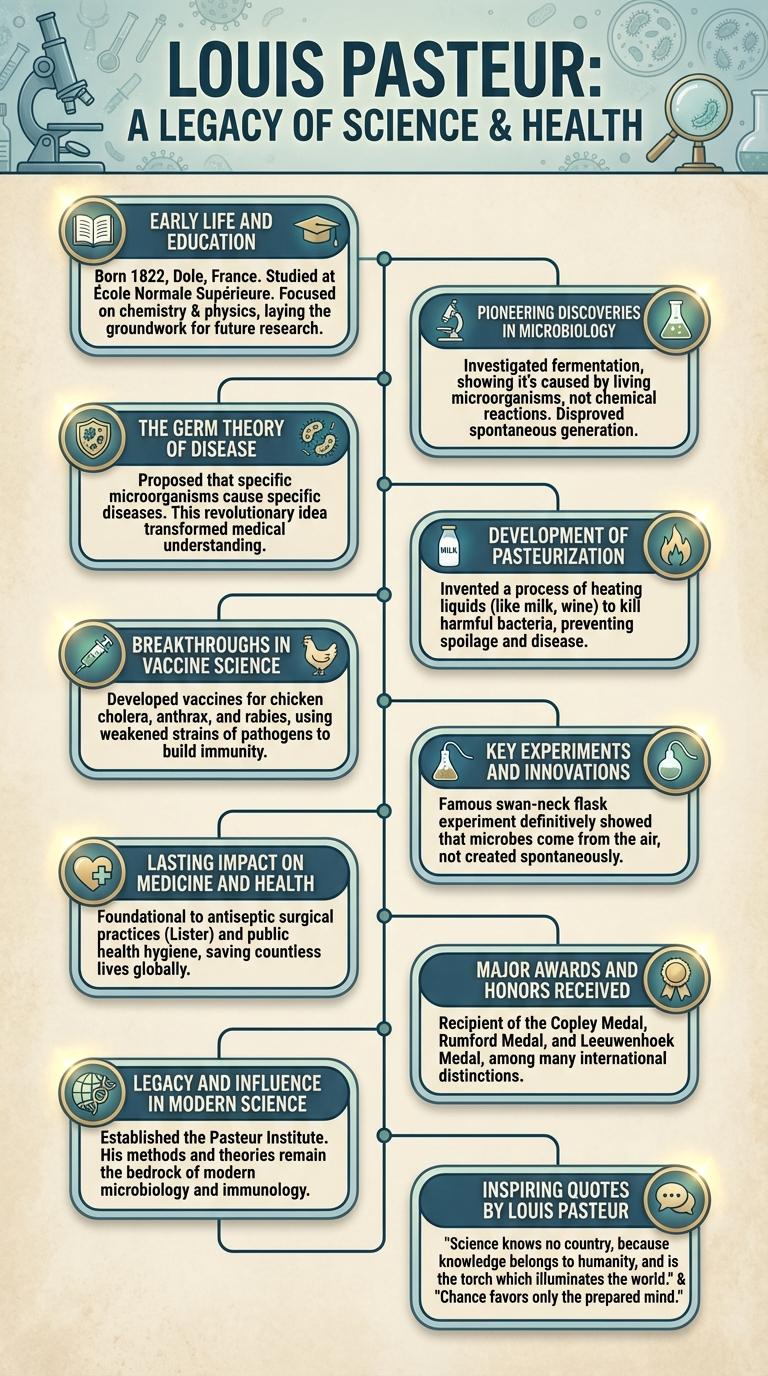
Louis Pasteur revolutionized science with his groundbreaking discoveries in microbiology and vaccination. His work on germ theory laid the foundation for modern medicine, preventing diseases and saving countless lives. This infographic highlights key milestones and contributions of Pasteur's legacy.
Early Life and Education of Louis Pasteur
Louis Pasteur was born on December 27, 1822, in Dole, France, into a family of modest means. His early curiosity about science led him to pursue higher education in chemistry and physics at the Ecole Normale Superieure in Paris.
- Childhood Environment - Raised in a small town, Pasteur's early life was influenced by rural surroundings that sparked his interest in natural sciences.
- Academic Path - Enrolled at Ecole Normale Superieure, where he excelled in chemistry and physics, laying groundwork for his future discoveries.
- Early Research - Conducted studies on crystallography during his time as a student, which contributed to his scientific reputation.
Pasteur's strong educational foundation and early scientific pursuits were crucial in shaping his groundbreaking contributions to microbiology and vaccination.
Pioneering Discoveries in Microbiology
Louis Pasteur revolutionized microbiology with his groundbreaking research on microorganisms and their role in disease. His pioneering discoveries laid the foundation for modern medical and scientific practices.
- Germ Theory of Disease - Pasteur demonstrated that microorganisms cause fermentation and disease, disproving the theory of spontaneous generation.
- Pasteurization - He developed the pasteurization process to kill harmful microbes in food and beverages, improving public health.
- Vaccines Development - Pasteur created the first vaccines for rabies and anthrax, advancing immunology and preventive medicine.
The Germ Theory of Disease
Louis Pasteur revolutionized medicine by establishing the Germ Theory of Disease, proving that microorganisms cause infections. His discoveries laid the foundation for modern microbiology and infection control.
- Microorganisms Cause Disease - Pasteur demonstrated that bacteria and other microbes are responsible for infections, challenging previous beliefs.
- Pasteurization Process - He developed pasteurization to kill harmful microbes in food and beverages, reducing illness from contaminated sources.
- Vaccination Development - Pasteur created vaccines for rabies and anthrax, applying germ theory to prevent deadly diseases effectively.
Development of Pasteurization
Louis Pasteur developed the pasteurization process to prevent spoilage in beverages like wine and milk by heating them to a specific temperature. This method kills harmful microorganisms without affecting the taste or quality of the product.
Pasteurization revolutionized food safety, reducing the spread of diseases caused by contaminated food and drinks. It remains a critical technique in the dairy and beverage industries worldwide.
Breakthroughs in Vaccine Science
Louis Pasteur revolutionized vaccine science by developing the first vaccines for rabies and anthrax, significantly reducing mortality rates. His pioneering work on germ theory laid the foundation for the development of modern immunology. Pasteur's breakthroughs continue to influence vaccine research and public health worldwide.
Key Experiments and Innovations
Louis Pasteur conducted groundbreaking experiments that disproved the theory of spontaneous generation, demonstrating that microorganisms come from other microorganisms. His swan-neck flask experiment was pivotal in establishing the germ theory of disease.
Pasteur innovated the process of pasteurization, which uses heat to kill harmful microbes in food and beverages, significantly improving food safety. He also developed vaccines for rabies and anthrax, transforming medical science and public health worldwide.
Lasting Impact on Medicine and Health
How did Louis Pasteur's discoveries transform medicine and healthcare? Louis Pasteur pioneered germ theory, proving that microorganisms cause disease, which revolutionized the understanding of infection. His development of vaccines and pasteurization set foundational practices that continue to protect global health today.
Major Awards and Honors Received
Louis Pasteur was a pioneering French microbiologist and chemist whose groundbreaking work in germ theory revolutionized medicine. His discoveries laid the foundation for vaccines, pasteurization, and modern microbiology.
Pasteur received numerous prestigious awards including the Copley Medal from the Royal Society in 1874 for his contributions to science. He was also honored with the Rumford Medal in 1883 and the Grand Cross of the Legion of Honour in France. His legacy endures in many scientific institutions bearing his name worldwide.