
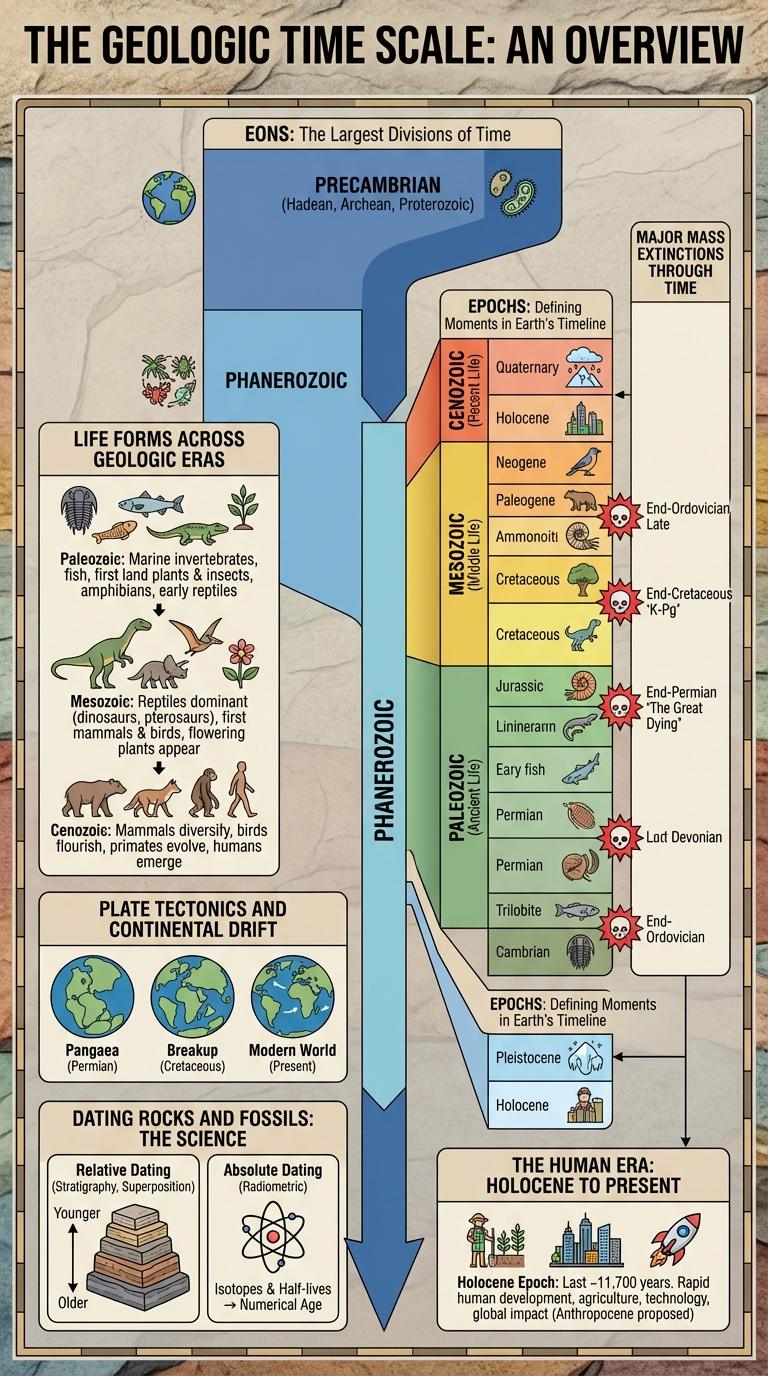
The geologic time scale organizes Earth's history into distinct intervals based on major geological and biological events. This infographic visually breaks down these eras, periods, and epochs to illustrate the timeline of Earth's formation and evolution. It highlights key milestones such as the appearance of life, mass extinctions, and the rise of mammals.
The Geologic Time Scale: An Overview
The Geologic Time Scale divides Earth's 4.6 billion-year history into distinct intervals based on significant geological and biological events. It is organized into eons, eras, periods, epochs, and ages, providing a framework to study Earth's evolution. Key markers include the Precambrian, Paleozoic, Mesozoic, and Cenozoic eras, each representing major shifts in climate, life forms, and continental arrangements.
Eons: The Largest Divisions of Time
The geologic time scale divides Earth's history into large segments called eons. Eons represent the broadest intervals of geologic time, spanning hundreds to thousands of millions of years.
There are four primary eons: Hadean, Archean, Proterozoic, and Phanerozoic. Each eon marks significant changes in Earth's formation, atmosphere, and biological development.
Eras: Major Shifts in Earth's History
The geologic time scale divides Earth's history into distinct eras characterized by significant geological and biological changes. These eras mark major shifts in climate, life forms, and tectonic activity shaping the planet's development.
The Paleozoic Era witnessed the rise of marine life and the first land plants. The Mesozoic Era is known for the dominance of dinosaurs and the appearance of the first birds and mammals.
The Cenozoic Era, starting 66 million years ago, saw the rise of mammals and flowering plants. This era continues today, highlighting human evolution as a major event in Earth's recent history.
Periods: Key Chapters of Life's Evolution
The geologic time scale divides Earth's history into distinct periods, each marking significant chapters in life's evolution. From the Cambrian Period's explosion of marine life to the rise of mammals in the Cenozoic, these intervals reveal major biological milestones. Understanding these periods helps trace the development of ecosystems and the progression of species over millions of years.
Epochs: Defining Moments in Earth's Timeline
| Epoch | Significant Events |
|---|---|
| Holocene | Emergence of human civilizations; development of agriculture; climate stabilization |
| Pleistocene | Ice ages; evolution and spread of Homo sapiens; megafauna extinctions |
| Miocene | Expansion of grasslands; diversification of mammals and birds; early hominids appear |
| Eocene | Warm climate peak; rise of modern mammal families; first whales |
| Cretaceous | Last period of dinosaurs; flowering plants dominate; ends with mass extinction |
Major Mass Extinctions Through Time
The geologic time scale records Earth's history through major eras and significant events, including mass extinctions that reshaped life on the planet. These extinction events caused drastic reductions in biodiversity and paved the way for new evolutionary paths.
- End-Permian Extinction - Occurred around 252 million years ago, it is the largest mass extinction, wiping out about 96% of marine species and 70% of terrestrial vertebrates.
- End-Cretaceous Extinction - Happened 66 million years ago, this event ended the reign of dinosaurs and allowed mammals to diversify and dominate.
- Late Devonian Extinction - Took place approximately 375 million years ago, significantly affecting marine life, particularly reef-building organisms.
Life Forms Across Geologic Eras
How have life forms evolved throughout the geologic eras? The geologic time scale divides Earth's history into distinct eras, each marked by significant developments in life forms. From simple microorganisms in the Precambrian to the diverse mammals of the Cenozoic, life has continuously transformed.
| Era | Dominant Life Forms |
|---|---|
| Precambrian | Simple single-celled organisms, early multicellular life |
| Paleozoic | Marine invertebrates, early fish, amphibians, and first land plants |
| Mesozoic | Dinosaurs, early birds, and flowering plants |
| Cenozoic | Mammals, birds, and modern plants |
Each era reflects dramatic shifts in biodiversity driven by climate, geological changes, and extinction events. Life complexity increased steadily, forming the foundation for ecosystems present today.
Plate Tectonics and Continental Drift
The geologic time scale chronicles Earth's history, highlighting major events like the movement of tectonic plates. Plate tectonics explains the dynamic shifting of Earth's lithosphere, shaping continents and ocean basins over millions of years.
Continental drift, a key concept within plate tectonics, describes the gradual movement of continents across Earth's surface. This movement caused the formation and breakup of supercontinents, influencing climate, sea levels, and biodiversity. Understanding these processes helps explain the distribution of fossils and geological formations worldwide.
Dating Rocks and Fossils: The Science
The geologic time scale organizes Earth's history into distinct intervals based on rock layers and fossil records. Dating rocks and fossils involves scientific techniques to determine their age accurately.
- Radiometric Dating - Measures decay of radioactive isotopes in minerals to calculate absolute age of rocks and fossils.
- Stratigraphy - Analyzes the layering of sedimentary rocks to identify relative age and sequence of events.
- Fossil Correlation - Uses index fossils to link rock layers of similar age across different geographic locations.
These methods together provide a comprehensive understanding of Earth's geologic timeline and evolutionary history.