
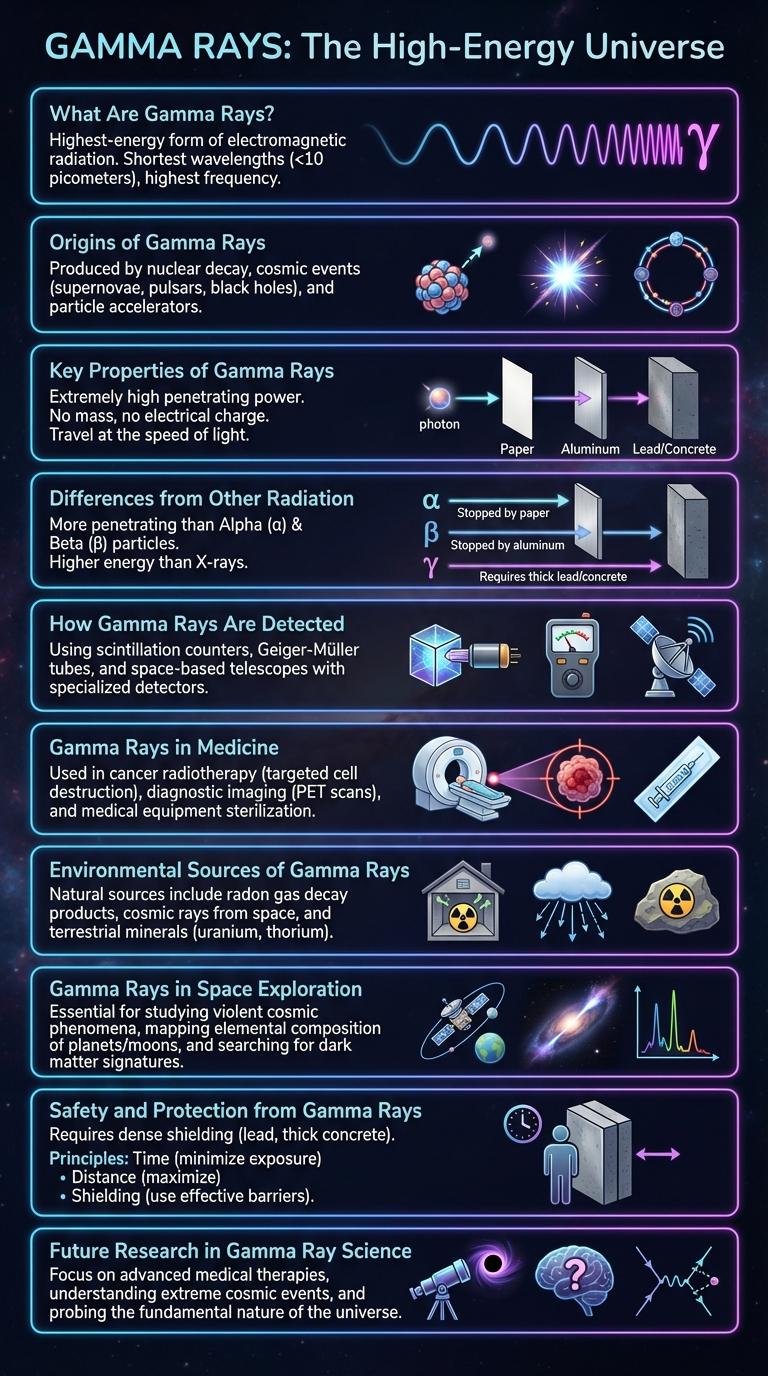
Gamma rays, a form of high-energy electromagnetic radiation, play a crucial role in scientific research and medical applications. Their incredibly short wavelengths enable detailed imaging and cancer treatment by targeting diseased cells with precision. Understanding gamma rays enhances our knowledge of nuclear reactions and the universe's most energetic processes.
What Are Gamma Rays?
Gamma rays are a form of electromagnetic radiation with the highest energy and shortest wavelength in the spectrum. They originate from nuclear reactions, cosmic phenomena, and radioactive decay. Gamma rays have the ability to penetrate most materials, making them useful in medical imaging and cancer treatment.
Origins of Gamma Rays
| Source | Description |
|---|---|
| Supernova Explosions | Gamma rays are emitted during the intense nuclear reactions and shock waves when massive stars explode. |
| Neutron Stars and Pulsars | Rapidly spinning neutron stars release gamma rays through their strong magnetic fields and particle acceleration. |
| Black Holes | Accretion disks around black holes produce gamma radiation from high-energy particle collisions and relativistic jets. |
| Cosmic Ray Interactions | High-energy cosmic rays colliding with interstellar gas generate gamma rays through secondary particle emissions. |
| Radioactive Decay | Certain unstable atomic nuclei emit gamma rays during radioactive decay processes on Earth and in space. |
Key Properties of Gamma Rays
Gamma rays are a form of electromagnetic radiation with the highest energy and shortest wavelength in the electromagnetic spectrum. They have wavelengths less than 0.01 nanometers, enabling them to penetrate most materials.
Gamma rays are emitted by radioactive atoms and certain cosmic sources such as neutron stars and supernovae. Their high frequency and energy allow applications in medical imaging, cancer treatment, and astrophysics research.
Differences from Other Radiation
Gamma rays are electromagnetic waves with extremely high energy and very short wavelengths, making them more penetrating than other types of radiation like alpha and beta particles. Unlike alpha particles, gamma rays carry no electric charge and can pass through most materials, including human tissue, requiring dense shielding such as lead to block effectively.
Gamma rays differ from beta radiation, which consists of high-energy electrons with limited penetration ability and electric charge. Their ionizing power is lower than alpha particles but higher penetration distinguishes gamma rays for uses in medical imaging, cancer treatment, and sterilization processes.
How Gamma Rays Are Detected
How are gamma rays detected effectively?
Gamma rays are detected using specialized instruments that measure their high-energy photons. Common devices include scintillation detectors and semiconductor detectors, which convert gamma rays into measurable electrical signals.
Gamma Rays in Medicine
Gamma rays are high-energy electromagnetic waves used in medicine for diagnosing and treating diseases. They play a key role in cancer radiotherapy by targeting and destroying malignant cells with precision. Medical imaging techniques like PET scans utilize gamma rays to provide detailed internal body images for accurate diagnosis.
Environmental Sources of Gamma Rays
Gamma rays are high-energy electromagnetic radiation emitted by naturally occurring sources in the environment. These rays penetrate various materials and contribute to background radiation affecting all living organisms.
- Cosmic Rays - High-energy particles from outer space collide with the Earth's atmosphere, producing secondary gamma rays.
- Radioactive Decay - Naturally occurring isotopes such as uranium, thorium, and radon emit gamma rays during their radioactive decay processes.
- Terrestrial Sources - Gamma radiation originates from soil, rocks, and minerals containing radioactive elements distributed across the Earth's crust.
Gamma Rays in Space Exploration
Gamma rays are the highest-energy form of electromagnetic radiation and are crucial in space exploration. They provide insights into cosmic phenomena that are not visible in other wavelengths.
Gamma-ray telescopes detect bursts from distant galaxies, revealing the violent processes in the universe such as supernovae and black hole activity. Space missions like NASA's Fermi Gamma-ray Space Telescope have mapped gamma-ray sources across the sky, improving our understanding of cosmic events. Scientists use gamma-ray data to study cosmic rays, dark matter, and the life cycle of stars.
Safety and Protection from Gamma Rays
Gamma rays are highly penetrating electromagnetic radiation that can pose significant health risks. Proper safety measures and protective materials are essential to minimize exposure and prevent radiation damage.
- Lead Shielding - Lead is commonly used to block gamma rays due to its high density and atomic number.
- Distance Principle - Increasing distance from gamma radiation sources reduces exposure intensity following the inverse square law.
- Time Limitation - Limiting time spent near gamma ray sources decreases the total absorbed radiation dose.
- Protective Clothing - Specialized garments embedded with radiation-attenuating materials offer additional protection.
- Radiation Monitoring - Geiger counters and dosimeters track gamma ray exposure to ensure safe operational environments.