
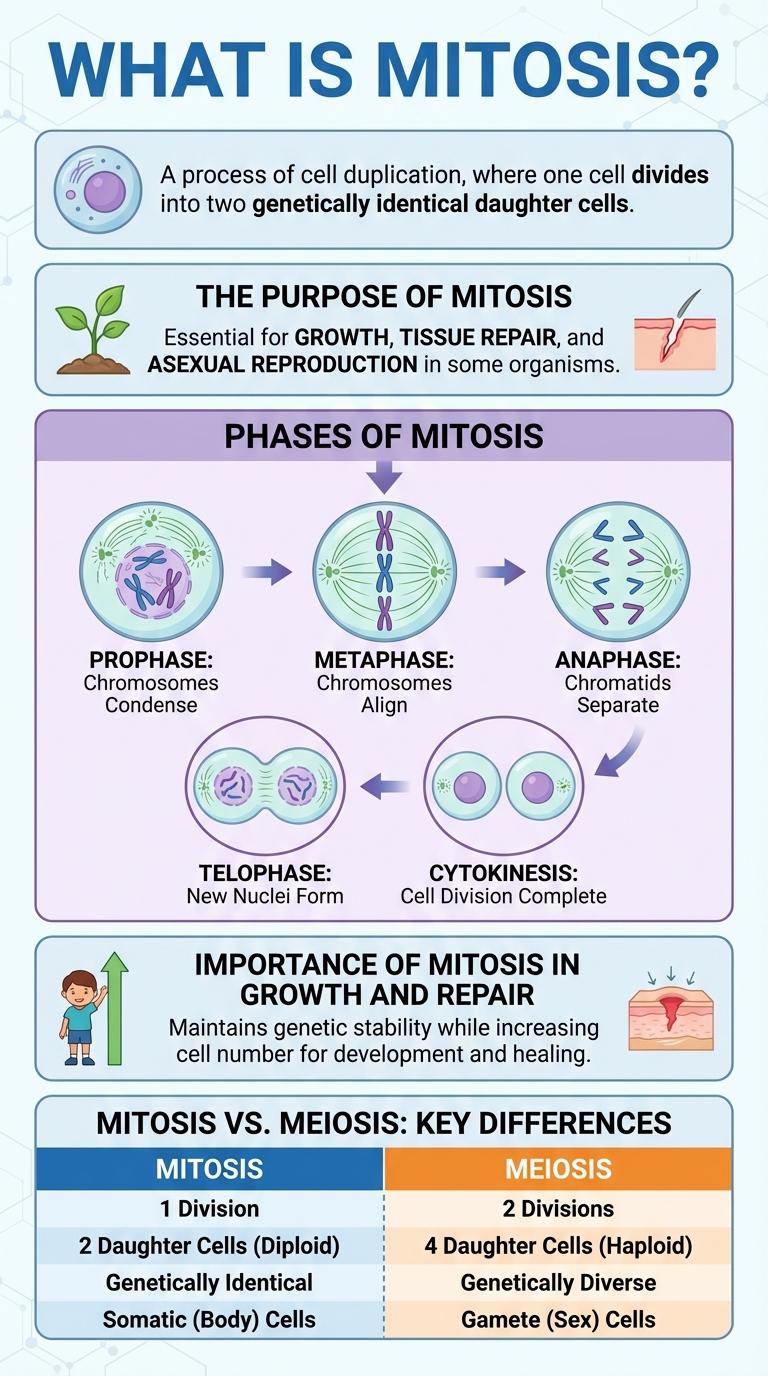
Mitosis is a vital process in cell division, ensuring that genetic material is accurately duplicated and distributed to daughter cells. This infographic breaks down each phase of mitosis, highlighting key stages such as prophase, metaphase, anaphase, and telophase. Understanding mitosis provides insight into growth, development, and tissue repair in multicellular organisms.
What is Mitosis?
Mitosis is a process of cell division that results in two genetically identical daughter cells from a single parent cell. It is essential for growth, development, and tissue repair in multicellular organisms.
During mitosis, the cell's chromosomes are precisely duplicated and evenly distributed to ensure each daughter cell receives a complete set of genetic information. This process consists of distinct phases: prophase, metaphase, anaphase, and telophase, followed by cytokinesis. Proper mitotic division maintains genetic stability and supports organismal health.
The Purpose of Mitosis
What is the purpose of mitosis in living organisms?
The primary purpose of mitosis is to enable growth and repair by producing identical daughter cells. Mitosis ensures genetic consistency across cells, maintaining chromosome number in somatic cells.
Phases of Mitosis
Mitosis is a crucial process where a single cell divides to produce two identical daughter cells. It ensures genetic material is accurately duplicated and evenly distributed.
- Prophase - Chromosomes condense and become visible while the nuclear membrane begins to dissolve.
- Metaphase - Chromosomes align at the cell's equatorial plate, ensuring proper separation.
- Anaphase - Sister chromatids are pulled apart toward opposite poles of the cell.
- Telophase - Nuclear membranes re-form around the separated chromatids now at each pole.
- Cytokinesis - Cytoplasm divides, resulting in two distinct daughter cells.
Prophase: Chromosomes Condense
Prophase marks the first stage of mitosis where chromosomes begin to condense and become visible under a microscope. This condensation is essential for the accurate segregation of genetic material during cell division.
- Chromosome Condensation - Chromatin fibers tightly coil and shorten, forming distinct chromosomes.
- Spindle Formation - Microtubules start to organize into the mitotic spindle originating from centrioles.
- Nuclear Envelope Breakdown - The nuclear membrane disassembles to allow spindle fibers to access chromosomes.
The visible chromosomes ensure that each daughter cell will receive an identical set of genetic information.
Metaphase: Chromosomes Align
Metaphase is a critical stage of mitosis where chromosomes line up in the middle of the cell. This alignment ensures equal distribution of genetic material to the two daughter cells.
- Chromosome Alignment - Chromosomes arrange themselves along the metaphase plate at the cell's equator.
- Spindle Fiber Attachment - Spindle fibers connect to the centromeres of each chromosome to facilitate movement.
- Preparation for Separation - The proper alignment is essential for accurate chromosome segregation during anaphase.
Anaphase: Chromatids Separate
Anaphase is a crucial stage of mitosis where sister chromatids separate and move toward opposite poles of the cell. This movement ensures that each new daughter cell receives an identical set of chromosomes.
During anaphase, spindle fibers shorten, pulling chromatids apart at the centromere. The separation marks the transition toward the final stages of cell division, leading to cell replication.
Telophase: New Nuclei Form
Telophase is the final stage of mitosis where new nuclei form around the separated sets of chromosomes. During this phase, nuclear envelopes reassemble, creating two distinct nuclei within the cell. Chromosomes begin to decondense, preparing the cell for division completion and the onset of cytokinesis.
Cytokinesis: Cell Division Complete
Cytokinesis marks the final step in cell division, completing the separation of the cell into two daughter cells. This process ensures each daughter cell contains its own nucleus and a complete set of organelles.
During cytokinesis, the cytoplasm is evenly divided by a contractile ring that pinches the cell membrane. This physical division finalizes mitosis, enabling cells to function independently.
Importance of Mitosis in Growth and Repair
| Aspect | Details |
|---|---|
| Definition of Mitosis | A process of cell division resulting in two genetically identical daughter cells. |
| Role in Growth | Enables organismal growth by increasing cell number, essential during development. |
| Role in Repair | Replaces damaged or dead cells to maintain tissue integrity and function. |
| Cell Cycle Stage | Occurs during the M phase of the cell cycle. |
| Significance | Maintains genetic stability and supports regeneration of tissues. |