
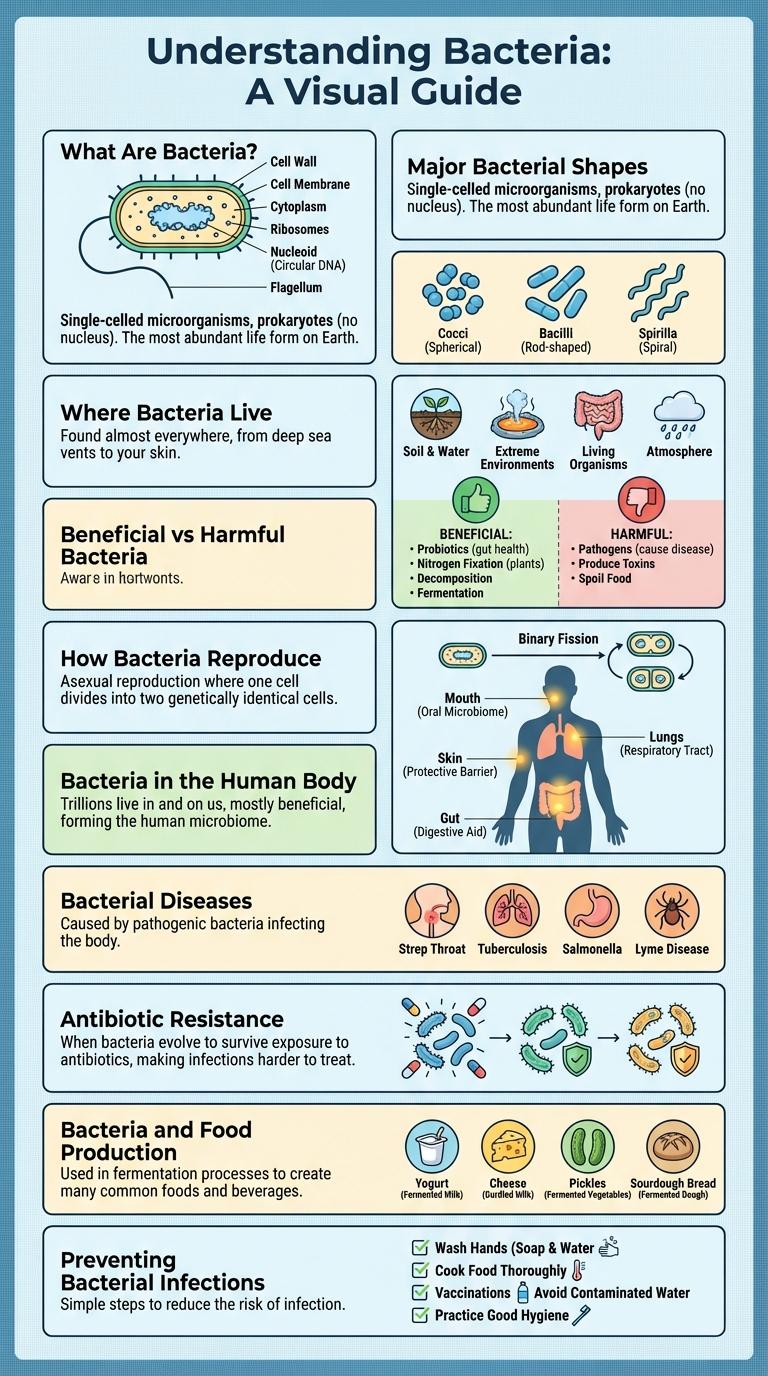
Bacteria are microscopic organisms that play crucial roles in ecosystems, human health, and industry. Understanding their shapes, types, and functions helps reveal their impact on daily life and scientific research. This infographic highlights key facts about bacteria, illustrating their diversity and importance.
What Are Bacteria?
Bacteria are microscopic, single-celled organisms found in virtually every environment on Earth. They play essential roles in ecosystems, human health, and industry.
These prokaryotic microorganisms lack a nucleus and have diverse shapes such as rods, spheres, and spirals. Some bacteria cause diseases, while many are beneficial for processes like digestion and nitrogen fixation.
Major Bacterial Shapes
Bacteria exhibit diverse shapes that play a crucial role in their identification and classification. These shapes influence their movement, reproduction, and interaction with environments.
The three major bacterial shapes are cocci, bacilli, and spirilla. Cocci are spherical bacteria found in clusters or chains. Bacilli are rod-shaped bacteria common in soil and water. Spirilla are spiral-shaped bacteria known for their unique corkscrew motion.
Where Bacteria Live
Bacteria inhabit diverse environments ranging from soil and water to extreme conditions like hot springs and deep ocean vents. They thrive on human skin, inside the digestive tract, and on household surfaces, contributing to both health and disease. These microorganisms adapt to nearly every habitat on Earth, making them some of the most versatile life forms.
Beneficial vs Harmful Bacteria
Bacteria are microscopic organisms that exist in various environments, playing crucial roles in ecosystems and human health. They can be broadly categorized into beneficial bacteria that support life processes and harmful bacteria that cause diseases.
- Beneficial bacteria aid digestion - These bacteria help break down food and synthesize vitamins in the human gut.
- Beneficial bacteria promote immunity - They stimulate the immune system and protect against harmful pathogens.
- Harmful bacteria cause infections - Pathogenic bacteria can invade tissues and trigger diseases such as pneumonia and tuberculosis.
Understanding the balance between beneficial and harmful bacteria is essential for maintaining health and preventing infections.
How Bacteria Reproduce
| Method | Description |
|---|---|
| Binary Fission | Bacteria replicate their DNA, then divide into two identical daughter cells. This is the most common reproduction method. |
| Conjugation | Two bacterial cells connect via pili, exchanging genetic material to increase genetic diversity without producing new cells immediately. |
| Transformation | Bacteria absorb free DNA fragments from their environment, integrating new genetic traits for adaptation. |
| Transduction | Bacteriophages carry genetic material from one bacterium to another, facilitating horizontal gene transfer. |
| Spore Formation | Under harsh conditions, some bacteria form endospores that can survive until the environment becomes favorable for growth. |
Bacteria in the Human Body
Bacteria play a crucial role in the human body, contributing to various essential functions. These microorganisms form complex communities that affect health and disease.
The human gut hosts the largest bacterial population, influencing digestion and immunity.
- Microbiome Diversity - Over 1,000 different bacterial species colonize the human body, primarily in the gut.
- Immune System Support - Beneficial bacteria help train and regulate the immune response to pathogens.
- Vitamin Production - Certain bacteria synthesize vitamins such as vitamin K and B vitamins essential for human health.
Bacterial Diseases
Bacterial diseases are illnesses caused by harmful bacteria invading the body. Common examples include tuberculosis, strep throat, and urinary tract infections. Early diagnosis and proper antibiotic treatment are essential to prevent complications and spread.
Antibiotic Resistance
What is antibiotic resistance in bacteria?
Antibiotic resistance occurs when bacteria evolve to survive exposure to antibiotics designed to kill them. This makes infections harder to treat and increases the risk of disease spread, severe illness, and death.
Bacteria and Food Production
Bacteria play a crucial role in food production by aiding fermentation processes that enhance flavor, texture, and preservation. These microorganisms convert sugars and other compounds into beneficial products like lactic acid and alcohol.
Common examples include Lactobacillus in yogurt, which ferments lactose into lactic acid, and Saccharomyces in bread-making, which produces carbon dioxide for dough rising. Bacteria also contribute to the production of cheese, sauerkraut, and fermented beverages.