
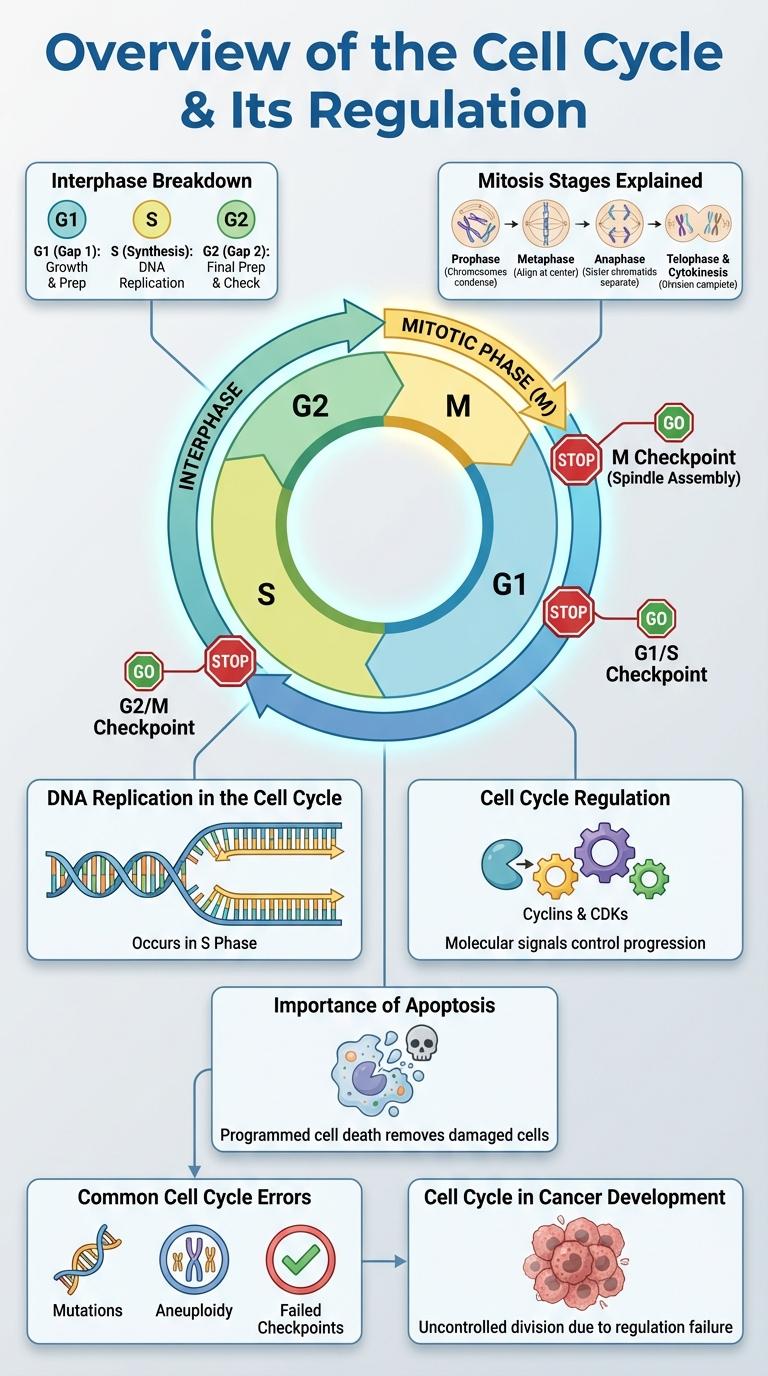
The cell cycle is a series of carefully regulated phases that ensure accurate cell growth and division. This infographic visually breaks down each stage, including interphase and mitosis, highlighting key events and checkpoints. Understanding the cell cycle is crucial for grasping how cells reproduce and maintain genetic stability.
Overview of the Cell Cycle
The cell cycle is a series of ordered phases that lead to cell growth and division. It ensures accurate replication and distribution of genetic material to daughter cells.
The cycle consists of interphase and mitotic phase. Interphase includes G1, S, and G2 phases where the cell grows and DNA replicates. The mitotic phase involves mitosis and cytokinesis, resulting in two identical daughter cells.
Phases of the Cell Cycle
The cell cycle is a series of stages that a cell goes through to grow and divide. Each phase is essential for proper cell function and replication.
- G1 Phase - The cell grows and synthesizes proteins needed for DNA replication.
- S Phase - DNA replication occurs, resulting in the duplication of chromosomes.
- G2 Phase - The cell prepares for mitosis by producing necessary organelles and molecules.
- M Phase - Mitosis takes place, dividing the cell's duplicated chromosomes into two daughter nuclei.
- Cytokinesis - The cytoplasm divides, forming two separate daughter cells.
Interphase Breakdown
The cell cycle consists of distinct phases that prepare a cell for division. Interphase is the longest stage, comprising G1, S, and G2 phases, during which the cell grows and DNA is replicated. Breakdown of Interphase highlights critical processes such as protein synthesis, DNA replication, and checkpoint control ensuring cell readiness for mitosis.
Mitosis Stages Explained
The cell cycle is a series of phases that lead to cell division and replication. Mitosis is a crucial part of this cycle, ensuring accurate distribution of duplicated chromosomes into two daughter cells. The stages of mitosis include prophase, metaphase, anaphase, and telophase, each characterized by distinct cellular events.
In prophase, chromosomes condense and the mitotic spindle forms. Metaphase aligns chromosomes along the cell's equatorial plane, preparing them for separation. During anaphase, sister chromatids are pulled apart toward opposite poles, followed by telophase, where nuclear membranes re-form and chromosomes decondense.
Cytokinesis typically follows mitosis, dividing the cytoplasm and completing cell division. This tightly regulated process maintains genetic stability across generations of cells. Visualizing these stages in an infographic aids in understanding mitotic progression and cell cycle regulation.
Key Cell Cycle Checkpoints
What are the key checkpoints in the cell cycle that ensure proper cell division?
Cell cycle checkpoints monitor and regulate the progression of cell division to maintain genomic stability. These checkpoints halt the cycle if errors or DNA damage are detected, allowing for repair or triggering apoptosis if necessary.
| Checkpoint | Function |
|---|---|
| G1 Checkpoint | Checks for DNA damage and cell size before entering S phase. |
| S Checkpoint | Monitors DNA replication accuracy during S phase. |
| G2 Checkpoint | Ensures all DNA is replicated and undamaged before mitosis. |
| M Checkpoint | Verifies proper chromosome attachment to spindle fibers before anaphase. |
DNA Replication in the Cell Cycle
The cell cycle is a series of stages that a cell goes through to grow and divide. DNA replication is a critical process that occurs during the cell cycle to ensure genetic material is accurately duplicated.
- DNA Replication Timing - DNA replication occurs during the S phase of the cell cycle, where the cell synthesizes a complete copy of its DNA.
- Replication Origin Sites - Replication initiates at multiple origin sites along the DNA molecule to allow efficient copying of the entire genome.
- Replication Enzymes - Key enzymes like DNA polymerase and helicase play essential roles in unwinding the DNA and synthesizing new strands.
Precise DNA replication during the cell cycle ensures that daughter cells receive an exact genetic copy for proper function and development.
Cell Cycle Regulation
| Phase | Regulation Mechanism |
|---|---|
| G1 Phase | Controlled by Cyclin D and CDK4/6; restriction point checks DNA integrity before replication |
| S Phase | Activation of Cyclin E/CDK2 complex initiates DNA synthesis; ATR and ATM proteins monitor replication stress |
| G2 Phase | Checkpoint regulated by Cyclin A/CDK2 and Wee1 kinase to ensure DNA replication completion and repair |
| M Phase | Regulated by Cyclin B/CDK1 complex; spindle assembly checkpoint prevents chromosome missegregation |
| Key Regulators | p53 tumor suppressor induces cell cycle arrest on DNA damage; Rb protein modulates E2F transcription factors |
Importance of Apoptosis
The cell cycle regulates cell growth and division, ensuring proper development and tissue repair. Apoptosis, or programmed cell death, is crucial for eliminating damaged or unnecessary cells to maintain cellular health.
Apoptosis prevents the accumulation of harmful mutations that could lead to diseases like cancer. This process supports tissue homeostasis by balancing cell proliferation with cell death.
Common Cell Cycle Errors
The cell cycle is a tightly regulated process essential for cell growth and division. Errors during this cycle can lead to serious cellular malfunctions and diseases.
- Checkpoint Failure - Cells may proceed through the cycle despite DNA damage, risking mutations.
- Chromosome Missegregation - Improper separation of chromosomes can result in aneuploidy and genetic instability.
- Uncontrolled Cell Division - Loss of regulation may cause unchecked proliferation, contributing to cancer development.