
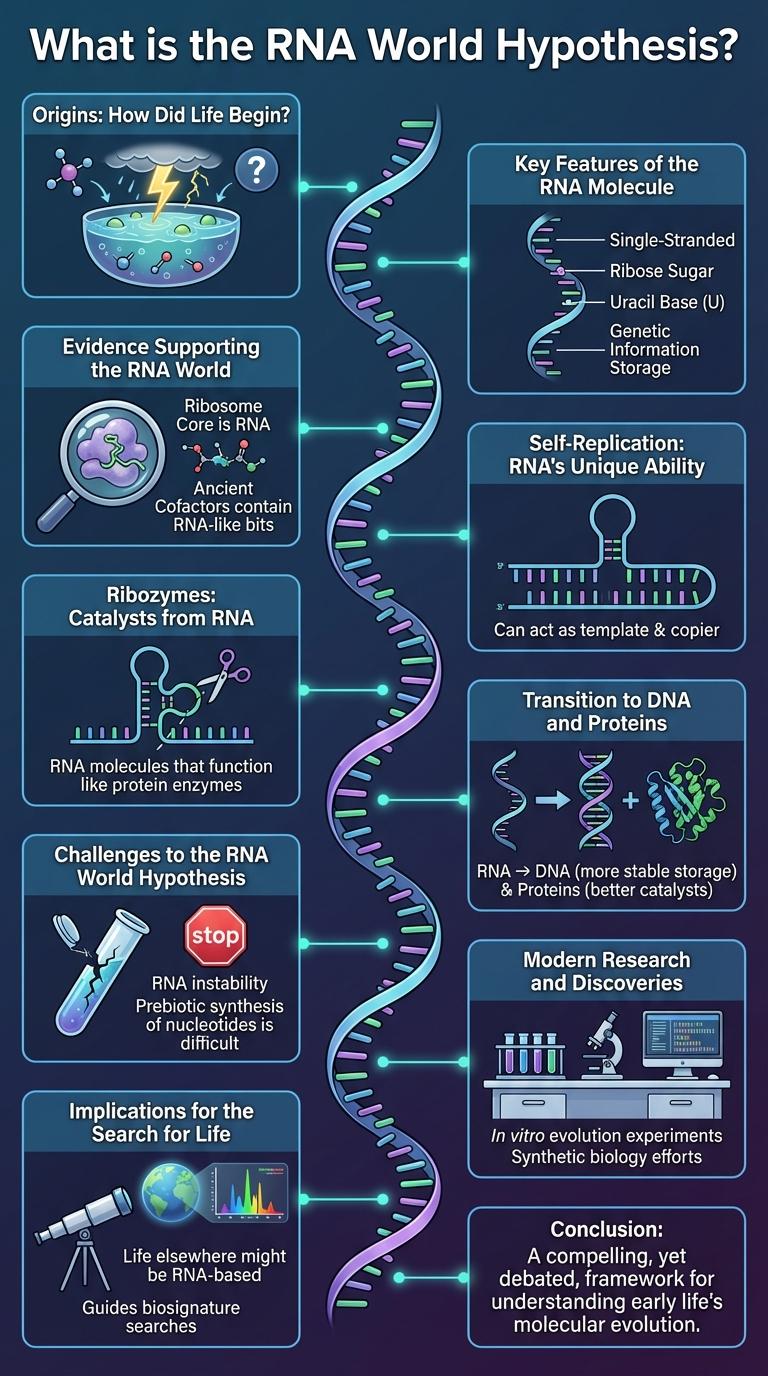
The RNA World Hypothesis proposes that RNA molecules were the first to store genetic information and catalyze chemical reactions, predating DNA and proteins. This concept highlights RNA's dual role as both genetic material and enzyme, essential for early life's emergence. Understanding this hypothesis sheds light on the origin of life and the evolutionary transition to more complex biological systems.
What is the RNA World Hypothesis?
The RNA World Hypothesis proposes that RNA molecules were the key components in early life forms before DNA and proteins existed. It suggests RNA had the dual role of storing genetic information and catalyzing chemical reactions.
- RNA as Genetic Material - RNA likely served as the first genetic material, capable of self-replication without proteins.
- Catalytic Functions - Ribozymes, RNA molecules with enzymatic activity, support the idea that RNA catalyzed early biochemical reactions.
- Evolutionary Bridge - The hypothesis explains the transition from simple RNA molecules to complex DNA-protein life forms through natural selection.
Origins: How Did Life Begin?
The RNA World Hypothesis suggests that early life forms used RNA both to store genetic information and to catalyze chemical reactions. This theory proposes that RNA molecules were the precursors to current life, preceding DNA and proteins. It explains the origin of life by highlighting RNA's dual role in heredity and metabolism before the evolution of complex biological systems.
Key Features of the RNA Molecule
The RNA World Hypothesis proposes that RNA molecules were precursors to current life, carrying both genetic information and catalytic functions. Key features of RNA molecules support their dual role in early biological systems.
- Self-replication - RNA can store genetic information and catalyze its own replication, enabling early life forms to propagate.
- Catalytic activity - Ribozymes, RNA molecules with enzymatic functions, facilitate biochemical reactions without proteins.
- Structural versatility - RNA can fold into complex three-dimensional shapes essential for diverse biological functions.
Evidence Supporting the RNA World
The RNA World Hypothesis suggests that early life was based on RNA molecules capable of storing genetic information and catalyzing chemical reactions. This concept provides a plausible explanation for the origin of life before DNA and proteins became dominant.
Evidence supporting this hypothesis includes the discovery of ribozymes, RNA molecules that can catalyze specific biochemical reactions, demonstrating RNA's dual function. The existence of RNA sequences capable of self-replication highlights RNA's potential role as both genetic material and enzymatic catalyst in primordial organisms.
Self-Replication: RNA's Unique Ability
The RNA World Hypothesis proposes RNA as the first self-replicating molecule essential for life's origin. RNA's unique ability to store genetic information and catalyze chemical reactions supports this theory.
- Self-Replication - RNA molecules can catalyze their own replication without proteins.
- Catalytic Activity - Ribozymes, RNA enzymes, perform biochemical reactions crucial for replication.
- Genetic Storage - RNA carries genetic codes necessary to produce functional molecules.
RNA's dual role as genetic material and catalyst underpins its central role in early molecular evolution.
Ribozymes: Catalysts from RNA
The RNA World Hypothesis suggests that early life relied on RNA both to store genetic information and to catalyze chemical reactions. Ribozymes are RNA molecules that act as catalysts, supporting this theory by demonstrating RNA's ability to perform enzyme-like functions.
Ribozymes facilitate essential biochemical reactions, such as RNA splicing and peptide bond formation, without proteins. Their catalytic activity highlights RNA's dual role in genetic coding and metabolism in primordial cells. This evidence supports the concept that RNA was a key player in the origin of life before DNA and proteins emerged.
Transition to DNA and Proteins
What is the RNA World Hypothesis and its role in the transition to DNA and proteins?
The RNA World Hypothesis suggests early life used RNA for both genetic information and catalysis. RNA's versatility paved the way for the evolution of DNA as a more stable genetic material and proteins as efficient enzymes.
| Stage | Key Transition |
|---|---|
| RNA World | RNA molecules stored genetic info and catalyzed reactions. |
| Transition to DNA | DNA evolved for more stable, long-term genetic storage. |
| Emergence of Proteins | Proteins developed as specialized catalysts enhancing biochemical efficiency. |
| RNA's Role | RNA acted as a template and catalyst before proteins dominated. |
The shift from RNA to DNA allowed cells to maintain genetic integrity with less mutation. Proteins replaced ribozymes by providing a wider range of catalytic activities essential to complex life.
Challenges to the RNA World Hypothesis
The RNA World Hypothesis suggests that early life forms relied on RNA for both genetic information storage and catalytic functions. This theory provides a framework for understanding the origin of life before DNA and proteins became dominant.
Significant challenges to the RNA World Hypothesis include the instability of RNA molecules under prebiotic conditions. Additionally, the spontaneous formation of complex RNA strands and their replication mechanisms remain difficult to explain.
Modern Research and Discoveries
The RNA World Hypothesis suggests that early life forms relied on RNA both to store genetic information and to catalyze chemical reactions. Modern research has identified ribozymes, RNA molecules with enzymatic functions, which support this theory by demonstrating RNA's capability to self-replicate. Recent discoveries of ancient RNA sequences in extreme environments provide further evidence of RNA's central role in the origin of life.