
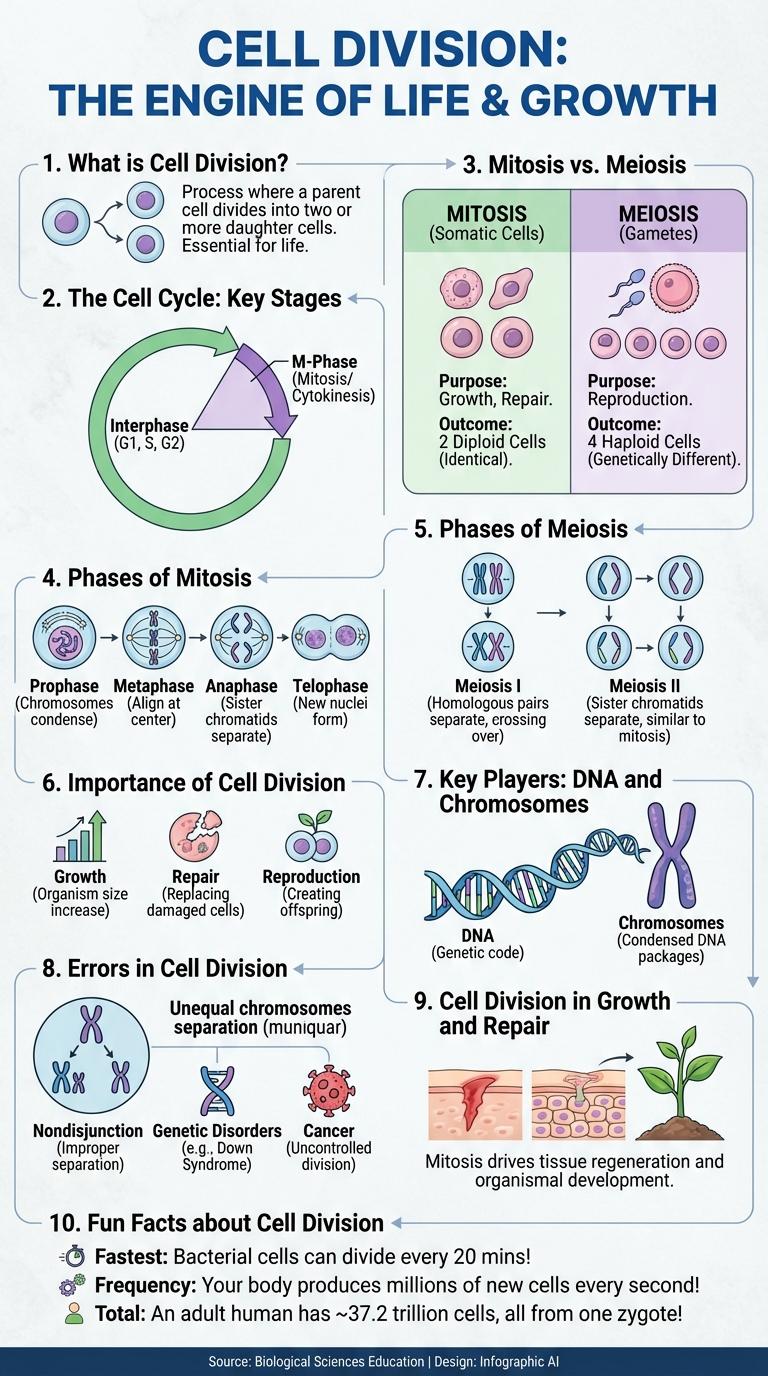
Cell division is a fundamental biological process where a single cell divides into two daughter cells, essential for growth, development, and tissue repair. This infographic visually breaks down the stages of cell division, highlighting key phases like mitosis and cytokinesis. Understanding these steps clarifies how organisms maintain cellular function and genetic consistency.
What is Cell Division?
Cell division is the biological process by which a single cell splits into two or more daughter cells. This process is essential for growth, development, and tissue repair in living organisms.
- Definition of Cell Division - Cell division involves the replication and distribution of a cell's genetic material to ensure each new cell has the necessary components.
- Types of Cell Division - The primary types of cell division are mitosis, which produces identical cells, and meiosis, which produces reproductive cells with half the chromosome number.
- Significance of Cell Division - Cell division supports organismal growth, replaces damaged cells, and enables reproduction in unicellular and multicellular organisms.
The Cell Cycle: Key Stages
The cell cycle is a series of stages that a cell undergoes to grow and divide. It ensures accurate DNA replication and cellular function, preparing the cell for mitosis.
The key stages of the cell cycle include Interphase, Mitosis, and Cytokinesis. Interphase is the longest phase, where the cell grows and DNA is replicated.
Mitosis is the phase where the cell's chromosomes are separated into two identical sets. This process includes Prophase, Metaphase, Anaphase, and Telophase, ensuring equal genetic distribution.
Cytokinesis follows mitosis, dividing the cytoplasm to form two distinct daughter cells. These daughter cells enter the cycle again, maintaining tissue growth and repair.
Mitosis vs. Meiosis
| Aspect | Mitosis |
|---|---|
| Purpose | Growth, tissue repair, and asexual reproduction |
| Number of Divisions | One division |
| Number of Daughter Cells | Two genetically identical diploid cells |
| Chromosome Number | Maintained (diploid, 2n) |
| Genetic Variation | Minimal, daughter cells are clones |
| Aspect | Meiosis |
|---|---|
| Purpose | Production of gametes for sexual reproduction |
| Number of Divisions | Two successive divisions (Meiosis I & II) |
| Number of Daughter Cells | Four genetically distinct haploid cells |
| Chromosome Number | Halved (haploid, n) |
| Genetic Variation | High, due to crossing over and independent assortment |
Phases of Mitosis
Mitosis is a process of cell division that results in two genetically identical daughter cells. It consists of distinct phases: Prophase, Metaphase, Anaphase, and Telophase. Each phase ensures proper chromosome alignment, separation, and distribution to maintain cellular function.
Phases of Meiosis
What are the key phases of meiosis? Meiosis consists of two main stages: Meiosis I and Meiosis II, each containing specific phases that ensure genetic diversity through cell division. These phases precisely reduce chromosome numbers by half to form gametes.
| Phase | Description |
|---|---|
| Prophase I | Chromosomes condense, homologous chromosomes pair up, and crossing-over occurs, exchanging genetic material. |
| Metaphase I | Homologous chromosome pairs align at the cell equator preparing for separation. |
| Anaphase I | Homologous chromosomes are pulled to opposite poles, reducing chromosome number by half. |
| Telophase I | Chromosomes arrive at poles; the cell divides into two haploid cells. |
| Meiosis II (Prophase II to Telophase II) | Similar to mitosis, sister chromatids separate, resulting in four genetically distinct haploid cells. |
Importance of Cell Division
Cell division is a fundamental biological process essential for growth, development, and tissue repair in living organisms. It ensures genetic material is accurately transmitted from one generation of cells to the next.
During cell division, a single parent cell divides into two daughter cells, each containing identical DNA. This process supports organismal growth by increasing cell number and replaces damaged or dead cells, maintaining tissue health. Proper regulation of cell division is crucial to prevent diseases such as cancer, where uncontrolled cell division occurs.
Key Players: DNA and Chromosomes
Cell division is a fundamental biological process where a single cell divides into two daughter cells. DNA carries the genetic instructions crucial for this process, while chromosomes ensure the accurate distribution of DNA during division. Together, DNA and chromosomes coordinate to maintain genetic continuity across generations.
Errors in Cell Division
Cell division is a critical biological process that ensures the proper replication and distribution of genetic material to daughter cells. Errors in cell division can lead to severe consequences, including genetic disorders and cancer.
- Aneuploidy - An error causing cells to have an abnormal number of chromosomes, often leading to diseases like Down syndrome.
- Chromosome Mis-segregation - Incorrect separation of chromosomes during mitosis, resulting in genetic instability.
- Spindle Assembly Checkpoint Failure - Malfunction in the checkpoint mechanism that normally prevents cells with chromosome alignment errors from dividing.
Cell Division in Growth and Repair
Cell division is a fundamental biological process that enables growth and repair in multicellular organisms. It ensures that new cells are produced to replace damaged or dead ones, maintaining tissue health and function.
During growth, cell division increases the number of cells to support the organism's development. In repair, it restores damaged tissues by generating new cells that heal wounds and recover functionality.