
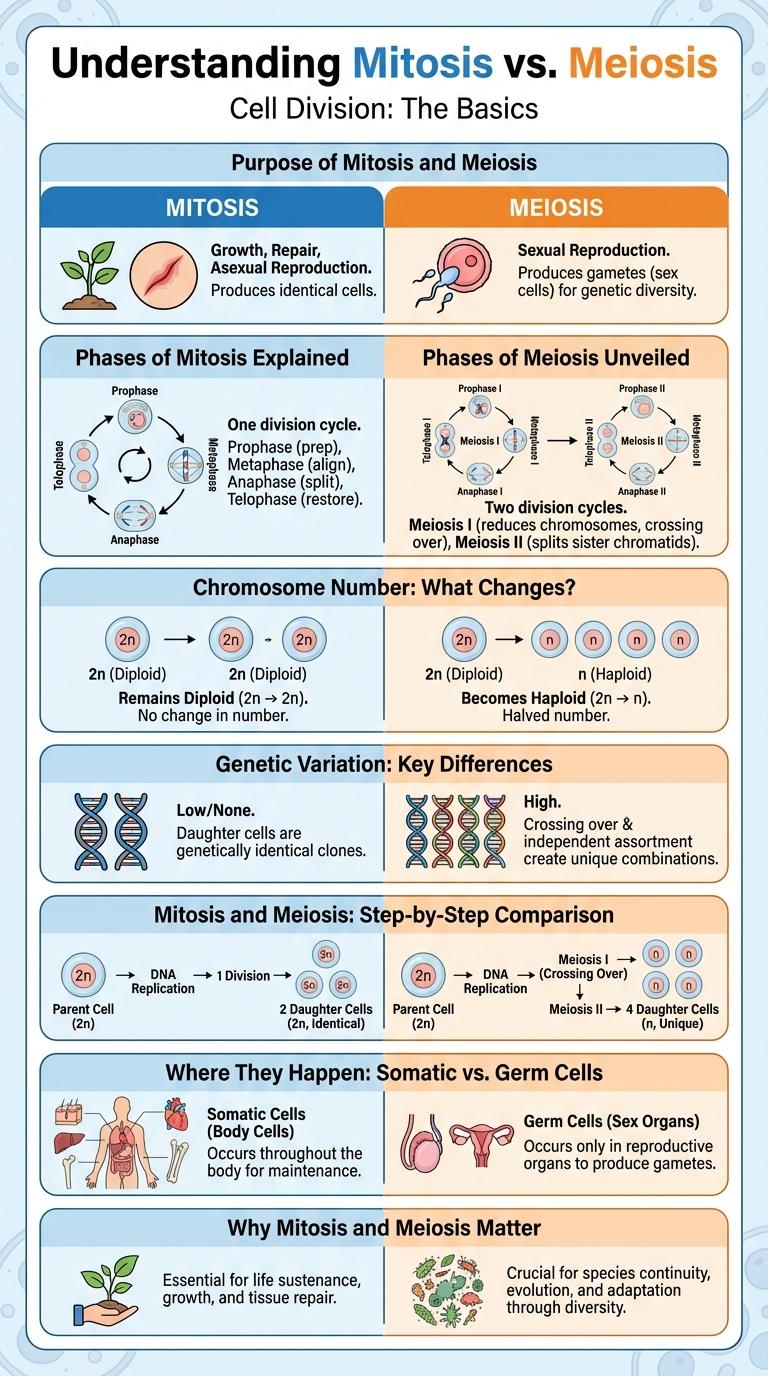
Mitosis and meiosis are essential cellular processes responsible for cell division and genetic diversity. Mitosis produces two identical daughter cells for growth and repair, while meiosis generates four genetically unique gametes for reproduction. Understanding their distinct phases and outcomes is crucial for grasping fundamental biological concepts.
Understanding Mitosis vs. Meiosis
Mitosis and meiosis are two types of cell division processes essential for growth, development, and reproduction in living organisms. Mitosis produces two genetically identical daughter cells, while meiosis results in four genetically diverse gametes.
Understanding the differences in stages, outcomes, and purposes of mitosis and meiosis helps clarify how organisms maintain genetic stability and promote variation. Mitosis is crucial for tissue repair, whereas meiosis enables sexual reproduction through the formation of sperm and egg cells.
Cell Division: The Basics
Cell division is a fundamental biological process where a single cell divides into two or more daughter cells. Mitosis results in two genetically identical diploid cells, essential for growth and tissue repair. Meiosis produces four genetically diverse haploid cells, crucial for sexual reproduction.
Purpose of Mitosis and Meiosis
Mitosis and meiosis are essential cellular processes that enable growth, development, and reproduction in organisms. They ensure the accurate distribution of genetic material to new cells, supporting life continuity.
- Purpose of Mitosis - Mitosis produces two genetically identical daughter cells for growth, repair, and asexual reproduction.
- Purpose of Meiosis - Meiosis generates four genetically diverse gametes to facilitate sexual reproduction and genetic variation.
- Genetic Stability - Mitosis maintains chromosome number, while meiosis reduces it by half to preserve species chromosome count after fertilization.
Both processes play critical roles in organismal survival by balancing genetic fidelity and diversity.
Phases of Mitosis Explained
| Phase of Mitosis | Description |
|---|---|
| Prophase | Chromosomes condense and become visible. The nuclear membrane begins to disintegrate. Spindle fibers start forming from centrosomes. |
| Metaphase | Chromosomes align at the metaphase plate (center of the cell). Spindle fibers attach to the centromere of each chromosome. |
| Anaphase | Sister chromatids separate and move toward opposite poles of the cell, pulled by spindle fibers. |
| Telophase | Separated chromatids reach the poles. Nuclear membranes reform around each set of chromosomes. Chromosomes begin to de-condense. |
| Cytokinesis | Division of the cytoplasm occurs, resulting in two daughter cells with identical genetic material. |
Phases of Meiosis Unveiled
Meiosis is a specialized cell division process that reduces the chromosome number by half, resulting in four genetically diverse gametes. Understanding the phases of meiosis reveals how genetic variation is introduced and maintained in sexually reproducing organisms.
The process consists of two consecutive divisions: Meiosis I and Meiosis II, each with distinct phases critical for genetic distribution.
- Prophase I - Homologous chromosomes pair and exchange genetic material through crossing over.
- Metaphase I - Paired homologous chromosomes align at the cell equator.
- Anaphase I - Homologous chromosomes separate and move to opposite poles.
- Telophase I and Cytokinesis - Two haploid cells form as the cytoplasm divides.
- Meiosis II - Sister chromatids separate during similar phases as mitosis, producing four unique haploid cells.
Chromosome Number: What Changes?
Mitosis and meiosis are critical cellular processes that differ primarily in how they affect chromosome numbers. Understanding these differences helps clarify their roles in growth, reproduction, and genetic diversity.
Chromosome number changes during mitosis and meiosis reflect their distinct biological purposes.
- Mitosis preserves chromosome number - Produces two daughter cells identical to the parent cell, maintaining the diploid chromosome number (2n).
- Meiosis reduces chromosome number - Results in four daughter cells with half the original chromosome number, producing haploid cells (n) for sexual reproduction.
- Chromosome duplication differs - In mitosis, chromosomes duplicate once and divide once; meiosis includes one duplication followed by two successive divisions.
Genetic Variation: Key Differences
How do mitosis and meiosis differ in generating genetic variation? Mitosis produces genetically identical cells, maintaining the original chromosome number. Meiosis creates genetically diverse gametes through processes like crossing over and independent assortment.
Mitosis and Meiosis: Step-by-Step Comparison
Mitosis and meiosis are two types of cell division essential for growth, repair, and reproduction. Mitosis results in two identical daughter cells, whereas meiosis produces four genetically diverse gametes. Understanding each step highlights differences in chromosome behavior and genetic outcomes.
| Mitosis | Meiosis |
|---|---|
| Prophase: Chromosomes condense and spindle forms. | Prophase I: Homologous chromosomes pair and cross over. |
| Metaphase: Chromosomes align at the cell equator. | Metaphase I: Homologous pairs line up side by side. |
| Anaphase: Sister chromatids separate to opposite poles. | Anaphase I: Homologous chromosomes separate, sister chromatids remain together. |
| Telophase: Nuclear envelopes reform and cell divides. | Telophase I: Two haploid cells form, each with duplicated chromosomes. |
| Cytokinesis: Produces two genetically identical diploid cells. | Meiosis II resembles mitosis, separating sister chromatids to form four haploid cells. |
Where They Happen: Somatic vs. Germ Cells
Mitosis occurs in somatic cells, which are all body cells except for the reproductive cells. This process is essential for growth, repair, and maintaining genetic consistency throughout an organism's body.
Meiosis takes place in germ cells within the reproductive organs, such as the ovaries and testes. It reduces the chromosome number by half, producing haploid gametes for sexual reproduction.