
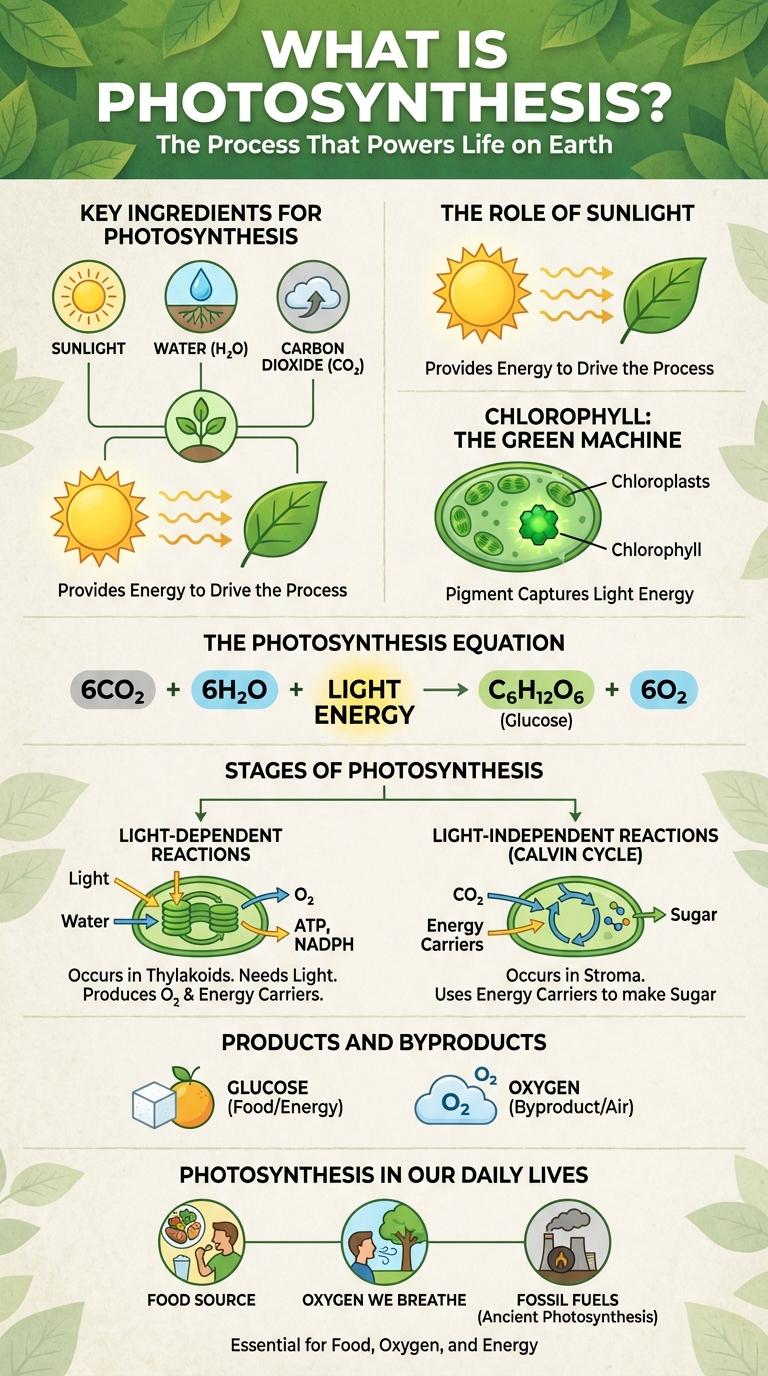
Photosynthesis is the process by which plants convert sunlight into energy, using carbon dioxide and water to produce oxygen and glucose. This infographic illustrates the key stages, including light absorption, energy conversion, and oxygen release. Understanding these steps highlights photosynthesis' role in sustaining life and balancing the Earth's atmosphere.
What Is Photosynthesis?
Photosynthesis is the process by which green plants, algae, and some bacteria convert light energy into chemical energy. This process occurs primarily in chloroplasts using chlorophyll to capture sunlight. Photosynthesis produces glucose and oxygen from carbon dioxide and water, sustaining life on Earth.
Key Ingredients for Photosynthesis
Photosynthesis is the process by which green plants convert sunlight into chemical energy. It requires specific key ingredients to efficiently produce glucose and oxygen.
The main ingredients for photosynthesis include sunlight, carbon dioxide, and water. Chlorophyll within the plant cells captures the sunlight, enabling the conversion of these elements into energy.
The Role of Sunlight
Sunlight is the primary energy source driving the process of photosynthesis in plants. It powers the conversion of carbon dioxide and water into glucose and oxygen.
- Light Absorption - Chlorophyll pigments in plant cells absorb sunlight to initiate photosynthesis.
- Energy Conversion - Sunlight energy is converted into chemical energy stored as ATP and NADPH.
- Glucose Production - The chemical energy from sunlight is used to synthesize glucose from carbon dioxide and water.
Chlorophyll: The Green Machine
Chlorophyll is the essential pigment that gives plants their green color and enables photosynthesis. It absorbs light most efficiently in the blue and red wavelengths, converting solar energy into chemical energy. This process powers the production of glucose, vital for plant growth and oxygen release.
The Photosynthesis Equation
Photosynthesis is the process by which green plants convert sunlight, carbon dioxide, and water into glucose and oxygen. The photosynthesis equation represents this chemical reaction in a simple, balanced form.
The equation shows the essential reactants and products involved in photosynthesis.
- Reactants - Carbon dioxide (CO2) and water (H2O) are the primary substances used by plants during photosynthesis.
- Products - Glucose (C6H12O6) provides energy and oxygen (O2) is released as a byproduct into the atmosphere.
- Equation - The balanced photosynthesis equation is: 6CO2 + 6H2O + light energy - C6H12O6 + 6O2.
Stages of Photosynthesis
Photosynthesis is a vital process by which green plants convert sunlight into chemical energy. It primarily occurs in the chloroplasts within plant cells.
The process consists of two main stages: the light-dependent reactions and the light-independent reactions. Each stage plays a crucial role in producing glucose and oxygen.
Light-Dependent Reactions
Light-dependent reactions are the initial phase of photosynthesis where light energy is converted into chemical energy. These reactions occur in the thylakoid membranes of chloroplasts, producing ATP and NADPH.
- Photon Absorption - Chlorophyll pigments absorb light photons, exciting electrons to higher energy states.
- Electron Transport Chain - Excited electrons travel through protein complexes, generating a proton gradient.
- ATP and NADPH Formation - Energy from the proton gradient synthesizes ATP, while NADP+ is reduced to NADPH.
These energy-rich molecules power the subsequent Calvin cycle, facilitating carbon fixation.
Light-Independent Reactions (Calvin Cycle)
| Aspect | Details |
|---|---|
| Process Name | Light-Independent Reactions (Calvin Cycle) |
| Location | Stroma of chloroplasts |
| Main Function | Conversion of carbon dioxide into glucose using ATP and NADPH |
| Key Phases |
|
| Primary Enzymes | Rubisco (ribulose-1,5-bisphosphate carboxylase/oxygenase) |
Products and Byproducts
Photosynthesis produces glucose and oxygen as its main products. These substances are essential for energy and respiration in plants and other organisms.
Glucose serves as a vital energy source and building block for plant growth. Oxygen released during photosynthesis supports aerobic life on Earth. Water and carbon dioxide act as reactants, while oxygen is a valuable byproduct that sustains the atmosphere.