
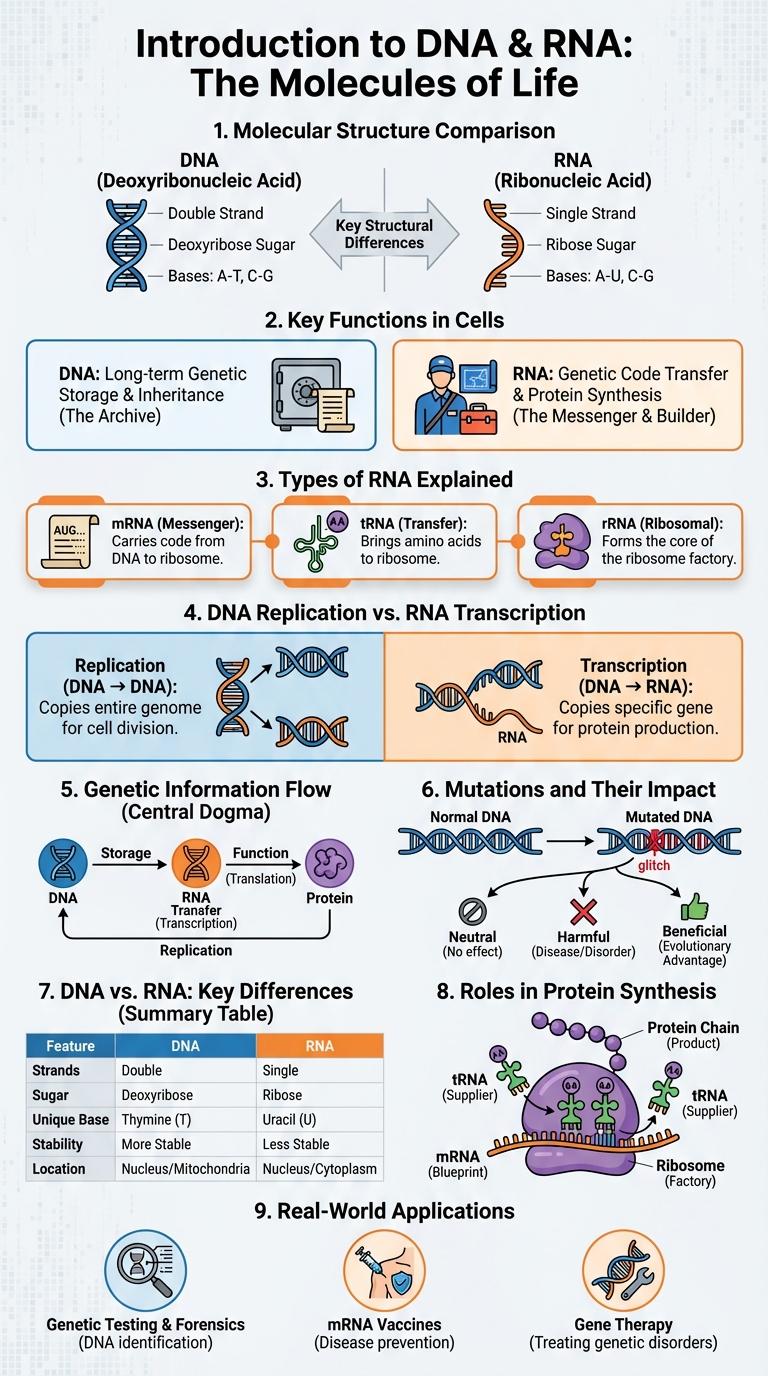
DNA and RNA are essential molecules that carry genetic information vital for all living organisms. DNA stores the blueprint for biological development, while RNA translates this code into proteins necessary for cellular functions. Understanding their unique structures and roles helps to reveal the complex processes behind heredity and gene expression.
Introduction to DNA and RNA
DNA (Deoxyribonucleic acid) and RNA (Ribonucleic acid) are essential molecules in all living organisms, carrying genetic information crucial for growth, development, and cellular function. DNA stores genetic blueprints, while RNA translates these instructions to synthesize proteins.
DNA consists of two strands forming a double helix, composed of four nucleotide bases: adenine, thymine, cytosine, and guanine. RNA is typically single-stranded and uses uracil instead of thymine to pair with adenine.
Molecular Structure Comparison
What are the key molecular differences between DNA and RNA? DNA contains deoxyribose sugar, whereas RNA contains ribose sugar. DNA is double-stranded forming a double helix, while RNA is generally single-stranded.
| Feature | DNA vs RNA |
|---|---|
| Sugar | Deoxyribose in DNA; Ribose in RNA |
| Strands | Double-stranded (DNA); Single-stranded (RNA) |
| Bases | Thymine in DNA; Uracil replaces thymine in RNA |
| Stability | More stable due to double strand; RNA less stable |
| Function | Genetic blueprint (DNA); Protein synthesis and regulation (RNA) |
Key Functions in Cells
DNA and RNA are essential nucleic acids that drive cellular processes. They store, transmit, and execute genetic information critical for life.
- DNA stores genetic information - DNA holds the instructions for building and maintaining an organism's cells.
- RNA translates genetic code - RNA converts DNA's information into proteins by guiding amino acid assembly.
- RNA regulates gene expression - RNA molecules control when and how genes are activated or silenced in cells.
Types of RNA Explained
| Type of RNA | Function |
|---|---|
| mRNA (Messenger RNA) | Serves as a template carrying genetic code from DNA to ribosomes for protein synthesis. |
| tRNA (Transfer RNA) | Transfers specific amino acids to the ribosome during translation according to mRNA sequence. |
| rRNA (Ribosomal RNA) | Forms the core of ribosome's structure and facilitates peptide bond formation. |
| snRNA (Small Nuclear RNA) | Involved in pre-mRNA splicing by forming spliceosomes in the nucleus. |
| miRNA (Micro RNA) | Regulates gene expression by binding to mRNA and inhibiting translation or promoting degradation. |
DNA Replication vs. RNA Transcription
DNA replication and RNA transcription are essential processes in genetic information management within cells. Both involve nucleic acid synthesis but serve different biological functions.
DNA replication copies the entire genome before cell division, while RNA transcription generates RNA molecules from specific gene sequences for protein synthesis.
- Template Usage - DNA replication uses the entire DNA double helix as a template, whereas RNA transcription uses only one DNA strand of a specific gene.
- Enzymes Involved - DNA replication relies on DNA polymerase, while RNA transcription employs RNA polymerase.
- Product Types - DNA replication produces two identical DNA molecules, RNA transcription synthesizes messenger RNA, transfer RNA, or ribosomal RNA for gene expression.
Genetic Information Flow
DNA stores genetic information in cells, encoding instructions for protein synthesis. RNA transcribes this information and translates it to build proteins essential for cellular functions. The flow of genetic information follows the pathway: DNA - RNA - Protein, known as the central dogma of molecular biology.
Mutations and Their Impact
Mutations are changes in the nucleotide sequence of DNA or RNA that can alter genetic information. These variations can occur naturally during replication or due to environmental factors like radiation and chemicals.
Mutations impact protein synthesis by changing amino acid sequences, potentially leading to altered or nonfunctional proteins. Some mutations cause genetic disorders, while others drive evolution by introducing beneficial traits.
DNA vs. RNA: Key Differences
DNA and RNA are essential nucleic acids that carry genetic information in living organisms. They differ in structure, function, and location within the cell.
DNA (deoxyribonucleic acid) contains the sugar deoxyribose, while RNA (ribonucleic acid) contains ribose sugar, which affects their stability and function. DNA is double-stranded forming a double helix, whereas RNA is usually single-stranded. DNA stores genetic instructions, and RNA translates these instructions to synthesize proteins.
| Feature | DNA vs. RNA |
|---|---|
| Sugar | DNA - Deoxyribose; RNA - Ribose |
| Strands | DNA - Double-stranded; RNA - Single-stranded |
| Bases | DNA - A, T, C, G; RNA - A, U, C, G |
| Function | DNA - Genetic blueprint; RNA - Protein synthesis |
| Location | DNA - Nucleus; RNA - Cytoplasm and nucleus |
Roles in Protein Synthesis
DNA and RNA play essential roles in the process of protein synthesis within cells. DNA stores genetic information, while RNA translates this information into functional proteins.
- DNA stores genetic code - DNA contains the instructions necessary for building proteins through sequences of nucleotides.
- mRNA transcribes DNA - Messenger RNA copies the genetic code from DNA to carry it to ribosomes for protein assembly.
- tRNA facilitates translation - Transfer RNA delivers specific amino acids to the ribosome according to the mRNA sequence during protein synthesis.
Both DNA and RNA work together to ensure accurate and efficient production of proteins essential for cellular functions.