
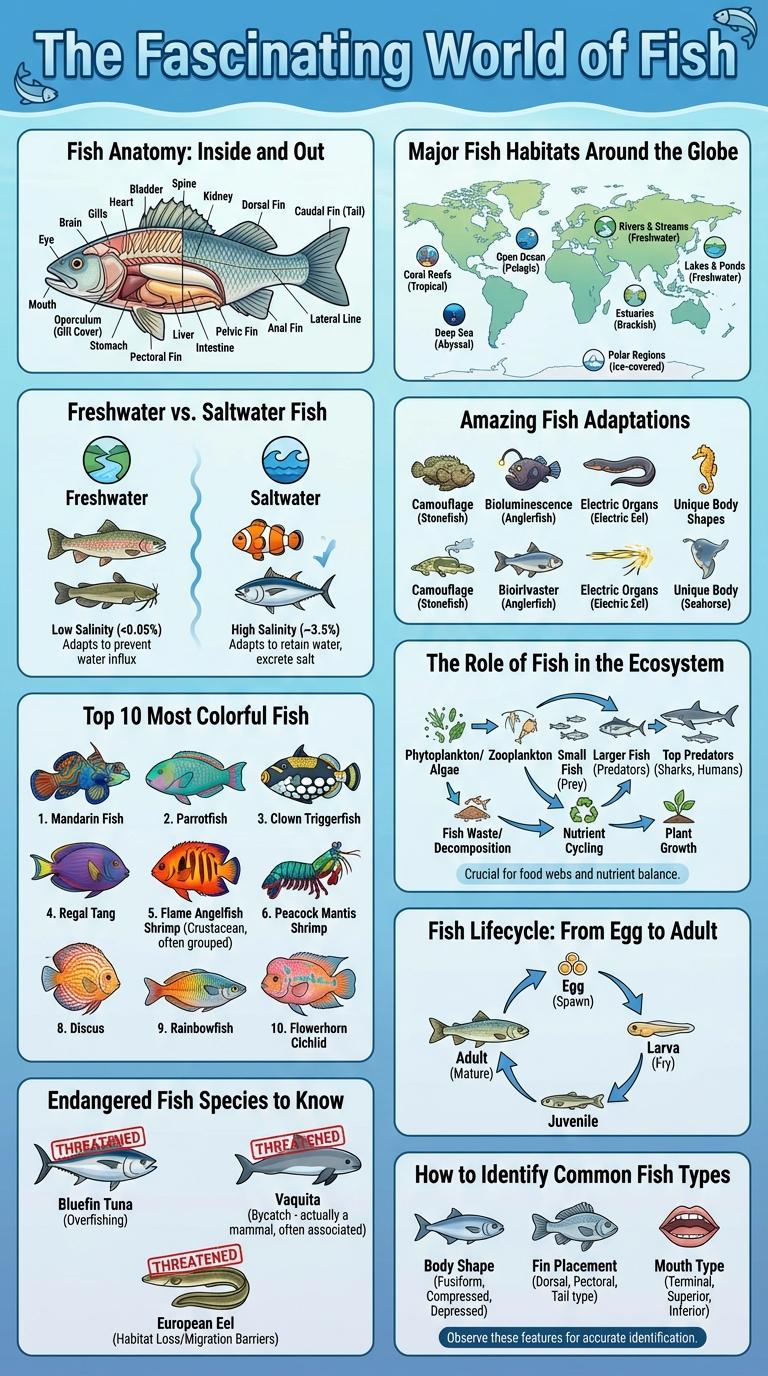
Fish infographic visualizes key information about various species, habitats, and behaviors. It highlights essential data on fish anatomy, diet, and ecological roles in aquatic environments. Viewers gain a comprehensive understanding of fish diversity and conservation efforts.
The Fascinating World of Fish
Fish represent one of the most diverse groups of animals on Earth, occupying nearly every aquatic environment. Their adaptations enable survival from deep ocean trenches to shallow freshwater streams.
The Fascinating World of Fish reveals impressive biological traits and ecological roles essential for aquatic ecosystems.
- Variety of Species - Over 34,000 known fish species exist, ranging from tiny seahorses to large sharks.
- Unique Respiratory Systems - Fish use gills to extract oxygen from water, allowing efficient underwater respiration.
- Sensory Adaptations - Many fish detect electrical signals and vibrations, enhancing navigation and hunting in murky waters.
Fish Anatomy: Inside and Out
Fish anatomy consists of external and internal structures that enable survival in aquatic environments. Externally, features like scales, fins, and gills provide protection, movement, and respiration. Internally, organs such as the swim bladder, heart, and digestive system support buoyancy, circulation, and nutrient absorption.
Major Fish Habitats Around the Globe
Fish species inhabit diverse aquatic environments that vary in temperature, salinity, and depth. Each major habitat supports unique ecosystems crucial for global biodiversity.
- Coral Reefs - These vibrant underwater structures provide shelter and feeding grounds for over 4,000 fish species worldwide.
- Freshwater Rivers and Lakes - Freshwater habitats host approximately 41% of all known fish species, sustaining complex food webs.
- Open Ocean - Covering more than 70% of Earth's surface, the pelagic zone supports large migratory fish like tuna and sharks.
- Deep Sea - Extreme conditions in deep-sea habitats harbor specialized fish adapted to cold, high pressure, and low light.
- Estuaries - Transitional areas between rivers and oceans where fish utilize brackish waters for spawning and nursery grounds.
Freshwater vs. Saltwater Fish
Fish inhabit two primary aquatic environments: freshwater and saltwater. Freshwater fish live in rivers, lakes, and streams with low salt concentration.
Saltwater fish thrive in oceans and seas where the salt content is significantly higher. Their bodies are adapted to handle the salinity differences and varying pressures.
Amazing Fish Adaptations
| Adaptation | Description |
|---|---|
| Camouflage | Many fish change color or pattern to blend with surroundings, avoiding predators and sneaking up on prey. |
| Bioluminescence | Deep-sea fish produce their own light through chemical reactions, helping with communication, hunting, and mating. |
| Electroreception | Species like sharks detect electric fields generated by other animals, aiding in navigation and hunting in murky water. |
| Swim Bladder | Inflatable organ that controls buoyancy, allowing fish to maintain depth without constant swimming effort. |
| Specialized Mouths | Fish such as the suckerfish have modified mouths to cling to surfaces or filter food efficiently in diverse environments. |
Top 10 Most Colorful Fish
What are the top 10 most colorful fish in the ocean? These fish display vibrant hues and intricate patterns that make them popular among divers and aquarium enthusiasts. Their dazzling colors serve various purposes, including camouflage, mating displays, and warning signals.
Which fish ranks highest for its vivid coloration? The Mandarin Fish tops the list with its electric blue, orange, and green patterns that create a mesmerizing effect. This small reef fish thrives in the Pacific Ocean and is admired for its psychedelic appearance.
What makes the Clownfish standout among colorful fish? Known for its bright orange body with white stripes outlined in black, the Clownfish is famous for its symbiotic relationship with sea anemones. This vivid coloration helps in recognition and protection.
How does the Royal Gramma display its colors? This fish boasts a striking gradient from purple to yellow, giving it a regal aesthetic. Native to the Caribbean, the Royal Gramma is a favorite in marine aquariums.
Why is the Betta fish popular for its colors? Betta fish showcase a wide range of brilliant colors, including reds, blues, and greens, often with flowing fins. Their color intensity is influenced by genetics and environment, making them ideal for ornamental purposes.
The Role of Fish in the Ecosystem
Fish play a crucial role in maintaining the balance of aquatic ecosystems. Their interactions contribute to nutrient cycling and habitat health.
- Food Web Dynamics - Fish act as both predators and prey, supporting diverse aquatic food chains.
- Nutrient Cycling - Fish facilitate the transfer of nutrients between water layers and sediment.
- Habitat Maintenance - Grazing fish help control algae growth and promote coral reef health.
Understanding fish roles aids in ecosystem conservation and sustainable fisheries management.
Endangered Fish Species to Know
Fish species around the world face increasing threats due to habitat loss, overfishing, and climate change. Protecting endangered fish is crucial for maintaining aquatic biodiversity and ecosystem health.
The Vaquita, native to the northern part of the Gulf of California, is critically endangered with fewer than 10 individuals remaining. The Smalltooth Sawfish inhabits tropical and subtropical waters but suffers from fishing pressures and habitat destruction. The Devils Hole Pupfish, found only in a single desert water-filled cavern in Nevada, represents one of the rarest fish species globally.
Fish Lifecycle: From Egg to Adult
Fish undergo a fascinating lifecycle that begins with eggs laid in water. After hatching, the young fish, called fry, grow and develop through several stages. Adult fish eventually reach maturity, ready to reproduce and continue the cycle.