
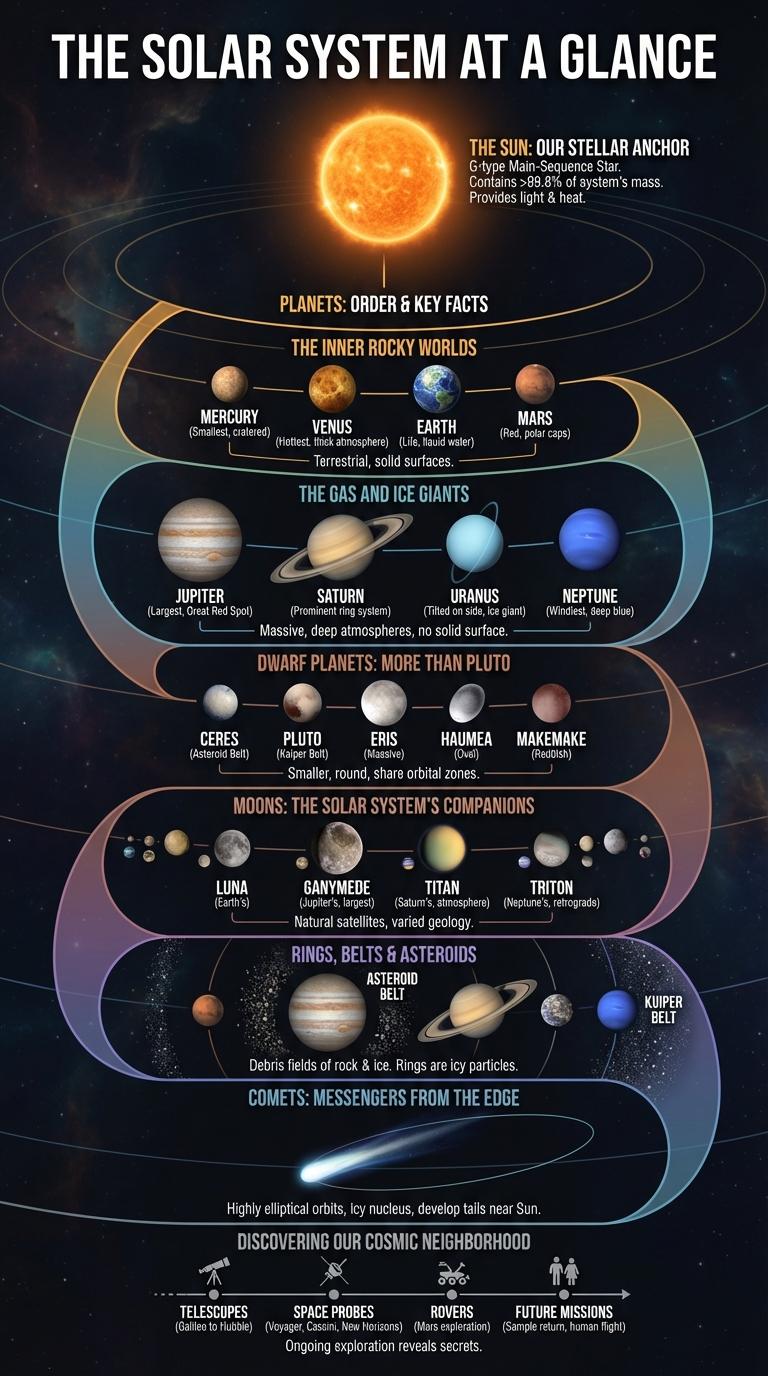
Explore a vibrant infographic that visually unpacks the vastness of our solar system, showcasing each planet's unique characteristics and distances from the sun. This detailed graphic helps to simplify complex astronomical data, making it accessible and engaging for learners of all ages. By illustrating planetary orbits, relative sizes, and key features, the infographic serves as an essential tool for understanding our cosmic neighborhood.
The Solar System at a Glance
The Solar System consists of the Sun and all celestial bodies bound by its gravity, including eight planets, their moons, dwarf planets, asteroids, and comets. The planets are divided into terrestrial planets--Mercury, Venus, Earth, and Mars--and gas giants--Jupiter, Saturn, Uranus, and Neptune. Distances from the Sun vary greatly, with Mercury orbiting closest and Neptune the farthest among the main planets.
The Sun: Our Stellar Anchor
The Sun, a G-type main-sequence star, is the center of our solar system and accounts for 99.86% of its total mass. Its gravitational pull keeps the planets, asteroids, and comets in orbit, creating a stable environment for life on Earth. The Sun's surface temperature reaches approximately 5,500 degrees Celsius, powering nuclear fusion that produces energy sustaining the solar system.
Planets: Order & Key Facts
The solar system consists of eight planets orbiting the Sun in a specific order: Mercury, Venus, Earth, Mars, Jupiter, Saturn, Uranus, and Neptune. Each planet has unique characteristics such as size, composition, and atmosphere.
Mercury is the smallest and closest to the Sun, while Jupiter is the largest gas giant with numerous moons. Earth is the only planet known to support life, and Neptune is the farthest from the Sun with a cold, icy environment.
The Inner Rocky Worlds
The inner rocky worlds of the solar system consist of Mercury, Venus, Earth, and Mars. These planets are characterized by solid, rocky surfaces and are located closest to the Sun.
- Mercury - The smallest and fastest planet, Mercury has a cratered, moon-like surface with extreme temperature variations.
- Venus - Venus has a thick, toxic atmosphere that creates a runaway greenhouse effect, making it the hottest planet.
- Earth - Earth is the only inner planet with liquid water and a breathable atmosphere, supporting diverse life forms.
- Mars - Known as the Red Planet, Mars has the largest volcano and canyon in the solar system and shows signs of past water flow.
The Gas and Ice Giants
The Gas and Ice Giants are massive planets located in the outer solar system. These planets are characterized by thick atmospheres and distinct compositions compared to the rocky inner planets.
- Jupiter - The largest gas giant with a strong magnetic field and dozens of moons.
- Saturn - Known for its extensive ring system composed of ice and rock particles.
- Uranus - An ice giant with a unique sideways rotation and methane-rich atmosphere.
- Neptune - The farthest ice giant, noted for its strong winds and deep blue color.
The Gas and Ice Giants play a crucial role in shaping the dynamics of the solar system's outer regions.
Dwarf Planets: More Than Pluto
The solar system contains five recognized dwarf planets: Pluto, Eris, Haumea, Makemake, and Ceres. These bodies orbit the Sun but are distinct from the eight classical planets due to their size and inability to clear their orbital zones.
Pluto, once considered the ninth planet, is now classified as a dwarf planet after the International Astronomical Union's 2006 decision. Dwarf planets offer valuable insights into the composition and history of the solar system's outer regions.
Moons: The Solar System's Companions
| Moon | Key Facts |
|---|---|
| Earth's Moon | 1 natural satellite; diameter ~3,474 km; influences tides and stabilizes Earth's axis |
| Jupiter's Galilean Moons | Io, Europa, Ganymede, Callisto; Ganymede is largest moon in Solar System (~5,268 km diameter) |
| Saturn's Titan | Second largest moon (~5,151 km diameter); thick nitrogen atmosphere; lakes of methane and ethane |
| Neptune's Triton | Retrograde orbit; geologically active with geysers; diameter ~2,710 km |
| Mars' Moons: Phobos & Deimos | Small, irregular shapes; Phobos is gradually spiraling toward Mars; diameters less than 25 km |
Rings, Belts & Asteroids
The solar system contains various rings, belts, and asteroid groups that define its intricate structure. These features influence planetary orbits and provide clues about the system's formation and evolution.
Rings are primarily found around giant planets, composed of ice and rock particles orbiting their host bodies. Belts and asteroids circulate mainly between Mars and Jupiter, forming important regions of small celestial bodies.
- Asteroid Belt - Located between Mars and Jupiter, this belt contains millions of rocky bodies ranging from dust-sized particles to dwarf planets like Ceres.
- Kuiper Belt - Beyond Neptune, the Kuiper Belt consists of icy objects and dwarf planets such as Pluto, serving as a source of short-period comets.
- Saturn's Rings - Composed mostly of ice particles, Saturn's rings are the most extensive and complex ring system among the planets in the solar system.
Comets: Messengers from the Edge
Comets are icy celestial bodies that orbit the Sun, often originating from the distant Oort Cloud or Kuiper Belt. These cosmic travelers carry valuable information about the early solar system's formation and composition.
Comets consist of a nucleus made of ice, dust, and rock; when they approach the Sun, solar radiation causes them to develop glowing comas and tails. Their long, elliptical orbits take them from the outer edges of the solar system into the inner planets. Studying comets helps scientists understand the primordial materials that shaped our planetary neighborhood.