
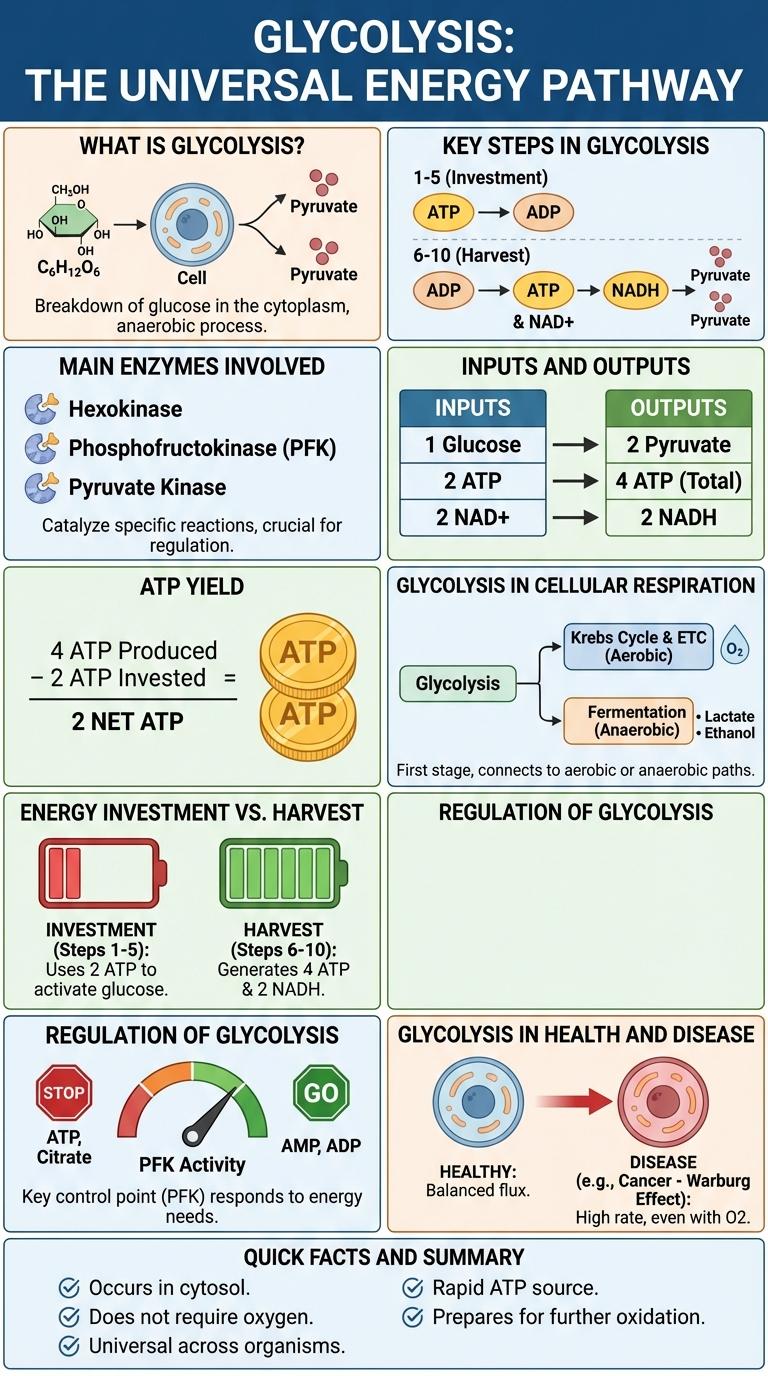
Glycolysis is a fundamental metabolic pathway that breaks down glucose into pyruvate, releasing energy stored in high-energy molecules like ATP and NADH. This process occurs in the cytoplasm of cells and serves as a critical step for cellular respiration. Understanding glycolysis provides insight into how cells generate energy and maintain metabolic functions.
What is Glycolysis?
Glycolysis is a metabolic pathway that converts glucose into pyruvate, releasing energy. It takes place in the cytoplasm of cells and is the first step in cellular respiration.
- Energy Production - Glycolysis generates a net gain of 2 ATP molecules per glucose molecule.
- Enzymatic Steps - The process involves 10 enzyme-catalyzed reactions that break down glucose.
- Oxygen Independence - Glycolysis occurs without the need for oxygen, making it an anaerobic process.
This pathway is essential for energy supply in both aerobic and anaerobic conditions.
Key Steps in Glycolysis
| Step | Description |
|---|---|
| Glucose Phosphorylation | Glucose is phosphorylated to glucose-6-phosphate by hexokinase using one ATP molecule. |
| Isomerization | Glucose-6-phosphate converts into fructose-6-phosphate catalyzed by phosphoglucose isomerase. |
| Second Phosphorylation | Fructose-6-phosphate is phosphorylated to fructose-1,6-bisphosphate by phosphofructokinase-1, consuming another ATP. |
| Cleavage | Fructose-1,6-bisphosphate splits into glyceraldehyde-3-phosphate and dihydroxyacetone phosphate via aldolase. |
| Energy Generation | Glyceraldehyde-3-phosphate is converted to pyruvate, producing 2 ATP and 2 NADH molecules per glucose molecule. |
Main Enzymes Involved
What are the main enzymes involved in glycolysis? Glycolysis is a metabolic pathway that converts glucose into pyruvate, generating energy in the form of ATP. Key enzymes catalyze each step, ensuring efficient energy extraction from glucose.
| Enzyme | Function |
|---|---|
| Hexokinase | Phosphorylates glucose to glucose-6-phosphate, the first step of glycolysis. |
| Phosphofructokinase-1 (PFK-1) | Regulates the conversion of fructose-6-phosphate to fructose-1,6-bisphosphate, a key control point. |
| Aldolase | Splits fructose-1,6-bisphosphate into two three-carbon sugars. |
| Glyceraldehyde-3-phosphate dehydrogenase | Catalyzes the oxidation and phosphorylation of glyceraldehyde-3-phosphate. |
| Pyruvate kinase | Converts phosphoenolpyruvate to pyruvate, producing ATP in the final step. |
Inputs and Outputs of Glycolysis
Glycolysis is a metabolic pathway that breaks down glucose into pyruvate, generating energy in the process. The primary inputs of glycolysis include one molecule of glucose, two molecules of ATP, and two molecules of NAD+. The outputs consist of two molecules of pyruvate, four molecules of ATP (net gain of two ATP), and two molecules of NADH.
ATP Yield in Glycolysis
Glycolysis is a fundamental metabolic pathway that breaks down glucose into pyruvate, producing ATP and NADH. This process occurs in the cytoplasm of cells and provides energy essential for cellular functions.
ATP yield in glycolysis includes initial investment and net production phases critical for energy balance.
- ATP Investment - Glycolysis consumes 2 ATP molecules during the initial phase to activate glucose.
- ATP Generation - A total of 4 ATP molecules are produced later through substrate-level phosphorylation.
- Net ATP Yield - The pathway results in a net gain of 2 ATP molecules per glucose molecule metabolized.
Glycolysis in Cellular Respiration
Glycolysis is the initial process of cellular respiration where one glucose molecule breaks down into two molecules of pyruvate. This metabolic pathway occurs in the cytoplasm and produces a net gain of two ATP molecules and two NADH molecules. Glycolysis is crucial for energy production, especially in anaerobic conditions, providing substrates for further energy extraction in the mitochondria.
Energy Investment vs. Energy Harvest
Glycolysis is a metabolic pathway that breaks down glucose to produce energy. It consists of two main phases: energy investment and energy harvest.
During the energy investment phase, the cell uses 2 ATP molecules to phosphorylate glucose and its derivatives. This step primes the molecule for subsequent breakdown.
The energy harvest phase generates 4 ATP and 2 NADH molecules from the breakdown of glyceraldehyde-3-phosphate. The net gain is 2 ATP and 2 NADH per glucose molecule.
Energy investment requires ATP input to destabilize glucose, while energy harvest recovers energy through substrate-level phosphorylation. This balance allows cells to efficiently extract usable energy.
Regulation of Glycolysis
Glycolysis is regulated by key enzymes that control the pathway's rate and maintain energy balance within the cell. These enzymes respond to cellular signals such as levels of ATP, ADP, and AMP to ensure efficient energy production.
Phosphofructokinase-1 (PFK-1) acts as the primary control point, inhibited by high ATP and citrate, and activated by AMP and fructose-2,6-bisphosphate. Hexokinase and pyruvate kinase also contribute to regulation, adjusting glycolytic flux based on glucose availability and energy demand.
Glycolysis in Health and Disease
Glycolysis is a fundamental metabolic pathway that breaks down glucose into pyruvate, generating energy in the form of ATP. Its regulation is crucial for maintaining cellular energy balance in both healthy and diseased states.
- Energy Production - Glycolysis provides rapid ATP generation, especially in cells with high energy demands such as muscle and brain cells.
- Cancer Metabolism - Cancer cells exploit glycolysis through the Warburg effect, relying heavily on glycolysis even in the presence of oxygen to support rapid growth.
- Diabetes Impact - Impaired glycolytic flux contributes to altered glucose homeostasis and insulin resistance in diabetes mellitus.