
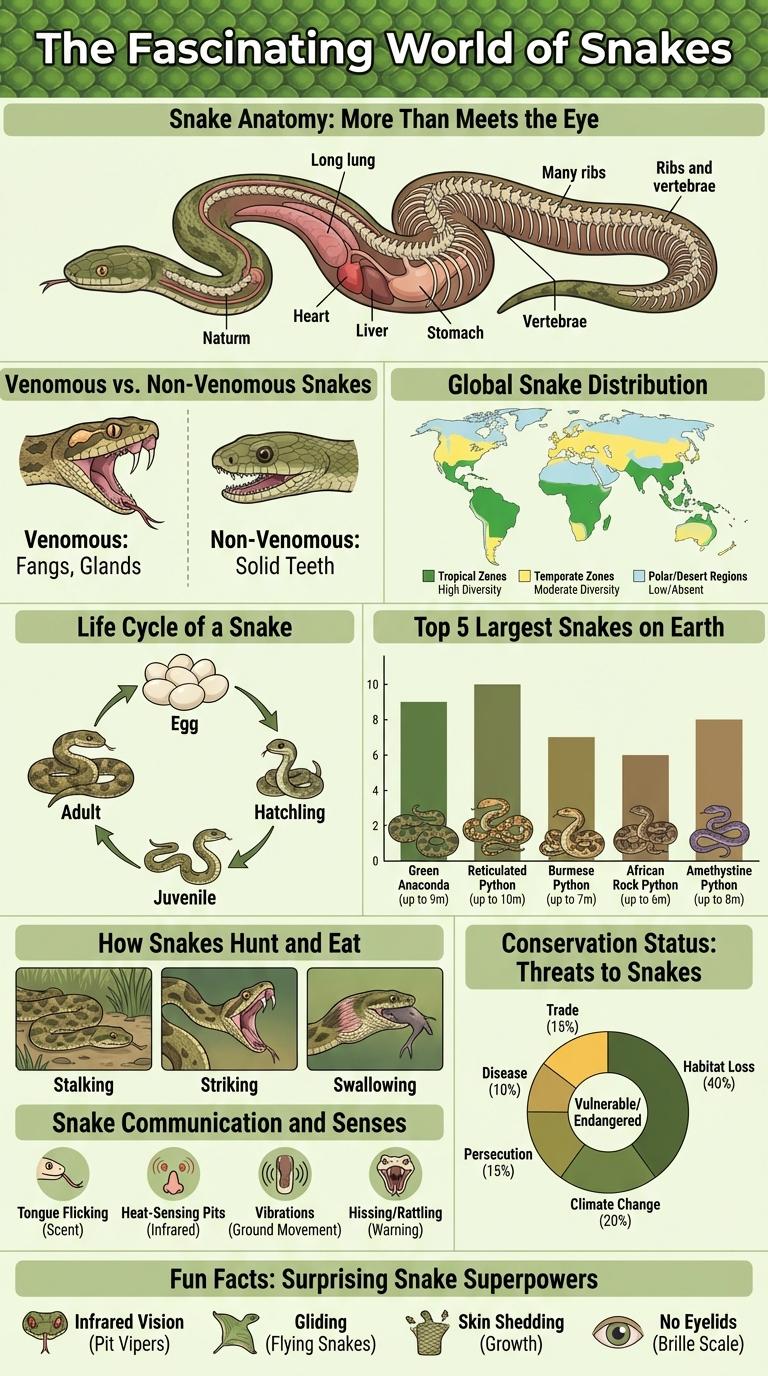
Snakes are fascinating reptiles known for their elongated bodies and lack of limbs. They play vital roles in ecosystems by controlling pest populations and maintaining balance. Understanding their behaviors, habitats, and species diversity provides insight into their importance and dispels common misconceptions.
The Fascinating World of Snakes
Snakes are one of the most diverse groups of reptiles, with over 3,000 species found worldwide. Their unique adaptations enable them to thrive in various habitats from deserts to rainforests.
- Venomous Species - About 600 species of snakes are venomous, using their venom to immobilize prey and defend against predators.
- Locomotion - Snakes move using specialized muscles and scales, allowing efficient movement through different terrains including water and trees.
- Sensory Adaptations - Many snakes use heat-sensing pits and a forked tongue to detect prey and navigate their environment.
Snakes play a vital role in ecosystems by controlling pest populations and maintaining environmental balance.
Snake Anatomy: More Than Meets the Eye
Snakes possess a unique anatomy that allows them to excel as stealthy predators. Their flexible jaws can unhinge, enabling them to swallow prey much larger than their head. Beneath their scaled exterior lies a complex muscular and skeletal structure designed for efficient movement and sensory perception.
Venomous vs. Non-Venomous Snakes
Snakes are found worldwide and can be classified into venomous and non-venomous species. Understanding the differences between these two types is crucial for safety and awareness.
Venomous snakes inject toxins through their fangs, while non-venomous snakes rely on constriction or other methods to subdue prey.
- Venom Composition - Venomous snakes produce complex venom containing proteins and enzymes used for immobilizing or digesting prey.
- Fang Structure - Venomous snakes possess specialized hollow or grooved fangs for venom delivery, unlike non-venomous snakes with solid teeth.
- Behavioral Traits - Non-venomous snakes often rely on escape and camouflage; venomous snakes may exhibit warning behaviors like hooding or rattling.
Global Snake Distribution
Snakes are found on every continent except Antarctica, inhabiting diverse environments from tropical rainforests to deserts. Their global distribution is influenced by climate, prey availability, and habitat type.
Most snake species thrive in warm regions, but some adapt to cooler climates at higher elevations or latitudes.
- Tropical Rainforests - Home to the highest diversity of snake species due to stable temperatures and abundant prey.
- Desert Regions - Species here have evolved to conserve water and regulate temperature efficiently.
- Temperate Zones - Snakes hibernate or become less active during cold months to survive seasonal changes.
Life Cycle of a Snake
The life cycle of a snake begins with the egg stage, where embryos develop inside protective shells. After hatching, young snakes emerge fully independent, ready to hunt and survive on their own.
During the juvenile stage, snakes grow rapidly, shedding their skin multiple times to accommodate their increasing size. Maturity is reached when snakes develop reproductive capabilities, continuing the cycle by laying eggs or giving birth to live young depending on the species.
Top 5 Largest Snakes on Earth
Snakes represent a fascinating group of reptiles, with some species growing to incredible lengths. The largest snakes on Earth showcase remarkable adaptations that allow them to thrive in diverse environments.
The top 5 largest snakes include the Green Anaconda, Reticulated Python, Burmese Python, African Rock Python, and Amethystine Python. The Green Anaconda holds the record for the heaviest and one of the longest snakes, reaching lengths over 29 feet. Reticulated Pythons are known as the longest snakes, with verified lengths exceeding 30 feet. Burmese Pythons and African Rock Pythons also rank among the largest, typically growing up to 16-23 feet. The Amethystine Python is the longest snake native to Australia and nearby islands, with sizes up to 20 feet.
How Snakes Hunt and Eat
How do snakes locate their prey? Snakes use their forked tongues to collect scent particles from the air, which are then processed by the Jacobson's organ to detect prey. They also rely on heat-sensing pits to track warm-blooded animals, especially in the dark.
What techniques do snakes use to capture prey? Some snakes use constriction, coiling around their prey to suffocate it, while others employ venom to immobilize or kill with specialized fangs. The method depends on the species and their ecological adaptation.
How do snakes consume prey larger than their head? Snakes have highly flexible jaws and stretchy ligaments allowing them to swallow prey whole, even if it is much wider than their head. This unique jaw structure eliminates the need to chew.
Why is the swallowing process slow and deliberate? Snakes use alternating movements of their jaw bones to gradually move the prey down the esophagus, preventing choking and ensuring safe ingestion. This process can take several minutes to hours depending on prey size.
How do snakes digest their food? After swallowing, snakes produce strong digestive enzymes and acids to break down tough tissues like bones and scales. The metabolism speeds up significantly to maximize nutrient absorption from the meal.
Snake Communication and Senses
Snakes communicate primarily through body language, vibrations, and chemical signals. They use their forked tongues to detect scent particles, which enhances their ability to track prey and recognize mates. Infrared-sensitive pits on some snake species allow them to detect heat signatures, aiding in hunting and navigation in the dark.
Conservation Status: Threats to Snakes
Snakes face numerous threats that jeopardize their survival, including habitat loss, pollution, and illegal wildlife trade. Many species are listed as vulnerable or endangered due to these growing dangers.
Conservation efforts focus on protecting natural habitats and enforcing laws against poaching. Public education and research are vital to understanding snake populations and promoting coexistence.