
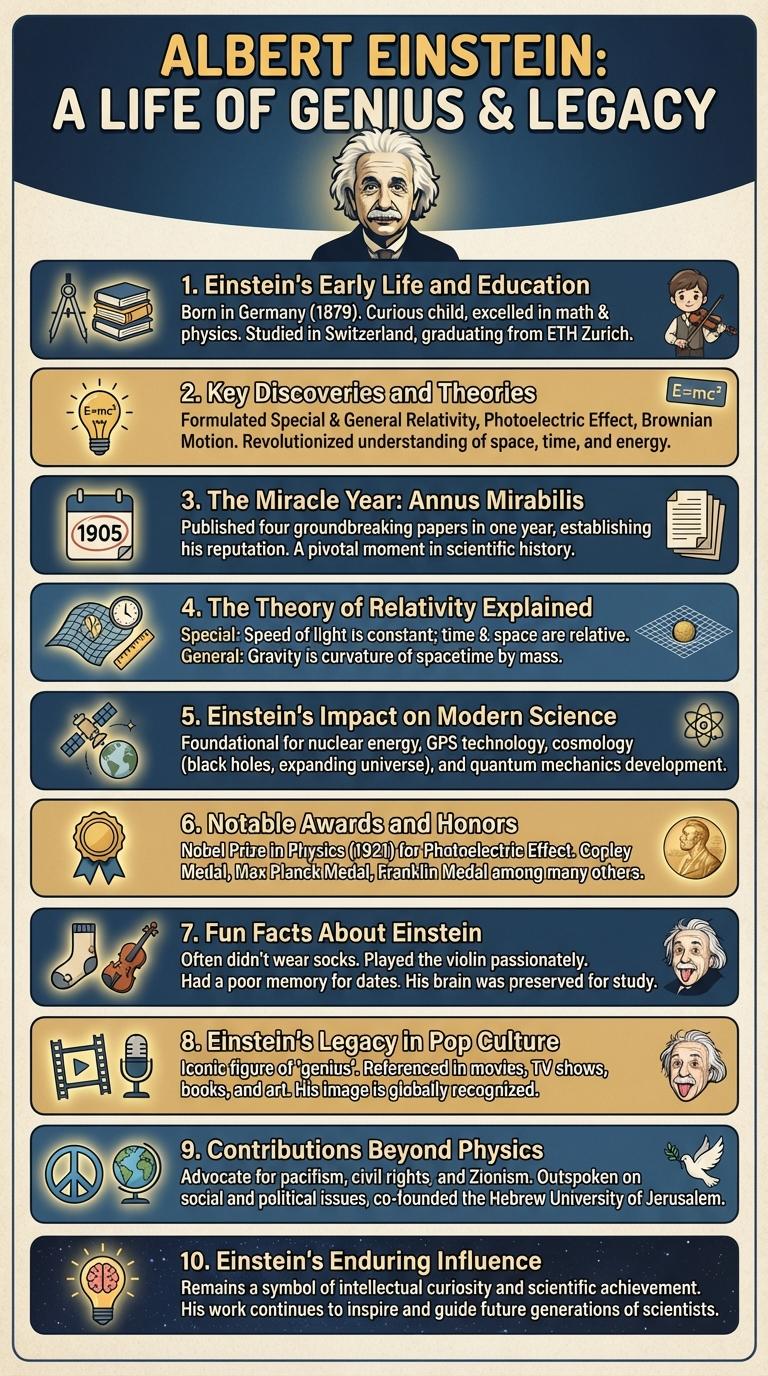
Albert Einstein revolutionized our understanding of physics with his theory of relativity and groundbreaking contributions to quantum mechanics. This infographic visually breaks down key moments in Einstein's life, major scientific achievements, and their profound impact on modern science. Explore complex concepts like E=mc2 and photoelectric effect explained in a clear and engaging manner for all audiences.
Einstein's Early Life and Education
Albert Einstein was born in Ulm, Germany, in 1879 and showed an early interest in mathematics and science. His education journey included attending the Polytechnic Institute in Zurich, where he developed foundational knowledge in physics.
- Early Curiosity - As a child, Einstein demonstrated a deep fascination with the natural world and abstract concepts.
- Formal Education - He enrolled at the Swiss Federal Polytechnic School to train as a teacher in physics and mathematics.
- Academic Challenges - Einstein sometimes clashed with rigid educational structures but excelled in independent thinking and problem-solving.
Key Discoveries and Theories
Albert Einstein revolutionized physics with his groundbreaking theories that reshaped our understanding of space, time, and energy. His work laid the foundation for modern physics and influenced numerous scientific advancements.
Einstein's key discovery, the theory of relativity, introduced the concept that space and time are interconnected and relative to the observer. The famous equation E=mc2 demonstrated the equivalence of mass and energy, transforming nuclear physics.
The Miracle Year: Annus Mirabilis
Albert Einstein's Annus Mirabilis, or Miracle Year, occurred in 1905 when he published four groundbreaking papers that revolutionized physics. These works addressed the photoelectric effect, Brownian motion, special relativity, and mass-energy equivalence.
Einstein's paper on the photoelectric effect introduced the concept of light quanta, laying the foundation for quantum theory. His special relativity theory reshaped understanding of space and time, while the mass-energy equivalence formula, E=mc2, established the relationship between energy and mass.
The Theory of Relativity Explained
Albert Einstein revolutionized physics with his Theory of Relativity, fundamentally changing our understanding of space, time, and gravity. The theory consists of two parts: Special Relativity, which addresses objects moving at constant speeds, and General Relativity, which explains gravity as the warping of spacetime by mass. This groundbreaking theory has been confirmed through numerous experiments and is essential for technologies like GPS and understanding black holes.
Einstein's Impact on Modern Science
Albert Einstein revolutionized modern science with his groundbreaking theories of relativity, fundamentally altering our understanding of space, time, and gravity. His work laid the foundation for numerous technological advancements and deepened our comprehension of the universe.
Einstein's theory of General Relativity provided a new framework for studying gravitational forces, influencing fields such as astrophysics and cosmology. His explanation of the photoelectric effect contributed to the development of quantum mechanics. These contributions have driven innovations in GPS technology, nuclear energy, and particle physics, highlighting his lasting legacy in science.
Notable Awards and Honors
Albert Einstein received the Nobel Prize in Physics in 1921 for his explanation of the photoelectric effect, a groundbreaking contribution to quantum theory. He was also awarded the Copley Medal by the Royal Society of London in 1925, recognizing his outstanding achievements in scientific research. In 1935, Einstein, along with colleagues Podolsky and Rosen, became known for the EPR paradox, significantly impacting discussions in quantum mechanics and modern physics.
Fun Facts About Einstein
Albert Einstein was not only a groundbreaking physicist but also had many surprising and fun aspects to his personality. His life included quirky habits and remarkable achievements beyond science.
- Late Talker - Einstein reportedly did not speak fluently until he was about four years old.
- Violin Enthusiast - He loved playing the violin and found music essential for his creativity.
- Nonconformist Dress - Einstein preferred comfort over style, often skipping socks and formal attire.
Einstein's playful spirit and unique traits contributed to his legacy as both a genius and a relatable human being.
Einstein's Legacy in Pop Culture
How has Albert Einstein influenced modern pop culture? Einstein's image as a genius has become an enduring symbol in movies, television, and advertising. His distinctive appearance and groundbreaking theories continue to inspire creative works worldwide.
What are some iconic representations of Einstein in entertainment? Einstein has appeared as a character in numerous films and TV shows, often used to portray intelligence or eccentricity. His famous equation E=mc2 is frequently referenced, highlighting his impact beyond science.
How does Einstein's legacy appear in advertising? Companies leverage Einstein's image to evoke ideas of innovation and intelligence in their branding. His likeness is used to promote products related to education, technology, and creativity.
Why do artists and musicians reference Einstein? Einstein symbolizes unconventional thinking and creativity. Musicians and visual artists incorporate his persona to emphasize genius and originality in their work.
In what ways does Einstein inspire educational media? Educational programs and materials often feature Einstein to engage audiences with science. Using his story helps simplify complex concepts and encourages curiosity and discovery.
Contributions Beyond Physics
| Contribution Area | Details |
|---|---|
| Philosophy of Science | Einstein influenced the philosophy of science by emphasizing empirical evidence and the role of theoretical frameworks in understanding nature. |
| Music | A skilled violinist, Einstein believed music enhanced creativity and intellectual development. |
| Social Activism | Advocated for civil rights, pacifism, and global disarmament, supporting racial equality and opposing war. |
| Education | Promoted innovative education methods, focusing on curiosity and critical thinking rather than rote learning. |
| Humanitarian Efforts | Supported refugees and spoke against totalitarian regimes, contributing to humanitarian causes worldwide. |