
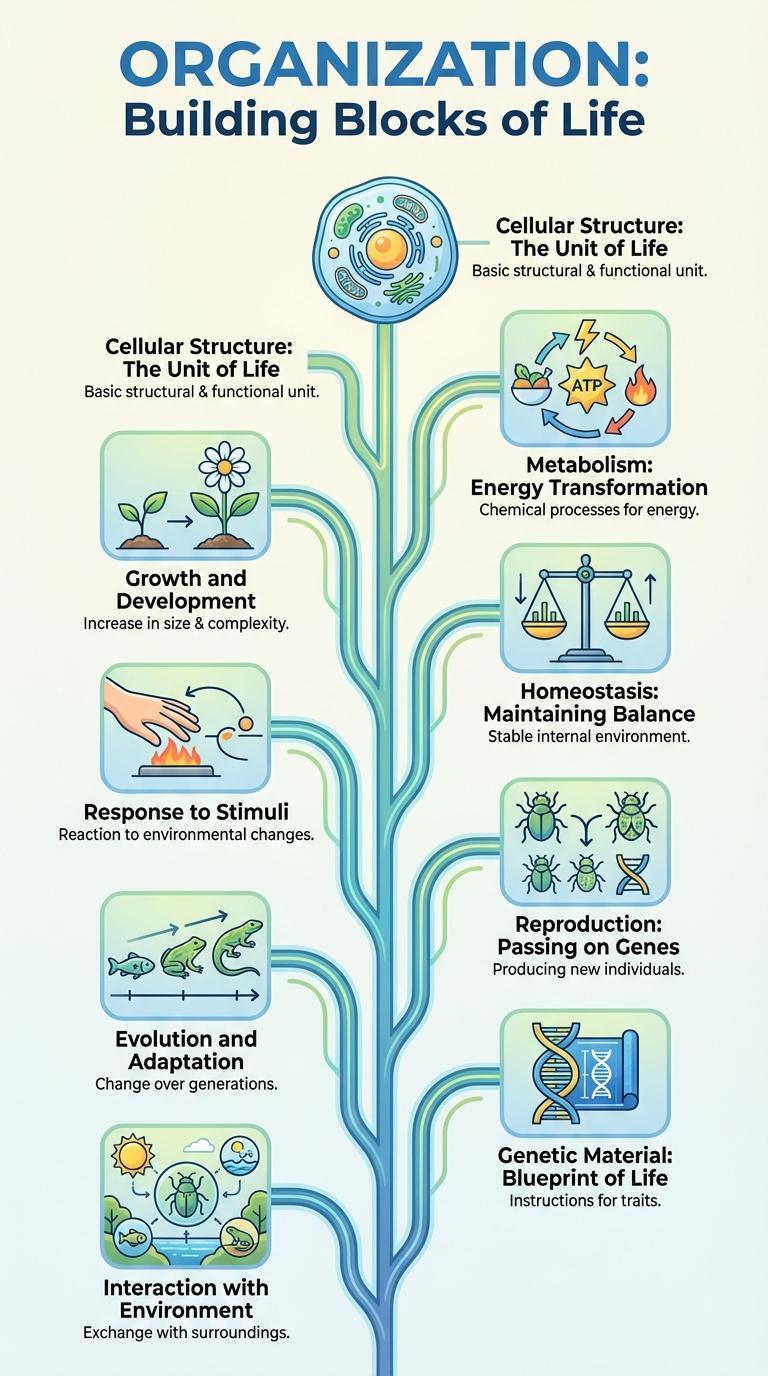
Living organisms exhibit key characteristics that distinguish them from non-living matter, including growth, reproduction, metabolism, responsiveness to stimuli, and adaptation. These traits ensure survival, enable evolution, and maintain homeostasis within varying environments. Understanding these fundamental features provides insight into the complexity and diversity of life on Earth.
Organization: Building Blocks of Life
Life is structured in a hierarchical organization from simple to complex systems. Understanding these levels reveals how living organisms maintain order and function.
- Atoms and Molecules - Fundamental building blocks that form the chemical basis of life.
- Cells - Basic units of life where biological processes occur.
- Tissues and Organs - Groups of cells working together to perform specific functions.
Organization ensures that biological components interact systematically to sustain life processes.
Cellular Structure: The Unit of Life
| Characteristic | Description |
|---|---|
| Cellular Structure | All living organisms are composed of one or more cells, the basic units of life that carry out essential functions. |
| Cell Types | Two main types: Prokaryotic cells (without nucleus) and Eukaryotic cells (with nucleus and organelles). |
| Cell Membrane | Selective barrier that regulates the movement of substances in and out of the cell, maintaining homeostasis. |
| Genetic Material | Cells contain DNA which stores information necessary for growth, development, and reproduction. |
| Metabolic Activity | Cells perform biochemical reactions to obtain energy, build molecules, and sustain life processes. |
Metabolism: Energy Transformation
Metabolism encompasses all chemical reactions that transform energy within living organisms. It enables the conversion of food into usable energy, sustaining life's processes.
- Catabolism - Breaks down molecules to release energy for cellular activities.
- Anabolism - Uses energy to build complex molecules necessary for growth and repair.
- ATP Production - Adenosine triphosphate (ATP) serves as the primary energy currency in cells.
Growth and Development
What defines growth and development in living organisms? Growth involves an increase in size and mass, while development refers to the progression through various life stages. These processes are essential for the survival and reproduction of all living beings.
How do cells contribute to growth and development? Cells divide and differentiate to form tissues and organs, enabling the organism to mature. This cellular activity supports complex functions and adaptability throughout life.
Why is energy important for growth and development? Energy drives metabolic processes that synthesize new cellular components and repair tissues. Without adequate energy, growth and proper development cannot occur effectively.
How does genetic information impact growth and development? DNA contains instructions that regulate cell function and organismal changes from birth to maturity. These genetic codes ensure each species follows a specific developmental pattern.
In what ways do environmental factors influence growth and development? Temperature, nutrition, and exposure to toxins can enhance or hinder biological progression. Organisms adapt to their surroundings to optimize their growth and developmental outcomes.
Homeostasis: Maintaining Balance
Homeostasis is the process by which living organisms maintain a stable internal environment despite external changes. This balance is crucial for the proper functioning of cells and overall survival. Mechanisms such as temperature regulation, pH balance, and water retention exemplify homeostasis in action.
Response to Stimuli
Response to stimuli is a fundamental characteristic of living organisms, allowing them to react to changes in their environment. This ability helps organisms survive by detecting and responding to various external factors such as light, temperature, and sound.
Living beings possess specialized receptors to sense stimuli, which trigger appropriate reactions. For example, plants bend toward light to maximize photosynthesis, while animals may move away from danger or toward food. These responses ensure adaptation and enhance survival chances in dynamic environments.
Reproduction: Passing on Genes
Reproduction is a fundamental characteristic of life that ensures the continuation of species. It involves the passing on of genetic information from parent to offspring, maintaining biological inheritance.
Genes carry the instructions for development, growth, and functioning, encoded in DNA. Through reproduction, genetic material is transmitted, allowing traits to be inherited and populations to evolve over generations.
Evolution and Adaptation
Evolution is the process by which species undergo genetic changes over generations, leading to the development of new traits. Adaptation refers to the specific traits that improve an organism's ability to survive and reproduce in its environment. These characteristics of life demonstrate the dynamic relationship between organisms and their changing surroundings.
Genetic Material: Blueprint of Life
The genetic material is fundamental to all living organisms, serving as the blueprint for growth, development, and function. DNA encodes the instructions required for an organism's survival and reproduction.
- DNA Structure - DNA consists of a double helix formed by nucleotide pairs that store genetic information.
- Gene Expression - Genes are transcribed and translated to produce proteins essential for cellular activities.
- Inheritance - Genetic material passes from parents to offspring, ensuring species continuity and variation.